Yellow-billed Nunbird

Yellow-billed Nunbird

Monasa flavirostris

Silhouette: Matt Wilkins (Photo by Len Blumin) · PhyloPic

LCLeast ConcernNTVUENCR
Daily sighting probability <5% · Rare
at Tambopata National Reserve

In 3 days ~10% in a week ~20%

118 Verified sightings at Tambopata National Reserve From 2019 to 2026
440 In all 4 parks
April Best month
☀️ Diurnal When it's spotted

About the Yellow-billed Nunbird

The yellow-billed nunbird (Monasa flavirostris) is a species of near-passerine bird in the family Bucconidae, the puffbirds, nunlets, and nunbirds. It is found in Bolivia, Brazil, Colombia, Ecuador, and Peru. The yellow-billed nunbird is monotypic.

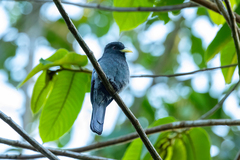
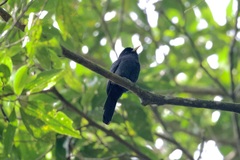
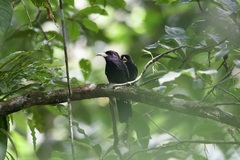
The yellow-billed nunbird is 23 to 25 cm (9.1 to 9.8 in) long and weighs about 39 g (1.4 oz). The adult is mostly sooty black, with the belly tending to very dark gray and the tail being greenish black. The lesser wing coverts are mostly white and show as white spots on the closed wing. The bill is yellow and noticeably shorter than those of the other members of its genus. Its eye is dark and the feet blackish. Immatures are a slightly duller black than adults and the white areas are not as prominent.

The yellow-billed nunbird is found in two areas of the upper Amazon Basin. One extends from southeastern Colombia through eastern Ecuador into northern Peru. The other includes eastern Peru, northern Bolivia, and western Brazil as far east as the upper Purus River. The species inhabits somewhat open landscapes such as transitional forest, secondary forest, the edges... Wikipedia →

Sounds

Call1:01

Peru · 2024

© Richard E. Webster · XC964329 · CC BY-NC-SA 4.0

Song0:12

Colombia · 2021

© Mauricio Cuellar Ramirez (@Birding.travel) · XC683913 · CC BY-NC-SA 4.0

Call0:14

Bolivia · 2021

© Jacob Wijpkema · XC687245 · CC BY-NC-SA 4.0

Global Distribution

Parks Where Found

# Park Country Daily sighting probability
1 Sierra de la Macarena National Park 🇨🇴 Colombia
~10%
2 Tambopata National Reserve 🇵🇪 Peru
<5%
3 Manu National Park 🇵🇪 Peru
<5%
4 Yasuní National Park 🇪🇨 Ecuador
<5%

Before you go

What are the chances of seeing a Yellow-billed Nunbird in Tambopata National Reserve?

Rare

Under 5% of wildlife watchers report a Yellow-billed Nunbird sighting in Tambopata National Reserve on a given day, based on 118 verified sightings from GBIF citizen-science data from 2019 to 2026. It is the 298th most-seen of the 550 birds we can rate there. Over three days the chance rises to about 10%, and over a week to about 20%, if each day is a fresh chance.

When is the best time to see a Yellow-billed Nunbird in Tambopata National Reserve?

April–May and November

In those months about 10% of wildlife watchers report a Yellow-billed Nunbird in Tambopata National Reserve on a given day, against under 5% in June–October and December–March, the lowest months.

What time of day is best to see a Yellow-billed Nunbird?

Between 8 and 11 am

Across all the parks we cover, that three-hour window holds the most Yellow-billed Nunbird sightings with a recorded time, and about 8 in 10 of them come between 6 am and 6 pm: it is a daytime animal.

Is Tambopata National Reserve the best place to see a Yellow-billed Nunbird?

2nd of 4

Of the 4 parks where we can rate Yellow-billed Nunbird sightings, Tambopata National Reserve ranks 2nd at under 5%. The best odds are in Sierra de la Macarena National Park (Colombia, about 10%).

Which relatives of the Yellow-billed Nunbird live in Tambopata National Reserve?

Same genus: Monasa

The closest relatives of the Yellow-billed Nunbird that you can see in Tambopata National Reserve (genus Monasa, Typical Nunbirds) are Black-fronted Nunbird (about 50%) and White-fronted Nunbird (about 20%), with each one's daily chance of a sighting.

Where does the Yellow-billed Nunbird sighting chance come from?

GBIF citizen-science records

It is estimated from how often the Yellow-billed Nunbird is recorded against all the birds logged in Tambopata National Reserve (118 verified sightings from 2019 to 2026), calibrated against known sighting rates. Figures are rounded to the nearest 10% because citizen-science data supports honest approximations, not decimals, and months with records from fewer than five people show "—". How it works.

← Back to Tambopata National Reserve