
Three-striped Rocket Frog

Three-striped Rocket Frog

Allobates trilineatus

Silhouette: Dmitry Bogdanov (vectorized by T. Michael Keesey) · PhyloPic

LCLeast ConcernNTVUENCR
Daily sighting probability ~10% · With luck
at Tambopata National Reserve

In 3 days ~30% in a week ~50%

10 Verified sightings at Tambopata National Reserve From 2019 to 2026
10 In 1 park
July Best month
☀️ Diurnal When it's spotted

About the Three-striped Rocket Frog

Allobates trilineatus (common name: three-striped rocket frog) is a species of frog in the family Aromobatidae. It is found in northern Bolivia and Peru east of the Cordillera Oriental and in western Brazil (Acre), possibly extending into Colombia. It has been confused with Allobates marchesianus.

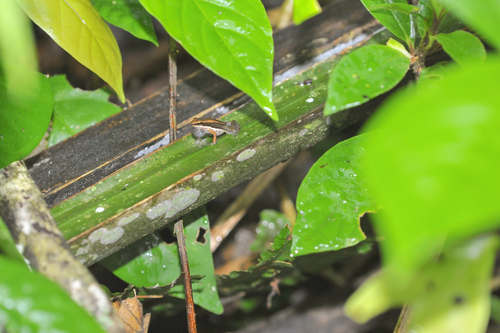
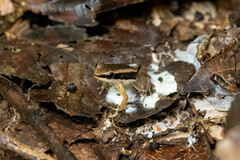
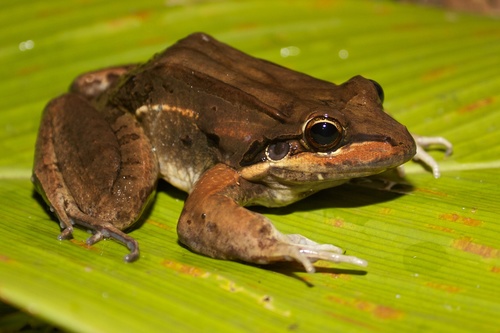
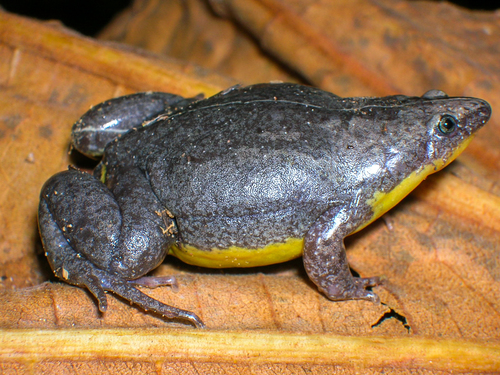
The adult male frog measures 15.0-17-7 mm in snout-vent length and the adult female frog 15.2–19.3 mm long, making this species one of the smallest in the family. The skin of the dorsum is dark brown in color. The male frog has a gray throat with spots. There are dorsolateral and dorsoventral stripes down each side of the body. The flanks are dark brown in color.

This diurnal frog is found on the leaf litter in tropical forests between 100 and 250 meters above sea level. It has been observed in areas that have been subject to selective logging but does not seem to be located exclusively near water.

This frog's known range includes many protected parks, for example Parque Nacional Manu, Bahuaja-Sonene National Park, Tambopata Reserve, and Pacaya Samiria Reserve. It is suspected in or its range also overlaps Yasuni National Park, Área de Proteção Ambiental Igarapé... Wikipedia →

Global Distribution

Parks Where Found

# Park Country Daily sighting probability
1 Tambopata National Reserve 🇵🇪 Peru
~10%

More parks will be added in future updates.

Before you go

What are the chances of seeing a Three-striped Rocket Frog in Tambopata National Reserve?

With luck

About 10% of wildlife watchers report a Three-striped Rocket Frog sighting in Tambopata National Reserve on a given day, based on 10 verified sightings from GBIF citizen-science data from 2019 to 2026. It is the 38th most-seen of the 44 amphibians we can rate there. Over three days the chance rises to about 30%, and over a week to about 50%, if each day is a fresh chance.

When is the best time to see a Three-striped Rocket Frog in Tambopata National Reserve?

January–February, May and July

In those months about 20% of wildlife watchers report a Three-striped Rocket Frog in Tambopata National Reserve on a given day, against under 5% in March–April, June and August–December, the lowest months.

What time of day is best to see a Three-striped Rocket Frog?

Between 8 and 11 am

Across all the parks we cover, that three-hour window holds the most Three-striped Rocket Frog sightings with a recorded time, and about 9 in 10 of them come between 6 am and 6 pm: it is a daytime animal.

Where else can you see a Three-striped Rocket Frog?

Only Tambopata National Reserve, in our data

Tambopata National Reserve is the only park on Wallace's Line with enough records to rate Three-striped Rocket Frog sightings: about 10% of wildlife watchers there report one on a given day.

Which relatives of the Three-striped Rocket Frog live in Tambopata National Reserve?

Same order: Anura

The closest relatives of the Three-striped Rocket Frog that you can see in Tambopata National Reserve (order Anura, Frogs and Toads) are Eastern Cane Toad (about 50%), Surinam Horned Frog (about 40%) and Sharp-nosed Jungle Frog (about 40%), with each one's daily chance of a sighting.

Where does the Three-striped Rocket Frog sighting chance come from?

GBIF citizen-science records

It is estimated from how often the Three-striped Rocket Frog is recorded against all the amphibians logged in Tambopata National Reserve (10 verified sightings from 2019 to 2026), calibrated against known sighting rates. Figures are rounded to the nearest 10% because citizen-science data supports honest approximations, not decimals, and months with records from fewer than five people show "—". How it works.

← Back to Tambopata National Reserve