Tiger-Striped Leaf Frog

Tiger-Striped Leaf Frog

Callimedusa tomopterna

Silhouette: Robbi Bishop-Taylor · PhyloPic

Daily sighting probability ~30% · Possible
at Tambopata National Reserve

In 3 days ~70% in a week ~90%

46 Verified sightings at Tambopata National Reserve From 2019 to 2026
99 In all 4 parks
September Best month
🌙 Nocturnal When it's spotted

About the Tiger-Striped Leaf Frog

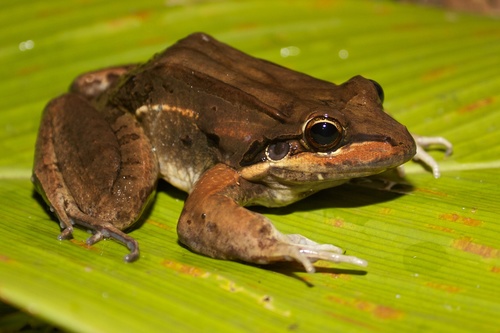
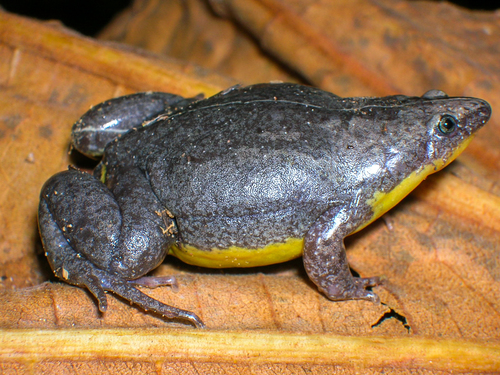
The tiger-striped tree frog, also called barred monkey frog and barred leaf frog, is a species of frog in the subfamily Phyllomedusinae. It is found in northern South America in the Upper Amazon Basin of Bolivia, Peru, Ecuador, and Colombia, Amazonian Brazil, and the Guianas from southeastern Venezuela to French Guiana. It might represent more than one species.

Adult males measure 44 mm (1.7 in) to 54 mm (2.1 in) in snout-vent length while adult female are larger at 60 mm (2.4 in). Its skin is green with orange pigmentation on the flanks and legs. The irises are silver or gray in color.

The tiger-striped tree frog is an arboreal species that occurs in pristine tropical rainforests, usually on trees around temporary to semi-temporary pools during the wet season, but specimens have been also collected in open areas and floodable forests on shrubs and aquatic edges.

It occurs at elevations up to 500 m (1,600 ft) above sea level. It is an uncommon species in most parts of its range. It can locally suffer from habitat loss. Tiger-striped tree frogs are nocturnal and sleep throughout the day. At night, males are able to communicate... Wikipedia →

Sounds

Recording

Brazil · 1985

© M.S. Hoogmoed · Xeno · CC BY 4.0

Global Distribution

Parks Where Found

# Park Country Daily sighting probability
1 Brownsberg Nature Park 🇸🇷 Suriname
~50%
2 Tambopata National Reserve 🇵🇪 Peru
~30%
3 Manu National Park 🇵🇪 Peru
~20%
4 Yasuní National Park 🇪🇨 Ecuador
~10%

Zoos & Centres Where Found

# Zoo / Centre Country
1 Monteverde Theme Park 🇨🇷 Costa Rica In captivity

Before you go

What are the chances of seeing a Tiger-Striped Leaf Frog in Tambopata National Reserve?

Possible

About 30% of wildlife watchers report a Tiger-Striped Leaf Frog sighting in Tambopata National Reserve on a given day, based on 46 verified sightings from GBIF citizen-science data from 2019 to 2026. It is the 7th most-seen of the 44 amphibians we can rate there. Over three days the chance rises to about 70%, and over a week to about 90%, if each day is a fresh chance.

When is the best time to see a Tiger-Striped Leaf Frog in Tambopata National Reserve?

September

In that month about 40% of wildlife watchers report a Tiger-Striped Leaf Frog in Tambopata National Reserve on a given day, against about 20% in January to March, the lowest months. That is one of Tambopata National Reserve's driest months, with about 90 mm of rain against 420 mm in February.

What time of day is best to see a Tiger-Striped Leaf Frog?

Between 8 and 11 pm

Across all the parks we cover, that three-hour window holds the most Tiger-Striped Leaf Frog sightings with a recorded time, and about 9 in 10 of them come between 6 pm and 6 am: it is mostly seen at night.

Is Tambopata National Reserve the best place to see a Tiger-Striped Leaf Frog?

2nd of 4

Of the 4 parks where we can rate Tiger-Striped Leaf Frog sightings, Tambopata National Reserve ranks 2nd at about 30%. The best odds are in Brownsberg Nature Park (Suriname, about 50%).

Which relatives of the Tiger-Striped Leaf Frog live in Tambopata National Reserve?

Same family: Phyllomedusidae

The closest relatives of the Tiger-Striped Leaf Frog that you can see in Tambopata National Reserve (family Phyllomedusidae, Leaf Frogs) are Black-eyed Monkey Frog (about 30%), White-lined Leaf Frog (about 10%) and Jaguar Leaf Frog (about 10%), with each one's daily chance of a sighting.

Where does the Tiger-Striped Leaf Frog sighting chance come from?

GBIF citizen-science records

It is estimated from how often the Tiger-Striped Leaf Frog is recorded against all the amphibians logged in Tambopata National Reserve (46 verified sightings from 2019 to 2026), calibrated against known sighting rates. Figures are rounded to the nearest 10% because citizen-science data supports honest approximations, not decimals, and months with records from fewer than five people show "—". How it works.

← Back to Tambopata National Reserve