Banded Sea Krait

Banded Sea Krait

Laticauda colubrina

Silhouette: SeismicShrimp · PhyloPic

LCLeast ConcernNTVUENCR
Daily sighting probability ~20% · Possible
at Tangkoko Nature Reserve

In 3 days ~40% in a week ~70%

5 Verified sightings at Tangkoko Nature Reserve From 2019 to 2026
46 In all 3 parks
December Best month
☀️ Diurnal When it's spotted

About the Banded Sea Krait

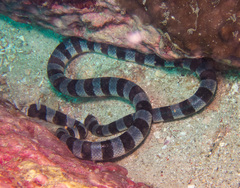
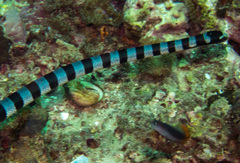
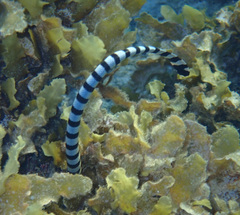
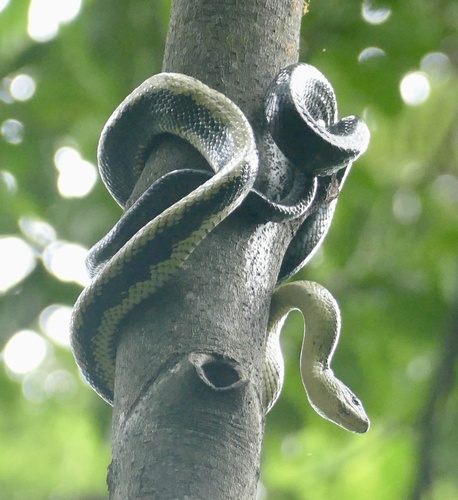
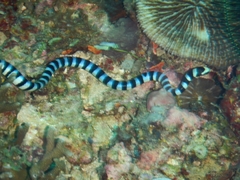
The yellow-lipped sea krait (Laticauda colubrina), also known as the banded sea krait or colubrine sea krait, is a species of highly venomous snake found in tropical Indo-Pacific oceanic waters. The snake has distinctive black stripes and a yellow snout, with a paddle-like tail for use in swimming.

It spends much of its time under water to hunt, but returns to land to digest, rest, and reproduce. It has very potent neurotoxic venom, which it uses to prey on eels and small fish. Because of its affinity to land, the yellow-lipped sea krait often encounters humans, but the snake is not aggressive and only attacks when feeling threatened.

The head of a yellow-lipped sea krait is black, with lateral nostrils and an undivided rostral scale. The upper lip and snout are characteristically colored yellow, and the yellow color extends backward on each side of the head above the eye to the temporal scales.

The body of the snake is subcylindrical, and is taller than it is wide. Its upper surface is typically a shade of blueish gray, while the belly is yellowish, with wide ventral scales that stretch from a third to more than half of the width of the body. Black rings of about... Wikipedia →

Sounds

Recording0:19

Thailand · 2026

© cindy_w · iNaturalist · CC BY-NC 4.0

Global Distribution

Parks Where Found

# Park Country Daily sighting probability
1 Raja Ampat 🇮🇩 Indonesia
~40%
2 Komodo National Park 🇮🇩 Indonesia
~30%
3 Tangkoko Nature Reserve 🇮🇩 Indonesia
~20%

Cities Where Found

# City Country Daily sighting probability
1 Denpasar 🇮🇩 Indonesia
~30%

Before you go

What are the chances of seeing a Banded Sea Krait in Tangkoko Nature Reserve?

Possible

About 20% of wildlife watchers report a Banded Sea Krait sighting in Tangkoko Nature Reserve on a given day, based on 5 verified sightings from GBIF citizen-science data from 2019 to 2026. It is the 12th most-seen of the 12 reptiles we can rate there. Over three days the chance rises to about 40%, and over a week to about 70%, if each day is a fresh chance.

When is the best time to see a Banded Sea Krait in Tangkoko Nature Reserve?

December

In that month about 40% of wildlife watchers report a Banded Sea Krait in Tangkoko Nature Reserve on a given day, against under 5% in January, March, June–July and September–November, the lowest months.

What time of day is best to see a Banded Sea Krait?

Between 10 am and 1 pm

Across all the parks we cover, that three-hour window holds the most Banded Sea Krait sightings with a recorded time, and about 7 in 10 of them come between 6 am and 6 pm: it is a daytime animal.

Is Tangkoko Nature Reserve the best place to see a Banded Sea Krait?

3rd of 3

Of the 3 parks where we can rate Banded Sea Krait sightings, Tangkoko Nature Reserve ranks 3rd at about 20%. The best odds are in Raja Ampat (Indonesia, about 40%) and Komodo National Park (Indonesia, about 30%).

Where does the Banded Sea Krait sighting chance come from?

GBIF citizen-science records

It is estimated from how often the Banded Sea Krait is recorded against all the reptiles logged in Tangkoko Nature Reserve (5 verified sightings from 2019 to 2026), calibrated against known sighting rates. Figures are rounded to the nearest 10% because citizen-science data supports honest approximations, not decimals, and months with records from fewer than five people show "—". How it works.

← Back to Tangkoko Nature Reserve