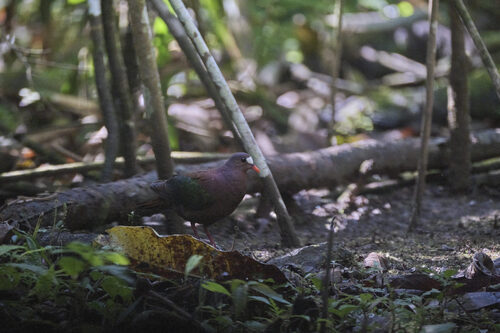
Gray-headed Imperial-Pigeon

Gray-headed Imperial-Pigeon

Ducula radiata

Silhouette: Sheatherius · PhyloPic

LCLeast ConcernNTVUENCR Endemic
Daily sighting probability ~10% · With luck
at Tangkoko Nature Reserve

In 3 days ~20% in a week ~40%

57 Verified sightings at Tangkoko Nature Reserve From 2019 to 2026
57 In 1 park
August Best month
☀️ Diurnal When it's spotted

About the Gray-headed Imperial-Pigeon

The grey-headed imperial pigeon (Ducula radiata) is a species of bird in the family Columbidae. It is endemic to Sulawesi in Indonesia. Its natural habitats are subtropical or tropical moist lowland forests and subtropical or tropical moist montane forests.

The grey-headed imperial pigeon is a moderate-sized imperial pigeon with a long tail and a total length of about 38 cm (15 in). The head and underparts are grey and the hind neck is black, while the upper parts are metallic green, glossed on the mantle and scapulars with brownish-crimson. The tail is dark in colour with a narrow and inconspicuous band of pale grey near the base. The iris is orange, the beak is olive-green with a black tip or black all over, and the legs are purplish-red. The rather similar white-bellied imperial pigeon (Ducula forsteni) is larger and more heavily built, and has a broader band of grey on the tail; this is more centrally located and conspicuous.

The grey-headed imperial pigeon is endemic to the island of Sulawesi in Indonesia. It is mostly a bird of montane forests, generally found at altitudes of between 1,100 and 2,400 m (3,600 and 7,900 ft), but sometimes frequents... Wikipedia →


Global Distribution

Parks Where Found

# Park Country Daily sighting probability
1 Tangkoko Nature Reserve 🇮🇩 Indonesia
~10%

More parks will be added in future updates.

Zoos & Centres Where Found

# Zoo / Centre Country
1 Aviary 🇭🇰 Hong Kong SAR China In captivity

Before you go

What are the chances of seeing a Gray-headed Imperial-Pigeon in Tangkoko Nature Reserve?

With luck

About 10% of wildlife watchers report a Gray-headed Imperial-Pigeon sighting in Tangkoko Nature Reserve on a given day, based on 57 verified sightings from GBIF citizen-science data from 2019 to 2026. It is the 82nd most-seen of the 138 birds we can rate there. Over three days the chance rises to about 20%, and over a week to about 40%, if each day is a fresh chance.

When is the best time to see a Gray-headed Imperial-Pigeon in Tangkoko Nature Reserve?

February, July–September and December

In those months about 10% of wildlife watchers report a Gray-headed Imperial-Pigeon in Tangkoko Nature Reserve on a given day, against under 5% in January, March–June and October–November, the lowest months.

What time of day is best to see a Gray-headed Imperial-Pigeon?

Between 7 and 10 am

Across all the parks we cover, that three-hour window holds the most Gray-headed Imperial-Pigeon sightings with a recorded time, and about 8 in 10 of them come between 6 am and 6 pm: it is a daytime animal.

Where else can you see a Gray-headed Imperial-Pigeon?

Only Tangkoko Nature Reserve, in our data

Tangkoko Nature Reserve is the only park on Wallace's Line with enough records to rate Gray-headed Imperial-Pigeon sightings: about 10% of wildlife watchers there report one on a given day.

Which relatives of the Gray-headed Imperial-Pigeon live in Tangkoko Nature Reserve?

Same genus: Ducula

The closest relatives of the Gray-headed Imperial-Pigeon that you can see in Tangkoko Nature Reserve (genus Ducula, Imperial Pigeons) are Green Imperial-Pigeon (about 80%), White Imperial-Pigeon (about 70%) and White-bellied Imperial-Pigeon (about 30%), with each one's daily chance of a sighting.

Where does the Gray-headed Imperial-Pigeon sighting chance come from?

GBIF citizen-science records

It is estimated from how often the Gray-headed Imperial-Pigeon is recorded against all the birds logged in Tangkoko Nature Reserve (57 verified sightings from 2019 to 2026), calibrated against known sighting rates. Figures are rounded to the nearest 10% because citizen-science data supports honest approximations, not decimals, and months with records from fewer than five people show "—". How it works.

← Back to Tangkoko Nature Reserve