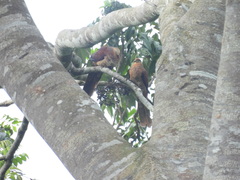
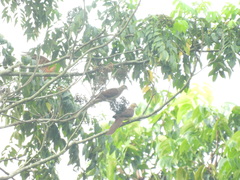
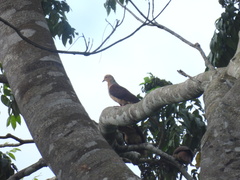
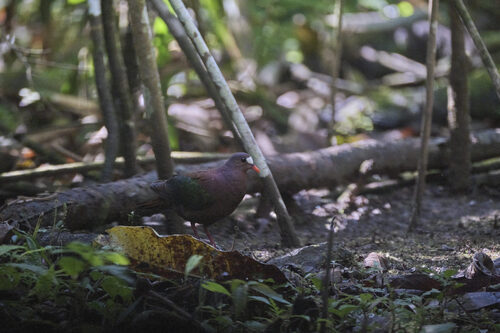
Sultan's Cuckoo-Dove

Sultan's Cuckoo-Dove

Macropygia doreya

Silhouette: Sheatherius · PhyloPic

Daily sighting probability ~40% · Likely
at Tangkoko Nature Reserve

In 3 days ~70% in a week >90%

331 Verified sightings at Tangkoko Nature Reserve From 2019 to 2026
688 In all 2 parks
November Best month
🌅 Crepuscular When it's spotted

About the Sultan's Cuckoo-Dove

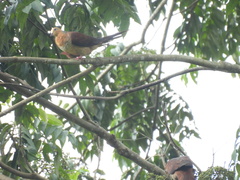
Sultan's cuckoo-dove (Macropygia doreya) is a dove in the genus Macropygia found in the northern Moluccas, Sulawesi to New Guinea and the western Papuan islands. It was one of three new species defined when the slender-billed cuckoo-dove was split up in 2016.

They are typically about 35–37 centimetres (14–15 in) long. The males tend to have a slight rose/green colouration on their nape and neck. Many subspecies have whitish underparts, fine dark barring below and/or a whitish cap.

The call of this dove is a very loud "whoop-a whoop" with some differences depending on the subspecies involved. Sultan's cuckoo-dove inhabits rainforest, woodland, scrubland and rainforest regrowth areas. The doves can often be seen in pairs or groups. Its diet consists of berries from both native plants and introduced weed species. They can be nomadic, depending on the supplies of food. They tend to fly short distances and low to the ground with great strength.

Breeding occurs in spring and summer. The nest is a flat platform of sticks and vines, either in a fork of a tree or on top of a low tree. Wikipedia →

Sounds

Song0:32

Indonesia · 2026

© Ding Li Yong · XC1166581 · CC BY-NC-ND 4.0

Call0:19

Papua New Guinea · 2022

© Iain Woxvold · XC750402 · CC BY-NC-SA 4.0

?0:20

Indonesia · 2011

© Frank Lambert · XC88261 · CC BY-NC-ND 4.0

Global Distribution

Parks Where Found

# Park Country Daily sighting probability
1 Tangkoko Nature Reserve 🇮🇩 Indonesia
~40%
2 Raja Ampat 🇮🇩 Indonesia
~30%

Before you go

What are the chances of seeing a Sultan's Cuckoo-Dove in Tangkoko Nature Reserve?

Likely

About 40% of wildlife watchers report a Sultan's Cuckoo-Dove sighting in Tangkoko Nature Reserve on a given day, based on 331 verified sightings from GBIF citizen-science data from 2019 to 2026. It is the 27th most-seen of the 138 birds we can rate there. Over three days the chance rises to about 70%, and over a week to over 90%, if each day is a fresh chance.

When is the best time to see a Sultan's Cuckoo-Dove in Tangkoko Nature Reserve?

March–May, July–August and November

In those months about 40% of wildlife watchers report a Sultan's Cuckoo-Dove in Tangkoko Nature Reserve on a given day, against about 20% in October and December, the lowest months.

What time of day is best to see a Sultan's Cuckoo-Dove?

Between 11 pm and 2 am

Across all the parks we cover, that three-hour window holds the most Sultan's Cuckoo-Dove sightings with a recorded time, and about 7 in 10 of them come between 6 pm and 6 am: it is most active around dawn and dusk.

Is Tangkoko Nature Reserve the best place to see a Sultan's Cuckoo-Dove?

Yes

Of the 2 parks where we can rate Sultan's Cuckoo-Dove sightings, Tangkoko Nature Reserve has the highest daily chance: about 40%. Next come Raja Ampat (Indonesia, about 30%).

Which relatives of the Sultan's Cuckoo-Dove live in Tangkoko Nature Reserve?

Same family: Columbidae

The closest relatives of the Sultan's Cuckoo-Dove that you can see in Tangkoko Nature Reserve (family Columbidae, Pigeons and Doves) are Green Imperial-Pigeon (about 80%), White Imperial-Pigeon (about 70%) and Black-naped Fruit-Dove (about 50%), with each one's daily chance of a sighting.

Where does the Sultan's Cuckoo-Dove sighting chance come from?

GBIF citizen-science records

It is estimated from how often the Sultan's Cuckoo-Dove is recorded against all the birds logged in Tangkoko Nature Reserve (331 verified sightings from 2019 to 2026), calibrated against known sighting rates. Figures are rounded to the nearest 10% because citizen-science data supports honest approximations, not decimals, and months with records from fewer than five people show "—". How it works.

← Back to Tangkoko Nature Reserve