White-bellied Imperial-Pigeon

White-bellied Imperial-Pigeon

Ducula forsteni

Silhouette: Sheatherius · PhyloPic

LCLeast ConcernNTVUENCR Endemic
Daily sighting probability ~30% · Possible
at Tangkoko Nature Reserve

In 3 days ~60% in a week ~90%

230 Verified sightings at Tangkoko Nature Reserve From 2019 to 2026
230 In 1 park
June Best month
☀️ Diurnal When it's spotted

About the White-bellied Imperial-Pigeon

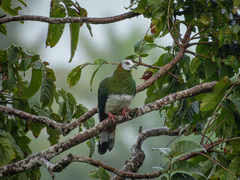
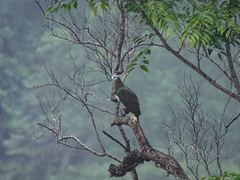
The white-bellied imperial pigeon (Ducula forsteni) is a species of bird in the pigeon family Columbidae. First described by the French ornithologist Charles Lucien Bonaparte in 1854, it is endemic to Indonesia, where it is found on Sulawesi, Buton, Taliabu, Togian, and Peleng. It inhabits primary forest, dense secondary forest, and isolated areas of hill forest. A large pigeon with a long tail, it measures 42.5–51.5 cm (16.7–20.3 in) long and weighs 510 g (18 oz) on average. Males are mainly green, with pale-grey heads and bellies, chestnut vents, and a pale grey tail band, along with a red orbital ring. Females are nearly identical, but have darker grey areas in their plumage.

The white-bellied imperial pigeon feeds on fruit. It is listed as being of least concern by the International Union for Conservation of Nature (IUCN) on the IUCN Red List due to its sufficiently large range and lack of significant population decline. However, its population is declining due to habitat destruction.

The first specimens of the white-bellied imperial pigeon were collected in May 1840 by the Dutch naturalist Eltio Alegondas Forsten from near Lake Tondano in northern... Wikipedia →

Sounds

Song0:17

Indonesia · 2025

© Richard E. Webster · XC1075894 · CC BY-NC-SA 4.0

Call0:57

Indonesia · 2022

© Barry Edmonston · XC818071 · CC BY-NC-SA 4.0

Song0:17

Indonesia · 2024

© Ding Li Yong · XC925053 · CC BY-NC-ND 4.0

Global Distribution

Parks Where Found

# Park Country Daily sighting probability
1 Tangkoko Nature Reserve 🇮🇩 Indonesia
~30%

More parks will be added in future updates.

Zoos & Centres Where Found

# Zoo / Centre Country
1 Bali Bird Park 🇮🇩 Indonesia In captivity

Before you go

What are the chances of seeing a White-bellied Imperial-Pigeon in Tangkoko Nature Reserve?

Possible

About 30% of wildlife watchers report a White-bellied Imperial-Pigeon sighting in Tangkoko Nature Reserve on a given day, based on 230 verified sightings from GBIF citizen-science data from 2019 to 2026. It is the 42nd most-seen of the 138 birds we can rate there. Over three days the chance rises to about 60%, and over a week to about 90%, if each day is a fresh chance.

When is the best time to see a White-bellied Imperial-Pigeon in Tangkoko Nature Reserve?

June

In that month about 40% of wildlife watchers report a White-bellied Imperial-Pigeon in Tangkoko Nature Reserve on a given day, against about 10% in September, the lowest month.

What time of day is best to see a White-bellied Imperial-Pigeon?

Between 5 and 8 am

Across all the parks we cover, that three-hour window holds the most White-bellied Imperial-Pigeon sightings with a recorded time, and about 7 in 10 of them come between 6 am and 6 pm: it is a daytime animal.

Where else can you see a White-bellied Imperial-Pigeon?

Only Tangkoko Nature Reserve, in our data

Tangkoko Nature Reserve is the only park on Wallace's Line with enough records to rate White-bellied Imperial-Pigeon sightings: about 30% of wildlife watchers there report one on a given day.

Which relatives of the White-bellied Imperial-Pigeon live in Tangkoko Nature Reserve?

Same genus: Ducula

The closest relatives of the White-bellied Imperial-Pigeon that you can see in Tangkoko Nature Reserve (genus Ducula, Imperial Pigeons) are Green Imperial-Pigeon (about 80%), White Imperial-Pigeon (about 70%) and Pied Imperial Pigeon (about 10%), with each one's daily chance of a sighting.

Where does the White-bellied Imperial-Pigeon sighting chance come from?

GBIF citizen-science records

It is estimated from how often the White-bellied Imperial-Pigeon is recorded against all the birds logged in Tangkoko Nature Reserve (230 verified sightings from 2019 to 2026), calibrated against known sighting rates. Figures are rounded to the nearest 10% because citizen-science data supports honest approximations, not decimals, and months with records from fewer than five people show "—". How it works.

← Back to Tangkoko Nature Reserve