
Ornate Lorikeet

Ornate Lorikeet

Trichoglossus ornatus

Silhouette: Farelli (photo), John E. McCormack, Michael G. Harvey, Brant C. Faircloth, Nicholas G. Crawford, Travis C. Glenn, Robb T. Brumfield & T. Michael Keesey · PhyloPic

LCLeast ConcernNTVUENCR
Daily sighting probability ~20% · Possible
at Tangkoko Nature Reserve

In 3 days ~40% in a week ~70%

147 Verified sightings at Tangkoko Nature Reserve From 2019 to 2026
147 In 1 park
November Best month
☀️ Diurnal When it's spotted

About the Ornate Lorikeet

The ornate lorikeet (Trichoglossus ornatus), sometimes named the ornate lory, is a species of parrot in the family Psittaculidae. It is endemic to the Sulawesi archipelago in Indonesia. It is found in forest, woodland, mangrove and plantations, and is locally common.

The ornate lorikeet was formally described by the Swedish naturalist Carl Linnaeus in 1758 in the tenth edition of his Systema Naturae under the binomial name Psittacus ornatus. Linnaeus based his description of the "Lory Parrakeet" that had been described and illustrated in 1751 by George Edwards in his "A Natural History of Uncommon Birds". Linnaeus mistakenly specified the location as "America" although Edwards had stated that the bird had come from the "East Indies" (actually the Indonesian island of Sulawesi). The ornate lorikeet is now placed in the genus Trichoglossus that was introduced by the English naturalist James Francis Stephens in 1826.

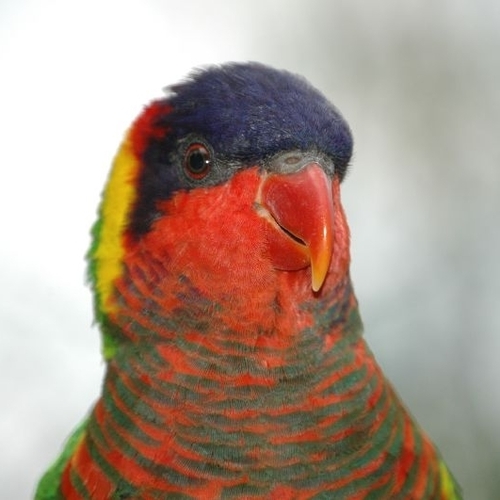
The ornate lorikeet is a mainly green parrot about 25 cm (10.0 in) long. Its head above its eyes is purple-blue and its face below its eyes is red. There is red at back of the head and yellow behind the eyes. It does not have a collar at... Wikipedia →

Global Distribution

Parks Where Found

# Park Country Daily sighting probability
1 Tangkoko Nature Reserve 🇮🇩 Indonesia
~20%

More parks will be added in future updates.

Zoos & Centres Where Found

# Zoo / Centre Country
1 Bird Paradise 🇸🇬 Singapore In captivity
2 Rainforest Wild Asia 🇸🇬 Singapore In captivity
3 Loro Parque 🇪🇸 Spain In captivity
4 North Carolina Aquarium at Fort Fisher 🇺🇸 United States In captivity

Before you go

What are the chances of seeing an Ornate Lorikeet in Tangkoko Nature Reserve?

Possible

About 20% of wildlife watchers report an Ornate Lorikeet sighting in Tangkoko Nature Reserve on a given day, based on 147 verified sightings from GBIF citizen-science data from 2019 to 2026. It is the 61st most-seen of the 138 birds we can rate there. Over three days the chance rises to about 40%, and over a week to about 70%, if each day is a fresh chance.

When is the best time to see an Ornate Lorikeet in Tangkoko Nature Reserve?

November

In that month about 30% of wildlife watchers report an Ornate Lorikeet in Tangkoko Nature Reserve on a given day, against under 5% in June and September, the lowest months.

What time of day is best to see an Ornate Lorikeet?

Between 6 and 9 am

Across all the parks we cover, that three-hour window holds the most Ornate Lorikeet sightings with a recorded time, and about 9 in 10 of them come between 6 am and 6 pm: it is a daytime animal.

Where else can you see an Ornate Lorikeet?

Only Tangkoko Nature Reserve, in our data

Tangkoko Nature Reserve is the only park on Wallace's Line with enough records to rate Ornate Lorikeet sightings: about 20% of wildlife watchers there report one on a given day.

Which relatives of the Ornate Lorikeet live in Tangkoko Nature Reserve?

Same family: Psittacidae

The closest relatives of the Ornate Lorikeet that you can see in Tangkoko Nature Reserve (family Psittacidae, New World and African Parrots) are Sulawesi Hanging-Parrot (about 40%), Azure-rumped Parrot (about 40%) and Pygmy Hanging-Parrot (about 20%), with each one's daily chance of a sighting.

Where does the Ornate Lorikeet sighting chance come from?

GBIF citizen-science records

It is estimated from how often the Ornate Lorikeet is recorded against all the birds logged in Tangkoko Nature Reserve (147 verified sightings from 2019 to 2026), calibrated against known sighting rates. Figures are rounded to the nearest 10% because citizen-science data supports honest approximations, not decimals, and months with records from fewer than five people show "—". How it works.

← Back to Tangkoko Nature Reserve