
Yellowish-breasted Racquet-tail

Yellowish-breasted Racquet-tail

Prioniturus flavicans

Silhouette: Farelli (photo), John E. McCormack, Michael G. Harvey, Brant C. Faircloth, Nicholas G. Crawford, Travis C. Glenn, Robb T. Brumfield & T. Michael Keesey · PhyloPic

LCNTNear ThreatenedVUENCR
Daily sighting probability ~20% · Possible
at Tangkoko Nature Reserve

In 3 days ~50% in a week ~80%

10 Verified sightings at Tangkoko Nature Reserve From 2019 to 2026
10 In 1 park
January Best month
☀️ Diurnal When it's spotted

About the Yellowish-breasted Racquet-tail

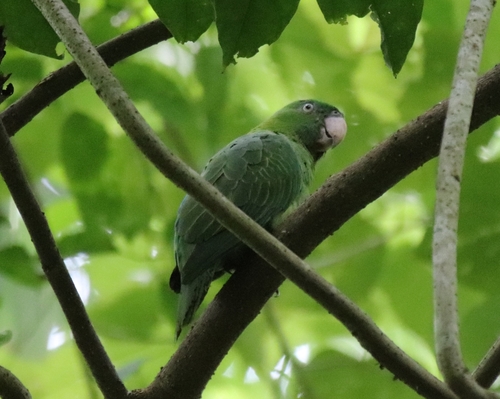
The yellow-breasted racket-tail (Prioniturus flavicans) is a species of parrot in the family Psittaculidae. It is endemic to Indonesia where it is native to the Minahasa Peninsula and the Togian Islands in the Gulf of Tomini. Its natural habitat is subtropical or tropical moist lowland forests.

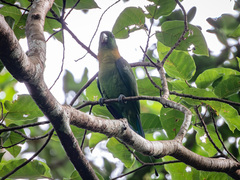
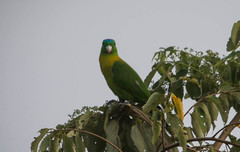
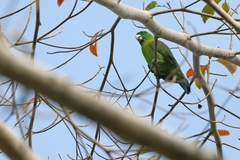
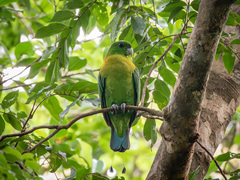
The yellow-breasted racket-tail has an olive-green back, neck and chest. The bill is pale grey and its irises are brown. Its legs are grey. Males are blue on the top of the head with a red area on the crown. The tail feather are green with terminal black spatulas. Females have a smaller area of blue on the head and no red. Juveniles are similar to females, but have less blue on the head.

Prioniturus flavicans is mainly found on the northern peninsula of the island of Sulawesi (along with other smaller nearby islands such as Bangka Island) and the Togian Islands. This bird's natural range only exists the country of Indonesia.

Prioniturus flavicans is a quiet and modest bird that is often found in pairs or small flocks. To avoid being noticed by predators, this bird prefers to stay in the upper canopy of trees and moves cautiously... Wikipedia →

Global Distribution

Parks Where Found

# Park Country Daily sighting probability
1 Tangkoko Nature Reserve 🇮🇩 Indonesia
~20%

More parks will be added in future updates.

Before you go

What are the chances of seeing a Yellowish-breasted Racquet-tail in Tangkoko Nature Reserve?

Possible

About 20% of wildlife watchers report a Yellowish-breasted Racquet-tail sighting in Tangkoko Nature Reserve on a given day, based on 10 verified sightings from GBIF citizen-science data from 2019 to 2026. It is the 51st most-seen of the 138 birds we can rate there. Over three days the chance rises to about 50%, and over a week to about 80%, if each day is a fresh chance.

When is the best time to see a Yellowish-breasted Racquet-tail in Tangkoko Nature Reserve?

January

In that month about 50% of wildlife watchers report a Yellowish-breasted Racquet-tail in Tangkoko Nature Reserve on a given day, against under 5% in March–April, June and September–December, the lowest months.

What time of day is best to see a Yellowish-breasted Racquet-tail?

Between 5 and 8 am

Across all the parks we cover, that three-hour window holds the most Yellowish-breasted Racquet-tail sightings with a recorded time, and about 7 in 10 of them come between 6 am and 6 pm: it is a daytime animal.

Where else can you see a Yellowish-breasted Racquet-tail?

Only Tangkoko Nature Reserve, in our data

Tangkoko Nature Reserve is the only park on Wallace's Line with enough records to rate Yellowish-breasted Racquet-tail sightings: about 20% of wildlife watchers there report one on a given day.

Which relatives of the Yellowish-breasted Racquet-tail live in Tangkoko Nature Reserve?

Same family: Psittacidae

The closest relatives of the Yellowish-breasted Racquet-tail that you can see in Tangkoko Nature Reserve (family Psittacidae, New World and African Parrots) are Sulawesi Hanging-Parrot (about 40%), Azure-rumped Parrot (about 40%) and Pygmy Hanging-Parrot (about 20%), with each one's daily chance of a sighting.

Where does the Yellowish-breasted Racquet-tail sighting chance come from?

GBIF citizen-science records

It is estimated from how often the Yellowish-breasted Racquet-tail is recorded against all the birds logged in Tangkoko Nature Reserve (10 verified sightings from 2019 to 2026), calibrated against known sighting rates. Figures are rounded to the nearest 10% because citizen-science data supports honest approximations, not decimals, and months with records from fewer than five people show "—". How it works.

← Back to Tangkoko Nature Reserve