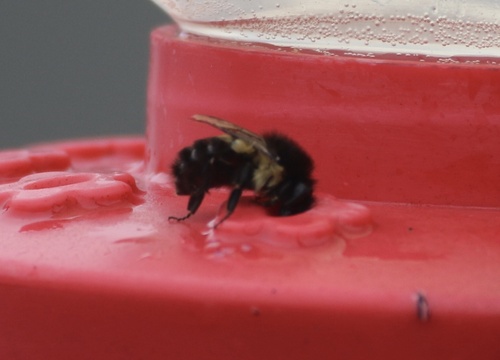
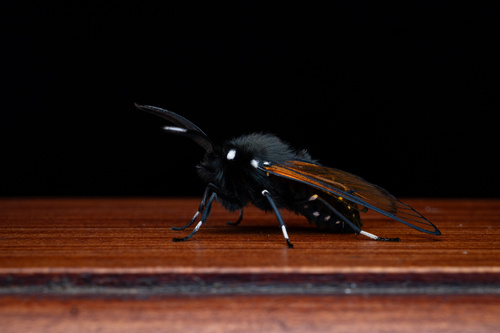
Black-Clothed Bumble Bee

Black-Clothed Bumble Bee

Bombus pullatus

Daily sighting probability ~10% · With luck
at Tapantí-Macizo de la Muerte National Park

In 3 days ~20% in a week ~40%

7 Verified sightings at Tapantí-Macizo de la Muerte National Park From 2019 to 2026
76 In all 7 parks
July Best month
☀️ Diurnal When it's spotted

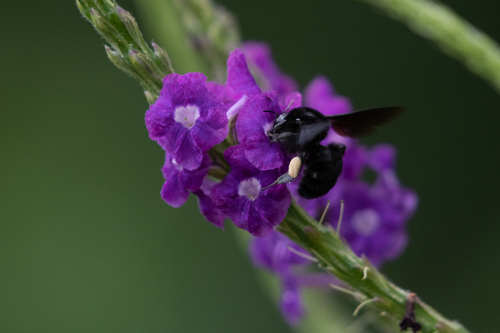
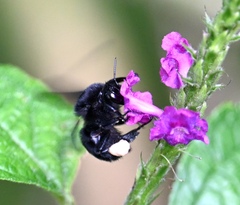
About the Black-Clothed Bumble Bee

Bombus pullatus is a tropical, eusocial species of bumblebee native to Mexico and Central America. Unlike many bumblebee species, they live in colonies with multiple queens. The majority of this species occurs in the lowlands of Central America, with approximately 90% of colonies being found in Costa Rica. However they have been found at elevations higher than 3 km above sea level. Colonies have been confirmed in Guatemala, Honduras, Nicaragua, Panama and the south of Mexico.

Bombus pullatus is considered a more basal member of the genus Bombus compared to Bombus pauloensis and Bombus transversalis. Historically, Bombus pullatus has commonly been misidentified as Bombus pauloensis and vice versa in many collections. Molecular analyses (such as DNA profiling) of these specimens are required to accurately identify both species. This issue is why the IUCN has agreed to reject data on this species that is more southern than Panama.

This species is known to be quite aggressive, stinging humans within approximately 6 m of the nest if it is disturbed. Unlike most bumblebees, Bombus pullatus colonies contain multiple queens (a form of polygyny... Wikipedia →
Global Distribution

Parks Where Found

# Park Country Daily sighting probability
1 Tenorio Volcano National Park 🇨🇷 Costa Rica
~10%
2 Arenal Volcano National Park 🇨🇷 Costa Rica
~10%
3 Los Quetzales National Park 🇨🇷 Costa Rica
~10%
4 Tapantí-Macizo de la Muerte National Park 🇨🇷 Costa Rica
~10%
5 Braulio Carrillo National Park 🇨🇷 Costa Rica
~10%
6 Monteverde Cloud Forest Reserve 🇨🇷 Costa Rica
~10%
7 La Amistad International Park (Panama) 🇵🇦 Panama
~10%

Before you go

What are the chances of seeing a Black-Clothed Bumble Bee in Tapantí-Macizo de la Muerte National Park?

With luck

About 10% of wildlife watchers report a Black-Clothed Bumble Bee sighting in Tapantí-Macizo de la Muerte National Park on a given day, based on 7 verified sightings from GBIF citizen-science data from 2019 to 2026. It is the 102nd most-seen of the 187 insects we can rate there. Over three days the chance rises to about 20%, and over a week to about 40%, if each day is a fresh chance.

When is the best time to see a Black-Clothed Bumble Bee in Tapantí-Macizo de la Muerte National Park?

July

In that month about 20% of wildlife watchers report a Black-Clothed Bumble Bee in Tapantí-Macizo de la Muerte National Park on a given day, against under 5% in April and August–February, the lowest months.

What time of day is best to see a Black-Clothed Bumble Bee?

Between 9 am and noon

Across all the parks we cover, that three-hour window holds the most Black-Clothed Bumble Bee sightings with a recorded time, and about 9 in 10 of them come between 6 am and 6 pm: it is a daytime animal.

Is Tapantí-Macizo de la Muerte National Park the best place to see a Black-Clothed Bumble Bee?

Among the best

Of the 7 parks where we can rate Black-Clothed Bumble Bee sightings, Tapantí-Macizo de la Muerte National Park ranks 4th at about 10%, level with the leaders once rounded. The best odds are in Tenorio Volcano National Park (Costa Rica, about 10%), Arenal Volcano National Park (Costa Rica, about 10%) and Los Quetzales National Park (Costa Rica, about 10%).

Where does the Black-Clothed Bumble Bee sighting chance come from?

GBIF citizen-science records

It is estimated from how often the Black-Clothed Bumble Bee is recorded against all the insects logged in Tapantí-Macizo de la Muerte National Park (7 verified sightings from 2019 to 2026), calibrated against known sighting rates. Figures are rounded to the nearest 10% because citizen-science data supports honest approximations, not decimals, and months with records from fewer than five people show "—". How it works.

← Back to Tapantí-Macizo de la Muerte National Park