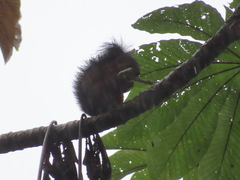
Central American Dwarf Squirrel

Central American Dwarf Squirrel

Microsciurus alfari

Silhouette: Joseph Smit · PhyloPic

LCLeast ConcernNTVUENCR
Daily sighting probability ~10% · With luck
at Tapantí-Macizo de la Muerte National Park

In 3 days ~20% in a week ~40%

6 Verified sightings at Tapantí-Macizo de la Muerte National Park From 2019 to 2026
49 In all 6 parks
October Best month
☀️ Diurnal When it's spotted

About the Central American Dwarf Squirrel

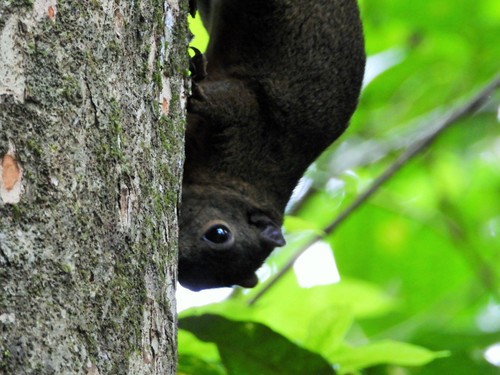
The Central American dwarf squirrel, also known as Alfaro's pygmy squirrel, (Microsciurus alfari) is a small tree squirrel in the genus Microsciurus and tribe Sciurini found in Colombia, Costa Rica, Nicaragua, and Panama. No species of squirrel within this genus are listed as endangered, however they are rarely seen because they are extremely elusive. This suggests that their population numbers may be larger than documented.

Central American dwarf squirrels are not as small as their name suggests. In fact, their body measurements are close to that of the red squirrel and gray squirrel, with a head-and-body length about 15 cm (5.9 in) with a 12 cm (4.7 in) long tail. The majority of their body is a dark, olive-green and brown color with a reddish-brown head coloration. The underside of their heads and limbs can range from a yellowish grey to a tawny grey color.

Central American dwarf squirrels are native to Colombia, Costa Rica, Nicaragua, and Panama. They typically inhabit tropical rainforests, with a preference for the heavy forest, particularly those with vines in the undergrowth, which can allow them to descend to the ground and quickly... Wikipedia →
Global Distribution

Parks Where Found

# Park Country Daily sighting probability
1 Tenorio Volcano National Park 🇨🇷 Costa Rica
~10%
2 Monteverde Cloud Forest Reserve 🇨🇷 Costa Rica
~10%
3 Corcovado National Park 🇨🇷 Costa Rica
~10%
4 Tapantí-Macizo de la Muerte National Park 🇨🇷 Costa Rica
~10%
5 Arenal Volcano National Park 🇨🇷 Costa Rica
~10%
6 La Amistad International Park (Panama) 🇵🇦 Panama
~10%

Before you go

What are the chances of seeing a Central American Dwarf Squirrel in Tapantí-Macizo de la Muerte National Park?

With luck

About 10% of wildlife watchers report a Central American Dwarf Squirrel sighting in Tapantí-Macizo de la Muerte National Park on a given day, based on 6 verified sightings from GBIF citizen-science data from 2019 to 2026. It is the 13th most-seen of the 21 mammals we can rate there. Over three days the chance rises to about 20%, and over a week to about 40%, if each day is a fresh chance.

When is the best time to see a Central American Dwarf Squirrel in Tapantí-Macizo de la Muerte National Park?

October

In that month about 20% of wildlife watchers report a Central American Dwarf Squirrel in Tapantí-Macizo de la Muerte National Park on a given day, against under 5% in March–August and November, the lowest months. That is one of Tapantí-Macizo de la Muerte National Park's wettest months, with about 570 mm of rain against 160 mm in February.

What time of day is best to see a Central American Dwarf Squirrel?

Between 9 am and noon

Across all the parks we cover, that three-hour window holds the most Central American Dwarf Squirrel sightings with a recorded time, and about 9 in 10 of them come between 6 am and 6 pm: it is a daytime animal.

Is Tapantí-Macizo de la Muerte National Park the best place to see a Central American Dwarf Squirrel?

Among the best

Of the 6 parks where we can rate Central American Dwarf Squirrel sightings, Tapantí-Macizo de la Muerte National Park ranks 4th at about 10%, level with the leaders once rounded. The best odds are in Tenorio Volcano National Park (Costa Rica, about 10%), Monteverde Cloud Forest Reserve (Costa Rica, about 10%) and Corcovado National Park (Costa Rica, about 10%).

Which relatives of the Central American Dwarf Squirrel live in Tapantí-Macizo de la Muerte National Park?

Same family: Sciuridae

The closest relatives of the Central American Dwarf Squirrel that you can see in Tapantí-Macizo de la Muerte National Park (family Sciuridae, Squirrels) are Red-tailed Squirrel (about 30%) and Variegated Squirrel (about 10%), with each one's daily chance of a sighting.

Where does the Central American Dwarf Squirrel sighting chance come from?

GBIF citizen-science records

It is estimated from how often the Central American Dwarf Squirrel is recorded against all the mammals logged in Tapantí-Macizo de la Muerte National Park (6 verified sightings from 2019 to 2026), calibrated against known sighting rates. Figures are rounded to the nearest 10% because citizen-science data supports honest approximations, not decimals, and months with records from fewer than five people show "—". How it works.

← Back to Tapantí-Macizo de la Muerte National Park