Freckled Nightjar

Freckled Nightjar

Caprimulgus tristigma

Silhouette: Ferran Sayol · PhyloPic

LCLeast ConcernNTVUENCR
Daily sighting probability <5% · Rare
at Tarangire National Park

In 3 days ~10% in a week ~20%

44 Verified sightings at Tarangire National Park From 2019 to 2026
454 In all 14 parks
March Best month
🌅 Crepuscular When it's spotted

About the Freckled Nightjar

The freckled nightjar or freckled rock nightjar (Caprimulgus tristigma) is a species of nightjar in the family Caprimulgidae. It has a wide yet patchy distribution throughout the Afrotropics. This species occurs throughout sub-Saharan African in localized populations. It is scarce in western Africa, occurring more commonly in the East. In the southern part of the continent, it is a year-round resident of the colder and drier areas, occurring most commonly in Zimbabwe, northern and eastern Botswana, western Mozambique, and eastern South Africa.

It has been found in Angola, Benin, Botswana, Burkina Faso, Burundi, Cameroon, Central African Republic, Republic of the Congo, Democratic Republic of the Congo, Ivory Coast, Eswatini, Ethiopia, Gabon, Ghana, Guinea, Kenya, Liberia, Malawi, Mali, Mozambique, Namibia, Niger, Nigeria, Rwanda, Sierra Leone, South Africa, South Sudan, Tanzania, Togo, Uganda, Zambia, and Zimbabwe.

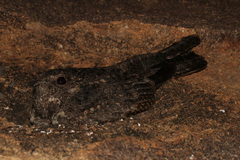
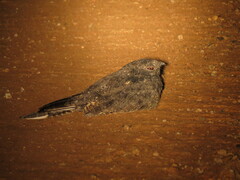
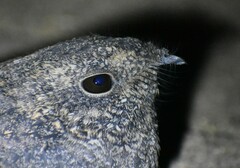
The freckled nightjar is a large, powerfully-build species of nightjar with long wings and relatively short tails. They lack any prominent markings and appear dark gray or nearly black from a distance. At closer range, white, cinnamon... Wikipedia →

Sounds

Song0:33

Namibia · 2023

© Bram Vogels · XC892945 · CC BY-NC-SA 4.0

Call0:50

South Africa · 2023

© Marc Anderson · XC875565 · CC BY-NC-ND 4.0

Song0:30

South Africa · 2022

© Ehren Eksteen · XC793333 · CC BY-NC-SA 4.0

Global Distribution

Parks Where Found

# Park Country Daily sighting probability
1 Kidepo Valley National Park 🇺🇬 Uganda
~10%
2 Waterberg Plateau Park 🇳🇦 Namibia
~10%
3 Lake Mburo National Park 🇺🇬 Uganda
~10%
4 Ruaha National Park 🇹🇿 Tanzania
~10%
5 Gonarezhou National Park 🇿🇼 Zimbabwe
~10%
6 Tsavo West National Park 🇰🇪 Kenya
<5%
7 Tarangire National Park 🇹🇿 Tanzania
<5%
8 Mana Pools National Park 🇿🇼 Zimbabwe
<5%
9 Akagera National Park 🇷🇼 Rwanda
<5%
10 Pilanesberg National Park 🇿🇦 South Africa
<5%
11 Kruger National Park 🇿🇦 South Africa
<5%
12 Etosha National Park 🇳🇦 Namibia
<5%
13 Masai Mara National Reserve 🇰🇪 Kenya
<5%
14 Serengeti National Park 🇹🇿 Tanzania
<5%

Cities Where Found

# City Country Daily sighting probability
1 Kampala 🇺🇬 Uganda
<5%
2 Johannesburg 🇿🇦 South Africa
<5%

Before you go

What are the chances of seeing a Freckled Nightjar in Tarangire National Park?

Rare

Under 5% of wildlife watchers report a Freckled Nightjar sighting in Tarangire National Park on a given day, based on 44 verified sightings from GBIF citizen-science data from 2019 to 2026. It is the 236th most-seen of the 411 birds we can rate there. Over three days the chance rises to about 10%, and over a week to about 20%, if each day is a fresh chance.

When is the best time to see a Freckled Nightjar in Tarangire National Park?

March

In that month about 20% of wildlife watchers report a Freckled Nightjar in Tarangire National Park on a given day, against under 5% in April to February, the lowest months. That is one of Tarangire National Park's wettest months, with about 110 mm of rain against almost none in September.

What time of day is best to see a Freckled Nightjar?

Between 6 and 9 pm

Across all the parks we cover, that three-hour window holds the most Freckled Nightjar sightings with a recorded time, and about 6 in 10 of them come between 6 pm and 6 am: it is most active around dawn and dusk.

Where does the Freckled Nightjar sighting chance come from?

GBIF citizen-science records

It is estimated from how often the Freckled Nightjar is recorded against all the birds logged in Tarangire National Park (44 verified sightings from 2019 to 2026), calibrated against known sighting rates. Figures are rounded to the nearest 10% because citizen-science data supports honest approximations, not decimals, and months with records from fewer than five people show "—". How it works.

← Back to Tarangire National Park