Hartlaub's Bustard

Hartlaub's Bustard

Lissotis hartlaubii

Silhouette: Kai Caspar · PhyloPic

LCLeast ConcernNTVUENCR
Daily sighting probability <5% · Rare
at Tarangire National Park

In 3 days ~10% in a week ~20%

38 Verified sightings at Tarangire National Park From 2019 to 2026
520 In all 10 parks
November Best month
☀️ Diurnal When it's spotted

About the Hartlaub's Bustard

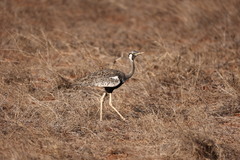
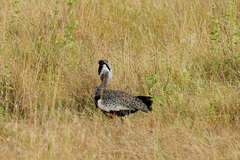
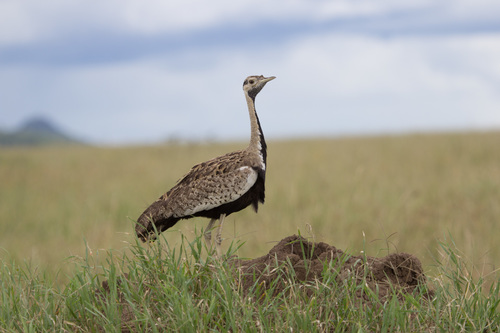
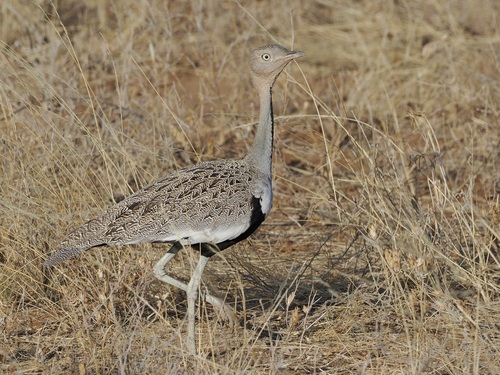
Hartlaub's bustard (Lissotis hartlaubii) is a species of bird in the family Otididae. It is a medium-sized bustard with a long, thick neck, and long legs. It is found in open, tall grassland, range from 1,600 to 2,000 metres (5,250 to 6,560 ft) in Ethiopia, Kenya, Somalia, Sudan, Tanzania, and Uganda.

The common name and Latin binomial commemorate the German physician and ornithologist Gustav Hartlaub. They initially classified under the genus Eupodotis in 1839, a subsequent genetic study revealed that the genus Lissotis represents a distinct, long-standing lineage, separate from Eupodotis, emerging during the evolutionary diversification of bustards at the generic level.

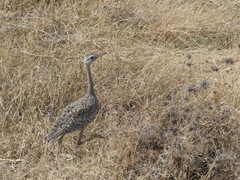
A mature Hartlaub's bustard is about 60 centimetres (24 in), recorded weights range from 1,500–1,600 g (3.3–3.5 lb). They are indistinguishable from a far distance, as they are similar to L. melanogaster. The male Hartlaub's bustard has a grayish coloration with a more distinct black stripe on its face, as well as a black stripe running down its neck that connects to its black belly. They have a small head set on a long neck, and a bulky body with large legs. The female is similar in appearance to... Wikipedia →

Global Distribution

Parks Where Found

# Park Country Daily sighting probability
1 Meru National Park 🇰🇪 Kenya
~20%
2 Mkomazi National Park 🇹🇿 Tanzania
~10%
3 Nairobi National Park 🇰🇪 Kenya
~10%
4 Amboseli National Park 🇰🇪 Kenya
~10%
5 Tsavo East National Park 🇰🇪 Kenya
<5%
6 Tsavo West National Park 🇰🇪 Kenya
<5%
7 Tarangire National Park 🇹🇿 Tanzania
<5%
8 Serengeti National Park 🇹🇿 Tanzania
<5%
9 Kidepo Valley National Park 🇺🇬 Uganda
<5%
10 Ngorongoro Conservation Area 🇹🇿 Tanzania
<5%

Before you go

What are the chances of seeing a Hartlaub's Bustard in Tarangire National Park?

Rare

Under 5% of wildlife watchers report a Hartlaub's Bustard sighting in Tarangire National Park on a given day, based on 38 verified sightings from GBIF citizen-science data from 2019 to 2026. It is the 266th most-seen of the 411 birds we can rate there. Over three days the chance rises to about 10%, and over a week to about 20%, if each day is a fresh chance.

When is the best time to see a Hartlaub's Bustard in Tarangire National Park?

November

In that month about 10% of wildlife watchers report a Hartlaub's Bustard in Tarangire National Park on a given day, against under 5% in December to October, the lowest months. That is one of Tarangire National Park's wettest months, with about 110 mm of rain against almost none in September.

What time of day is best to see a Hartlaub's Bustard?

Between 3 and 6 pm

Across all the parks we cover, that three-hour window holds the most Hartlaub's Bustard sightings with a recorded time, and about 7 in 10 of them come between 6 am and 6 pm: it is a daytime animal.

Is Tarangire National Park the best place to see a Hartlaub's Bustard?

7th of 10

Of the 10 parks where we can rate Hartlaub's Bustard sightings, Tarangire National Park ranks 7th at under 5%. The best odds are in Meru National Park (Kenya, about 20%), Mkomazi National Park (Tanzania, about 10%) and Nairobi National Park (Kenya, about 10%).

Where does the Hartlaub's Bustard sighting chance come from?

GBIF citizen-science records

It is estimated from how often the Hartlaub's Bustard is recorded against all the birds logged in Tarangire National Park (38 verified sightings from 2019 to 2026), calibrated against known sighting rates. Figures are rounded to the nearest 10% because citizen-science data supports honest approximations, not decimals, and months with records from fewer than five people show "—". How it works.

← Back to Tarangire National Park