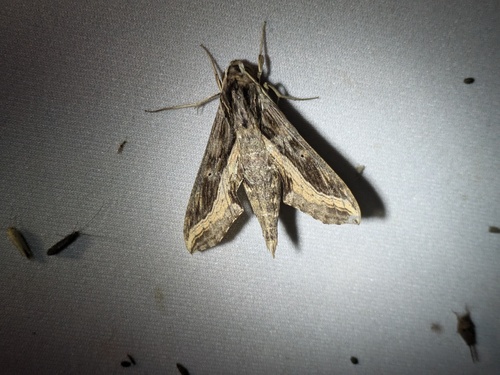
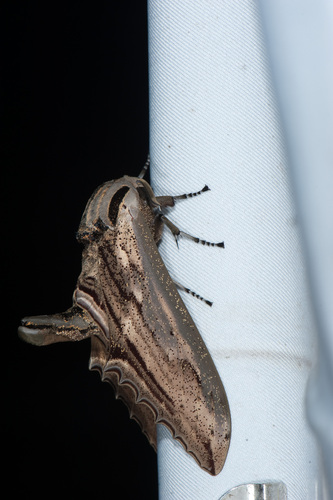
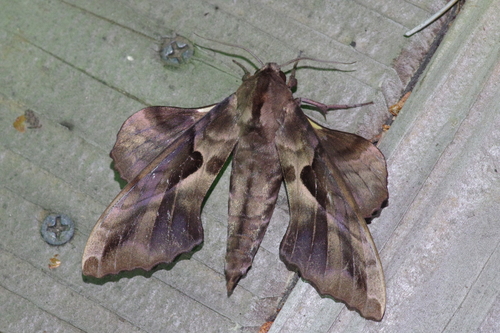
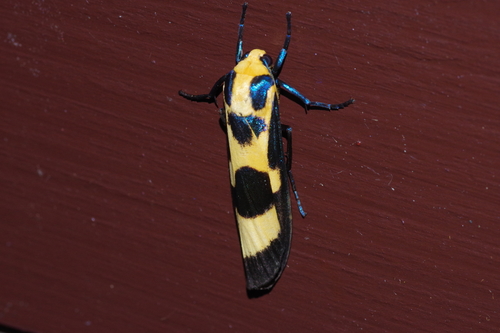
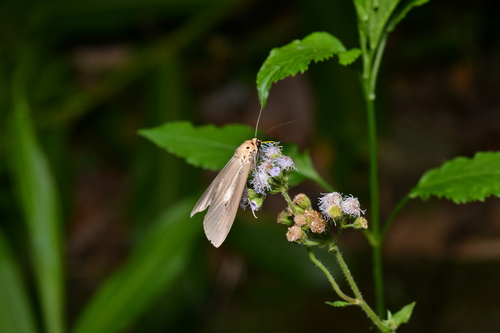
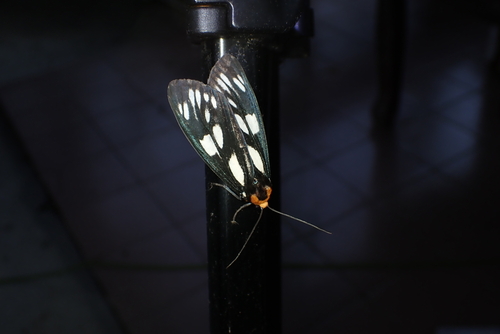
Dark Striated Hawkmoth

Dark Striated Hawkmoth

Hippotion velox

Daily sighting probability ~10% · With luck
at Taroko National Park

In 3 days ~20% in a week ~50%

8 Verified sightings at Taroko National Park From 2019 to 2026
16 In all 2 parks
November Best month
☀️🌙 Day & Night When it's spotted

About the Dark Striated Hawkmoth

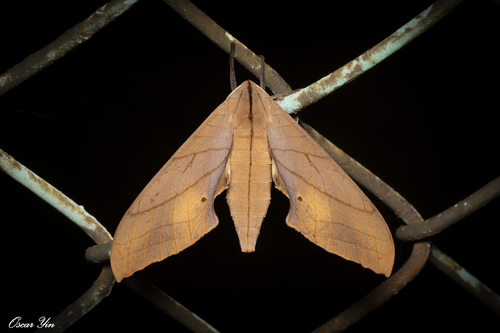
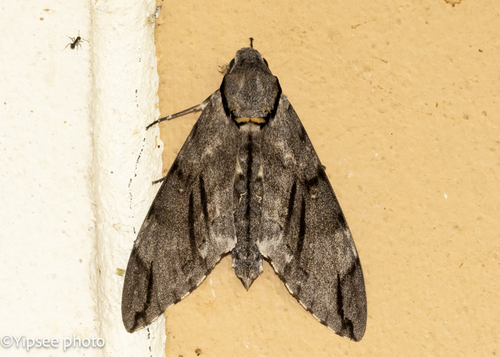
Hippotion velox, the dark striated hawkmoth, is a species of sphingid moth or the family Sphingidae. The species was described by Johan Christian Fabricius in 1793. It is found throughout the Indo-Australian tropics of India, Sri Lanka and east to Fiji and New Caledonia, north to Hong Kong, Taiwan, Sumatra southern Japan and northern Australia from Western Australia to Queensland.

The wingspan is 54–76 mm. The head and thorax are brown with pale lateral streaks. The abdomen is brown with numerous dark strigae and pairs of pale lateral strigae on each segment. The forewings are brown without any silvery makings, thus differ from T. celerio. Hindwings are smoky brown with traces of a darker submarginal line.

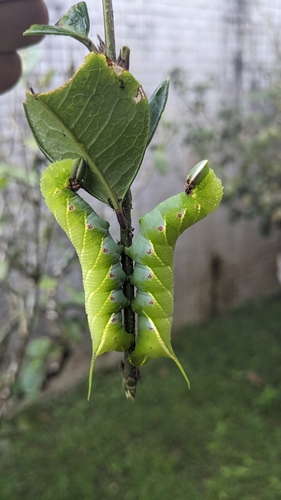
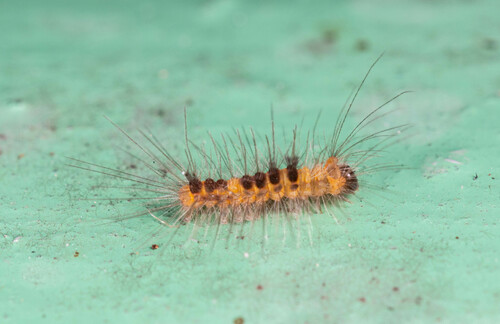
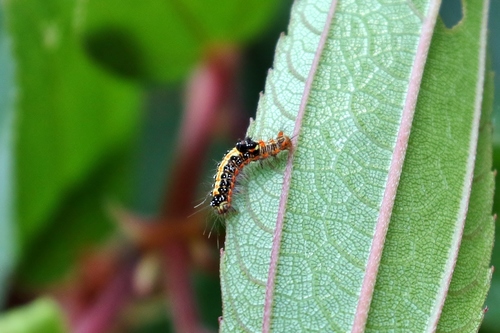
The final instar occurs in two forms, green and dark. Larvae are pale green or brown with dorsal black dots. There is an eyespot on the 4th somite which is blue centered with yellow in the green form. An ochreous black ring is present in brown form. There is a subdorsal line from 5th to 11th somite. Horn is purplish in the green form. Pupa is bone colored, closely spotted and speckled with brown and some black dots.

The larvae have been recorded... Wikipedia →

Global Distribution

Parks Where Found

# Park Country Daily sighting probability
1 Taroko National Park 🇹🇼 Taiwan
~10%
2 Daintree National Park 🇦🇺 Australia
~10%

Cities Where Found

# City Country Daily sighting probability
1 Kaohsiung 🇹🇼 Taiwan
<5%

Before you go

What are the chances of seeing a Dark Striated Hawkmoth in Taroko National Park?

With luck

About 10% of wildlife watchers report a Dark Striated Hawkmoth sighting in Taroko National Park on a given day, based on 8 verified sightings from GBIF citizen-science data from 2019 to 2026. It is the 240th most-seen of the 447 insects we can rate there. Over three days the chance rises to about 20%, and over a week to about 50%, if each day is a fresh chance.

When is the best time to see a Dark Striated Hawkmoth in Taroko National Park?

November

In that month about 30% of wildlife watchers report a Dark Striated Hawkmoth in Taroko National Park on a given day, against under 5% in January, April–July and September–October, the lowest months.

What time of day is best to see a Dark Striated Hawkmoth?

Between 9 am and noon

Across all the parks we cover, that three-hour window holds the most Dark Striated Hawkmoth sightings with a recorded time, and about 6 in 10 of them come between 6 am and 6 pm: it is seen both by day and at night.

Is Taroko National Park the best place to see a Dark Striated Hawkmoth?

Yes

Of the 2 parks where we can rate Dark Striated Hawkmoth sightings, Taroko National Park has the highest daily chance: about 10%. Next come Daintree National Park (Australia, about 10%).

Which relatives of the Dark Striated Hawkmoth live in Taroko National Park?

Same family: Sphingidae

The closest relatives of the Dark Striated Hawkmoth that you can see in Taroko National Park (family Sphingidae, Sphinx Moths) are Parum colligata (about 10%), Apple Hawkmoth (about 10%) and Phyllosphingia dissimilis (about 10%), with each one's daily chance of a sighting.

Where does the Dark Striated Hawkmoth sighting chance come from?

GBIF citizen-science records

It is estimated from how often the Dark Striated Hawkmoth is recorded against all the insects logged in Taroko National Park (8 verified sightings from 2019 to 2026), calibrated against known sighting rates. Figures are rounded to the nearest 10% because citizen-science data supports honest approximations, not decimals, and months with records from fewer than five people show "—". How it works.

← Back to Taroko National Park