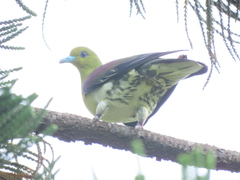
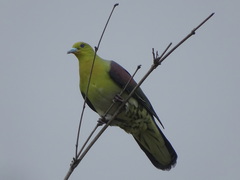
White-bellied Green-Pigeon

White-bellied Green-Pigeon

Treron sieboldii

Silhouette: Sheatherius · PhyloPic

LCLeast ConcernNTVUENCR
Daily sighting probability <5% · Rare
at Taroko National Park

In 3 days ~10% in a week ~20%

57 Verified sightings at Taroko National Park From 2019 to 2026
83 In all 3 parks
June Best month
☀️ Diurnal When it's spotted

About the White-bellied Green-Pigeon

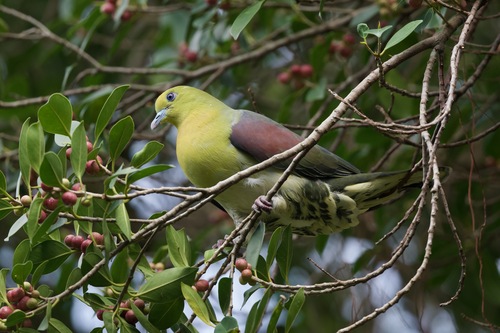
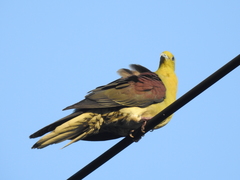
The white-bellied green pigeon (Treron sieboldii), also known as Siebold's green pigeon and Japanese green pigeon, is a species of bird in the family Columbidae. It is found in East, and Southeast Asia. Its natural habitat is temperate forests and woodlands. Its population has increased significantly since 2000. It is one of the few green pigeons that migrates.

The species epithet is named after Philipp Franz von Siebold, a German naturalist and traveler. White-bellied green pigeons are found in Japan, Taiwan, eastern and southern China, and northern Southeast Asia. In Japan, their population is found mainly in Hokkaido and the Ryukyu Islands. They also occur in Taiwan and eastern and southern China, and in northern Thailand, Laos and Vietnam.

The species is generally sedentary, but birds in Hokkaido are wholly migratory and only present there from May to September, and the populations in the rest of Japan also undertake some poorly understood migration. This pigeon is a forest dweller. It settles in deciduous and mixed forests, and prefers primary forests. In Japan, it exists in the forests of lowlands and in mountain forests, up to 1... Wikipedia →
Sounds

Song0:36

Japan · 2024

© Barry Edmonston · XC884466 · CC BY-NC-SA 4.0

Call0:06

Japan · 2015

© Peter Boesman · XC285792 · CC BY-NC-ND 4.0

Song0:20

Japan · 2014

© Brendan Sloan · XC617271 · CC BY-NC-ND 4.0

Global Distribution

Parks Where Found

# Park Country Daily sighting probability
1 Nikko National Park 🇯🇵 Japan
<5%
2 Taroko National Park 🇹🇼 Taiwan
<5%
3 Cuc Phuong National Park 🇻🇳 Vietnam
<5%

Cities Where Found

# City Country Daily sighting probability
1 Taipei 🇹🇼 Taiwan
<5%
2 Sapporo 🇯🇵 Japan
<5%
3 Osaka 🇯🇵 Japan
<5%
4 Fukuoka 🇯🇵 Japan
<5%
5 Kaohsiung 🇹🇼 Taiwan
<5%
6 Taichung 🇹🇼 Taiwan
<5%
7 Sendai 🇯🇵 Japan
<5%
8 Nagoya 🇯🇵 Japan
<5%
9 Tokyo 🇯🇵 Japan
<5%
10 Shanghai 🇨🇳 China
<5%

Zoos & Centres Where Found

# Zoo / Centre Country
1 Ueno Zoo 🇯🇵 Japan In captivity
2 Ocean Park Hong Kong 🇨🇳 China In captivity

Before you go

What are the chances of seeing a White-bellied Green-Pigeon in Taroko National Park?

Rare

Under 5% of wildlife watchers report a White-bellied Green-Pigeon sighting in Taroko National Park on a given day, based on 57 verified sightings from GBIF citizen-science data from 2019 to 2026. It is the 95th most-seen of the 147 birds we can rate there. Over three days the chance rises to about 10%, and over a week to about 20%, if each day is a fresh chance.

When is the best time to see a White-bellied Green-Pigeon in Taroko National Park?

April, June–July and September

In those months about 10% of wildlife watchers report a White-bellied Green-Pigeon in Taroko National Park on a given day, against under 5% in May, August and October–March, the lowest months.

What time of day is best to see a White-bellied Green-Pigeon?

Between 3 and 6 pm

Across all the parks we cover, that three-hour window holds the most White-bellied Green-Pigeon sightings with a recorded time, and about 9 in 10 of them come between 6 am and 6 pm: it is a daytime animal.

Is Taroko National Park the best place to see a White-bellied Green-Pigeon?

Among the best

Of the 3 parks where we can rate White-bellied Green-Pigeon sightings, Taroko National Park ranks 2nd at under 5%, level with the leaders once rounded. The best odds are in Nikko National Park (Japan, under 5%).

Where does the White-bellied Green-Pigeon sighting chance come from?

GBIF citizen-science records

It is estimated from how often the White-bellied Green-Pigeon is recorded against all the birds logged in Taroko National Park (57 verified sightings from 2019 to 2026), calibrated against known sighting rates. Figures are rounded to the nearest 10% because citizen-science data supports honest approximations, not decimals, and months with records from fewer than five people show "—". How it works.

← Back to Taroko National Park