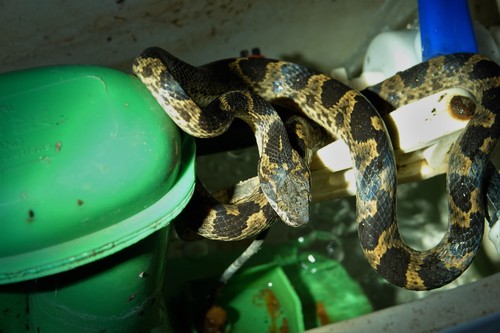
Grass Anole

Grass Anole

Anolis auratus

Silhouette: Sarah Werning · PhyloPic

LCLeast ConcernNTVUENCR
Daily sighting probability ~30% · Possible
at Tayrona National Natural Park

In 3 days ~70% in a week ~90%

25 Verified sightings at Tayrona National Natural Park From 2019 to 2026
73 In all 3 parks
May Best month
☀️ Diurnal When it's spotted

About the Grass Anole

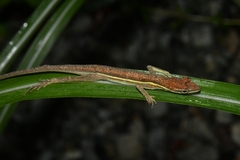
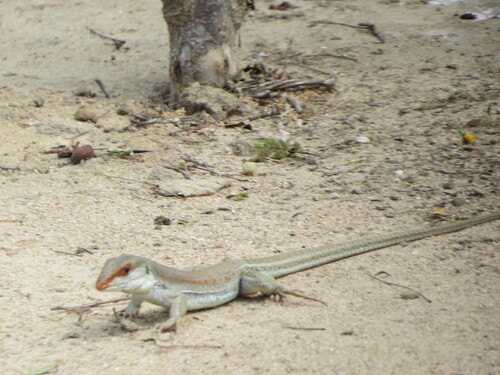
Anolis auratus, the grass anole, is a species of lizard in the family Dactyloidae. The species is found in Costa Rica, Panama, Venezuela, Colombia, French Guiana, Guyana, and Brazil. Though A. auratus presents a variety of physical characteristics based on geographic location, maturity, and sex, a common feature is a tan-coloured back with cream or dark brown to black lateral stripes, copper orange spots on the posterior thigh, a bright orange tongue, as well as an overall tan tail with light gray or black streaks, blotches, or stripes on the dorsal surface but orange coloration underneath. The female has a smaller dewlap with gray to blue skin in between cream scales, while the male possesses a larger dewlap, similar in skin color to that of the female but with yellow scales at the center and base of the structure.

In general, male and female A. auratus exhibit differences in pelvis width, trunk length, and head size, and thus, are sexually dimorphic with females possessing bigger pelvises and trunks and males having larger heads. As females play a more important role in reproduction, their larger trunks and wider pelvises allow them to carry more eggs as well as... Wikipedia →

Global Distribution

Parks Where Found

# Park Country Daily sighting probability
1 Tayrona National Natural Park 🇨🇴 Colombia
~30%
2 Soberanía National Park 🇵🇦 Panama
~20%
3 Parque Natural Metropolitano 🇵🇦 Panama
~10%

Cities Where Found

# City Country Daily sighting probability
1 Panama City 🇵🇦 Panama
~10%

Before you go

What are the chances of seeing a Grass Anole in Tayrona National Natural Park?

Possible

About 30% of wildlife watchers report a Grass Anole sighting in Tayrona National Natural Park on a given day, based on 25 verified sightings from GBIF citizen-science data from 2019 to 2026. It is the 12th most-seen of the 26 reptiles we can rate there. Over three days the chance rises to about 70%, and over a week to about 90%, if each day is a fresh chance.

When is the best time to see a Grass Anole in Tayrona National Natural Park?

May

In that month about 80% of wildlife watchers report a Grass Anole in Tayrona National Natural Park on a given day, against under 5% in January–April, July and September–October, the lowest months.

What time of day is best to see a Grass Anole?

Between 10 am and 1 pm

Across all the parks we cover, that three-hour window holds the most Grass Anole sightings with a recorded time, and about 8 in 10 of them come between 6 am and 6 pm: it is a daytime animal.

Is Tayrona National Natural Park the best place to see a Grass Anole?

Yes

Of the 3 parks where we can rate Grass Anole sightings, Tayrona National Natural Park has the highest daily chance: about 30%. Next come Soberanía National Park (Panama, about 20%) and Parque Natural Metropolitano (Panama, about 10%).

Which relatives of the Grass Anole live in Tayrona National Natural Park?

Same genus: Anolis

The closest relatives of the Grass Anole that you can see in Tayrona National Natural Park (genus Anolis, Anoles) are Gaige's Anole (about 50%) and Neotropical Green Anole (about 40%), with each one's daily chance of a sighting.

Where does the Grass Anole sighting chance come from?

GBIF citizen-science records

It is estimated from how often the Grass Anole is recorded against all the reptiles logged in Tayrona National Natural Park (25 verified sightings from 2019 to 2026), calibrated against known sighting rates. Figures are rounded to the nearest 10% because citizen-science data supports honest approximations, not decimals, and months with records from fewer than five people show "—". How it works.

← Back to Tayrona National Natural Park