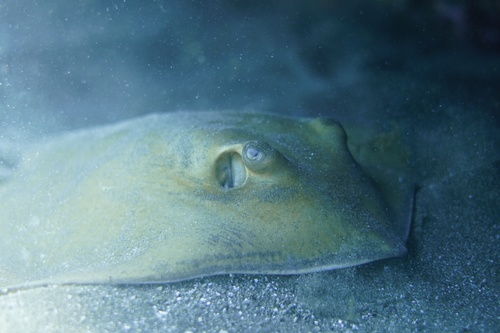
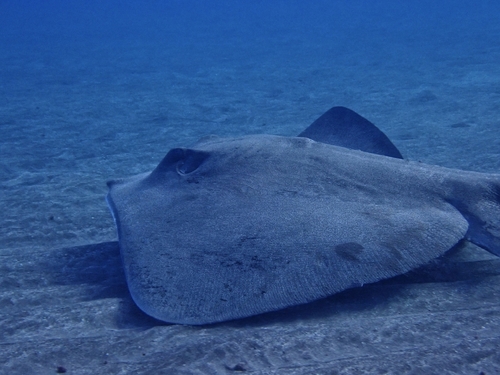
Angelshark

Angelshark

Squatina squatina

Daily sighting probability ~40% · Likely
at Teno-Rasca Marine Strip (Tenerife)

In 3 days ~80% in a week >90%

29 Verified sightings at Teno-Rasca Marine Strip (Tenerife) From 2019 to 2026
29 In 1 park
December Best month
☀️🌙 Day & Night When it's spotted

About the Angelshark

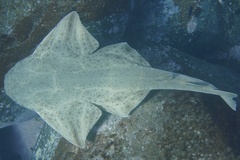
Squatina squatina, known as the common angelshark, is a species of shark in the family Squatinidae (known generally also as angel sharks), that were once widespread in the coastal waters of the northeastern Atlantic Ocean. Well-adapted for camouflaging itself on the sea floor, the angelshark has a flattened form with enlarged pectoral and pelvic fins, giving it a superficial resemblance to a ray. This species can be identified by its broad and stout body, conical barbels, thornless back (in larger individuals), and grayish or brownish dorsal coloration with a pattern of numerous small light and dark markings (that is more vivid in juveniles). It measures up to 2.4 m (7.9 ft) long.

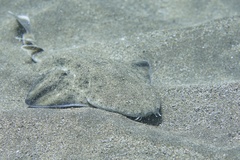
Like other members of its family, the angelshark is a nocturnal ambush predator that buries itself in sediment and waits for passing prey, mostly benthic bony fishes, but also skates and invertebrates. An aplacental viviparous species, females bear litters of seven to 25 pups every other year. The angelshark normally poses little danger to humans, though if provoked, it is quick to bite. Since the mid-20th century, intense commercial fishing across the angelshark's range has decimated its population via bycatch – it is now locally extinct or nearly so across most of its northern range, and the prospects of the remaining fragmented subpopulations are made more precarious by its slow rate of reproduction. As a result, the International Union for Conservation of Nature has assessed this species as critically endangered.

Wikipedia →

Global Distribution

Parks Where Found

# Park Country Daily sighting probability
1 Teno-Rasca Marine Strip (Tenerife) 🇪🇸 Spain
~40%

More parks will be added in future updates.

Zoos & Centres Where Found

# Zoo / Centre Country
1 Acuario de Sevilla 🇪🇸 Spain In captivity
2 Acquario dell'Elba 🇮🇹 Italy In captivity

Before you go

What are the chances of seeing an Angelshark in Teno-Rasca Marine Strip (Tenerife)?

Likely

About 40% of wildlife watchers report an Angelshark sighting in Teno-Rasca Marine Strip (Tenerife) on a given day, based on 29 verified sightings from GBIF citizen-science data from 2019 to 2026. It is the 2nd most-seen of the 9 sharks and rays we can rate there. Over three days the chance rises to about 80%, and over a week to over 90%, if each day is a fresh chance.

When is the best time to see an Angelshark in Teno-Rasca Marine Strip (Tenerife)?

December

In that month about 70% of wildlife watchers report an Angelshark in Teno-Rasca Marine Strip (Tenerife) on a given day, against about 10% in August, the lowest month. March has too few records to rate.

What time of day is best to see an Angelshark?

Between 1 and 4 pm

Across all the parks we cover, that three-hour window holds the most Angelshark sightings with a recorded time, and about 6 in 10 of them come between 6 am and 6 pm: it is seen both by day and at night.

Where else can you see an Angelshark?

Only Teno-Rasca Marine Strip (Tenerife), in our data

Teno-Rasca Marine Strip (Tenerife) is the only park on Wallace's Line with enough records to rate Angelshark sightings: about 40% of wildlife watchers there report one on a given day.

Where does the Angelshark sighting chance come from?

GBIF citizen-science records

It is estimated from how often the Angelshark is recorded against all the sharks and rays logged in Teno-Rasca Marine Strip (Tenerife) (29 verified sightings from 2019 to 2026), calibrated against known sighting rates. Figures are rounded to the nearest 10% because citizen-science data supports honest approximations, not decimals, and months with records from fewer than five people show "—". How it works.

← Back to Teno-Rasca Marine Strip (Tenerife)