Marbled Electric Ray

Marbled Electric Ray

Torpedo marmorata

Daily sighting probability ~10% · With luck
at Teno-Rasca Marine Strip (Tenerife)

In 3 days ~40% in a week ~70%

5 Verified sightings at Teno-Rasca Marine Strip (Tenerife) From 2019 to 2026
5 In 1 park
April Best month
☀️ Diurnal When it's spotted

About the Marbled Electric Ray

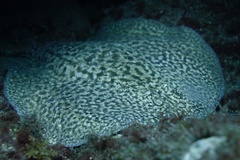
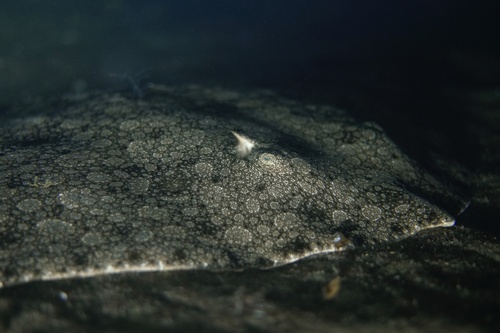
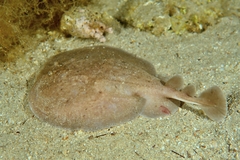
The marbled electric ray (Torpedo marmorata) is a species of electric ray in the family Torpedinidae found in the coastal waters of the eastern Atlantic Ocean from the North Sea to South Africa. This benthic fish inhabits rocky reefs, seagrass beds, and sandy and muddy flats in shallow to moderately deep waters. It can survive in environments with very little dissolved oxygen, such as tidal pools. The marbled electric ray has a nearly circular pectoral fin disc and a muscular tail that bears two dorsal fins of nearly equal size and a large caudal fin. It can be identified by the long, finger-like projections on the rims of its spiracles, as well as by its dark brown mottled color pattern, though some individuals are plain-colored. Males and females typically reach 36–38 cm (14–15 in) and 55–61 cm (22–24 in) long respectively.

Nocturnal and solitary, the marbled electric ray can often be found lying the sea floor buried except for its eyes and spiracles. This slow-moving predator feeds almost exclusively on small bony fishes, which it ambushes from the bottom and subdues with strong electric bursts. It defends itself by turning towards the threat, swimming in a loop, or curling up with its underside facing outward, while emitting electric shocks to drive off the prospective predator. Its paired electric organs are capable of producing 70–80 volts of electricity. This species is aplacental viviparous, with the developing embryos sustained by yolk and histotroph ("uterine milk") produced by the mother. Mating takes place from November to January, and females bear litters of 3–32 pups every other year after a gestation period of 9–12 months. The newborn ray is immediately capable of using electricity to hunt.

The electric shock delivered by a marbled electric ray can be severe but is not directly life-threatening. Its electrogenic properties have been known since classical antiquity, when live rays were used to treat conditions such as chronic headaches. This and other electric ray species are used as model organisms in biomedical research. Various coastal demersal fisheries take the marbled electric ray as bycatch; captured rays are usually discarded as they have little commercial value. The impact of fishing on its population is uncertain, and thus International Union for Conservation of Nature (IUCN) has listed this ray as Vulnerable. In the Mediterranean Sea, it remains the most common electric ray and in some areas may be increasing in number.

Wikipedia →

Global Distribution

Parks Where Found

# Park Country Daily sighting probability
1 Teno-Rasca Marine Strip (Tenerife) 🇪🇸 Spain
~10%

More parks will be added in future updates.

Zoos & Centres Where Found

# Zoo / Centre Country
1 Acquario dell'Elba 🇮🇹 Italy In captivity

Before you go

What are the chances of seeing a Marbled Electric Ray in Teno-Rasca Marine Strip (Tenerife)?

With luck

About 10% of wildlife watchers report a Marbled Electric Ray sighting in Teno-Rasca Marine Strip (Tenerife) on a given day, based on 5 verified sightings from GBIF citizen-science data from 2019 to 2026. It is the 8th most-seen of the 9 sharks and rays we can rate there. Over three days the chance rises to about 40%, and over a week to about 70%, if each day is a fresh chance.

When is the best time to see a Marbled Electric Ray in Teno-Rasca Marine Strip (Tenerife)?

January and April

In those months about 40% of wildlife watchers report a Marbled Electric Ray in Teno-Rasca Marine Strip (Tenerife) on a given day, against under 5% in August, the lowest month. March has too few records to rate.

What time of day is best to see a Marbled Electric Ray?

Between 10 am and 1 pm

Across all the parks we cover, that three-hour window holds the most Marbled Electric Ray sightings with a recorded time, and nearly all of them come between 6 am and 6 pm: it is a daytime animal.

Where else can you see a Marbled Electric Ray?

Only Teno-Rasca Marine Strip (Tenerife), in our data

Teno-Rasca Marine Strip (Tenerife) is the only park on Wallace's Line with enough records to rate Marbled Electric Ray sightings: about 10% of wildlife watchers there report one on a given day.

Where does the Marbled Electric Ray sighting chance come from?

GBIF citizen-science records

It is estimated from how often the Marbled Electric Ray is recorded against all the sharks and rays logged in Teno-Rasca Marine Strip (Tenerife) (5 verified sightings from 2019 to 2026), calibrated against known sighting rates. Figures are rounded to the nearest 10% because citizen-science data supports honest approximations, not decimals, and months with records from fewer than five people show "—". How it works.

← Back to Teno-Rasca Marine Strip (Tenerife)