Common Eagle Ray

Common Eagle Ray

Myliobatis aquila

Daily sighting probability ~30% · Possible
at Teno-Rasca Marine Strip (Tenerife)

In 3 days ~70% in a week ~90%

30 Verified sightings at Teno-Rasca Marine Strip (Tenerife) From 2019 to 2026
69 In all 2 parks
September Best month
☀️ Diurnal When it's spotted

About the Common Eagle Ray

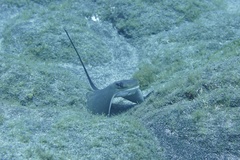
The common eagle ray or bullray (Myliobatis aquila) is a species of fish in the family Myliobatidae. It inhabits the eastern Atlantic Ocean (North Sea to South Africa), the Mediterranean Sea and the south-western Indian Ocean.

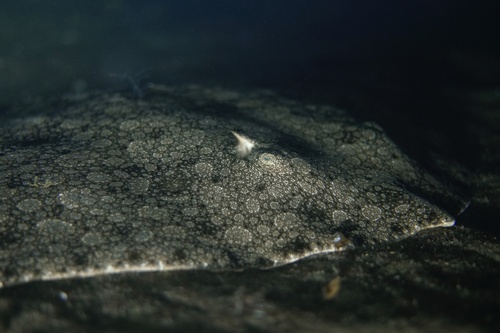
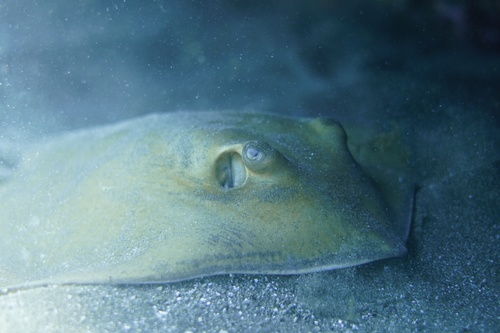
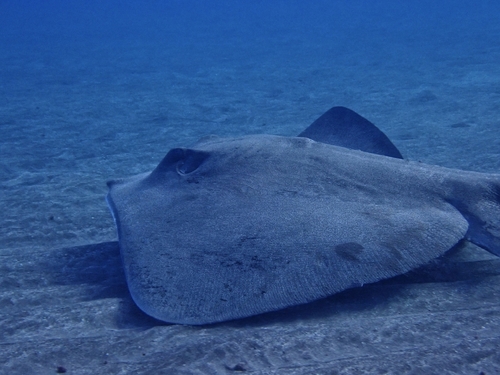
The common eagle ray reaches up to 183 cm (6.0 ft) in total length with a disc width up to 80 cm (2.6 ft), though most specimens are smaller. Females grow to be larger than males. The dorsal surface is brown or black while the ventral surface is white. It has a rhomboidal disc with a pair of large, triangular pectoral fins projecting on either side, and a single dorsal fin. The blunt snout is rounded and the tail is long and slender, with a large spine at its base but no tail fin. On average, males have 72 spine serrations and females have 66 spine serrations. The spine makes about 70% of the male's length and 65% of the female's length. The mid dorsal groove, which contains the glandular tissue necessary for venom injection, extends along 10–40% the tail. It has one or two excretory channels for the venom.

This species occurs in the eastern Atlantic Ocean, including the North Sea, from the British Isles to South...

Wikipedia →

Global Distribution

Parks Where Found

# Park Country Daily sighting probability
1 Corsica Regional Natural Park (Parc naturel régional de Corse) 🇫🇷 France
~50%
2 Teno-Rasca Marine Strip (Tenerife) 🇪🇸 Spain
~30%

Zoos & Centres Where Found

# Zoo / Centre Country
1 Pairi Daiza 🇧🇪 Belgium In captivity
2 Lisbon Oceanarium 🇵🇹 Portugal In captivity
3 Nausicaà Centre National de la Mer 🇫🇷 France In captivity
4 Lisbon Zoo 🇵🇹 Portugal In captivity
5 L'Oceanogràfic 🇪🇸 Spain In captivity
6 Aquarium Finisterrae 🇪🇸 Spain In captivity
7 Aquarium Barcelona 🇪🇸 Spain In captivity
8 Palma Aquarium 🇪🇸 Spain In captivity
9 Two Oceans Aquarium 🇿🇦 South Africa In captivity
10 Grand Aquarium de Touraine 🇫🇷 France In captivity
11 Acuario de Sevilla 🇪🇸 Spain In captivity
12 Aquarium de La Rochelle 🇫🇷 France In captivity
13 National Marine Aquarium of Namibia 🇳🇦 Namibia In captivity
14 Cala Gonone aquarium 🇮🇹 Italy In captivity
15 Centro de Recuperación de Rapaces Brinzal 🇪🇸 Spain In captivity
16 Acquario dell'Elba 🇮🇹 Italy In captivity
17 Aquário da Madeira 🇵🇹 Portugal In captivity
18 Berkshire College of Agriculture 🇬🇧 United Kingdom In captivity
19 Dubai Aquarium and Underwater Zoo 🇦🇪 United Arab Emirates In captivity

Before you go

What are the chances of seeing a Common Eagle Ray in Teno-Rasca Marine Strip (Tenerife)?

Possible

About 30% of wildlife watchers report a Common Eagle Ray sighting in Teno-Rasca Marine Strip (Tenerife) on a given day, based on 30 verified sightings from GBIF citizen-science data from 2019 to 2026. It is the 4th most-seen of the 9 sharks and rays we can rate there. Over three days the chance rises to about 70%, and over a week to about 90%, if each day is a fresh chance.

When is the best time to see a Common Eagle Ray in Teno-Rasca Marine Strip (Tenerife)?

September and November

In those months about 70% of wildlife watchers report a Common Eagle Ray in Teno-Rasca Marine Strip (Tenerife) on a given day, against about 20% in May and June, the lowest months. March has too few records to rate.

What time of day is best to see a Common Eagle Ray?

Between 9 am and noon

Across all the parks we cover, that three-hour window holds the most Common Eagle Ray sightings with a recorded time, and about 7 in 10 of them come between 6 am and 6 pm: it is a daytime animal.

Where does the Common Eagle Ray sighting chance come from?

GBIF citizen-science records

It is estimated from how often the Common Eagle Ray is recorded against all the sharks and rays logged in Teno-Rasca Marine Strip (Tenerife) (30 verified sightings from 2019 to 2026), calibrated against known sighting rates. Figures are rounded to the nearest 10% because citizen-science data supports honest approximations, not decimals, and months with records from fewer than five people show "—". How it works.

← Back to Teno-Rasca Marine Strip (Tenerife)