Purplish-backed Quail-Dove

Purplish-backed Quail-Dove

Zentrygon lawrencii

Silhouette: Natalia Ladino · PhyloPic

LCLeast ConcernNTVUENCR
Daily sighting probability <5% · Rare
at Tenorio Volcano National Park

In 3 days <5% in a week ~10%

72 Verified sightings at Tenorio Volcano National Park From 2019 to 2026
528 In all 7 parks
July Best month
☀️ Diurnal When it's spotted

About the Purplish-backed Quail-Dove

The purplish-backed quail-dove (Zentrygon lawrencii) is a species of bird in the family Columbidae. It is found in Costa Rica and Panama. The purplish-backed quail-dove is monotypic. However, the population of it in northwestern Costa Rica was at one time considered a subspecies. The purplish-backed quail-dove and the Tuxtla quail-dove (Zentrygon carrikeri) of Mexico were previously considered conspecific.

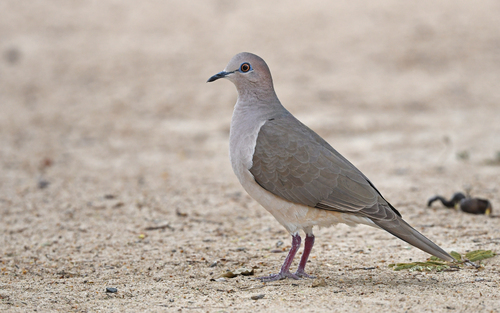
Male purplish-backed quail-doves are 26 to 27 cm (10 to 11 in) long and females are about 25 cm (9.8 in) long. The species weighs about 220 g (7.8 oz). Adults have a grayish white forehead and a bluish to greenish gray crown, nape, and hindneck. The mantle is dull purple and the rest of the upperparts and the wings are olive-brown to blackish brown with some reddish tinge. The central tail feathers are purple-brown and the outer ones blackish with gray tips. The face and throat are white with a black malar line and a line from the bill to the eye. The neck and breast are slate gray with greenish sides, the belly center pale buff to cinnamon, and the flanks chocolate. The eye is browish orange to red surrounded by bare magenta skin... Wikipedia →

Sounds

Call0:16

Panama · 2012

© William Adsett · XC105503 · CC BY-NC-ND 2.5

Song0:40

Costa Rica · 2011

© Andrew Spencer · XC71927 · CC BY-NC-ND 2.5

Call0:48

Panama · 2015

© William Adsett · XC253760 · CC BY-NC-SA 4.0

Global Distribution

Parks Where Found

# Park Country Daily sighting probability
1 Arenal Volcano National Park 🇨🇷 Costa Rica
<5%
2 Tenorio Volcano National Park 🇨🇷 Costa Rica
<5%
3 Tapantí-Macizo de la Muerte National Park 🇨🇷 Costa Rica
<5%
4 Chagres National Park 🇵🇦 Panama
<5%
5 Poás Volcano National Park 🇨🇷 Costa Rica
<5%
6 Braulio Carrillo National Park 🇨🇷 Costa Rica
<5%
7 Monteverde Cloud Forest Reserve 🇨🇷 Costa Rica
<5%

Zoos & Centres Where Found

# Zoo / Centre Country
1 Dallas World Aquarium 🇺🇸 United States In captivity

Before you go

What are the chances of seeing a Purplish-backed Quail-Dove in Tenorio Volcano National Park?

Rare

Under 5% of wildlife watchers report a Purplish-backed Quail-Dove sighting in Tenorio Volcano National Park on a given day, based on 72 verified sightings from GBIF citizen-science data from 2019 to 2026. It is the 254th most-seen of the 444 birds we can rate there. Over three days the chance rises to under 5%, and over a week to about 10%, if each day is a fresh chance.

When is the best time to see a Purplish-backed Quail-Dove in Tenorio Volcano National Park?

July

In that month about 10% of wildlife watchers report a Purplish-backed Quail-Dove in Tenorio Volcano National Park on a given day, against under 5% in August to June, the lowest months.

What time of day is best to see a Purplish-backed Quail-Dove?

Between 7 and 10 am

Across all the parks we cover, that three-hour window holds the most Purplish-backed Quail-Dove sightings with a recorded time, and about 9 in 10 of them come between 6 am and 6 pm: it is a daytime animal.

Is Tenorio Volcano National Park the best place to see a Purplish-backed Quail-Dove?

Among the best

Of the 7 parks where we can rate Purplish-backed Quail-Dove sightings, Tenorio Volcano National Park ranks 2nd at under 5%, level with the leaders once rounded. The best odds are in Arenal Volcano National Park (Costa Rica, under 5%).

Where does the Purplish-backed Quail-Dove sighting chance come from?

GBIF citizen-science records

It is estimated from how often the Purplish-backed Quail-Dove is recorded against all the birds logged in Tenorio Volcano National Park (72 verified sightings from 2019 to 2026), calibrated against known sighting rates. Figures are rounded to the nearest 10% because citizen-science data supports honest approximations, not decimals, and months with records from fewer than five people show "—". How it works.

← Back to Tenorio Volcano National Park