Black-bellied Slider

Black-bellied Slider

Trachemys dorbigni

Silhouette: DataBase Center for Life Science (DBCLS) · PhyloPic

Daily sighting probability ~10% · With luck
at Tijuca National Park

In 3 days ~20% in a week ~30%

6 Verified sightings at Tijuca National Park From 2019 to 2026
68 In all 3 parks
October Best month
☀️ Diurnal When it's spotted

About the Black-bellied Slider

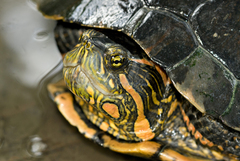
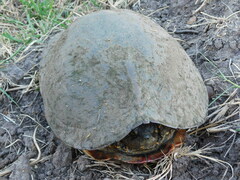
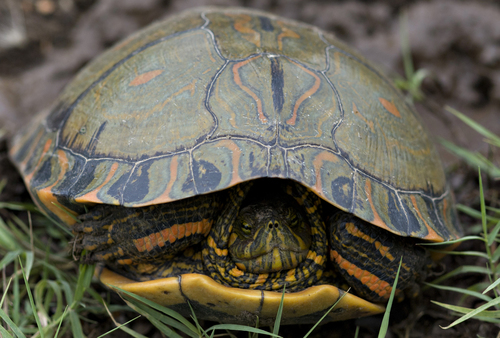
D'Orbigny's slider (Trachemys dorbigni) also commonly known as the black-bellied slider, and in Brazil as tartaruga-tigre or tartaruga-tigre-d'água (which mean "tiger turtle" and "water tiger turtle" in Portuguese), is a species of water turtle in the family Emydidae. The species is found in southern Brazil, northeastern Argentina, and Uruguay.

The specific name, dorbigni, is in honor of French naturalist Alcide d'Orbigny. Trachemys dorbigni is usually found in bodies of water such as lakes, marshes, streams and rivers. It has a preference for waters with low or moderate currents, soft bottoms and abundant aquatic vegetation.

The gender of Trachemys dorbigni can be determined by the form of the plastron, which after a few years of life, shows differences between male and female. The males has a penis that is located in the tail and becomes apparent only during the mating season when it is inserted into the female's cloaca. D'Orbigny's slider has a life span of between 30 and 100 years in captivity.

Hatchlings weigh 11 grams (0.39 oz) with a 3.5 cm (1.4 in) carapace. The average growth rate is about 3 cm (1.2 in) per year in the wild,... Wikipedia →
Global Distribution

Parks Where Found

# Park Country Daily sighting probability
1 El Palmar National Park 🇦🇷 Argentina
~50%
2 Tijuca National Park 🇧🇷 Brazil
~10%
3 Iguazú National Park 🇦🇷 Argentina
~10%

Cities Where Found

# City Country Daily sighting probability
1 Porto Alegre 🇧🇷 Brazil
~30%
2 Curitiba 🇧🇷 Brazil
~20%
3 Montevideo 🇺🇾 Uruguay
~10%
4 São Paulo 🇧🇷 Brazil
~10%
5 Rio de Janeiro 🇧🇷 Brazil
~10%
6 Belo Horizonte 🇧🇷 Brazil
~10%

Zoos & Centres Where Found

# Zoo / Centre Country
1 Pairi Daiza 🇧🇪 Belgium In captivity
2 Parque das Aves 🇧🇷 Brazil In captivity
3 Zoobotanic Park of Brusque 🇧🇷 Brazil In captivity
4 Zoológico de Brasília 🇧🇷 Brazil In captivity
5 Estación de Cría de Animales Silvestres (ECAS) 🇦🇷 Argentina In captivity
6 São Paulo Zoo 🇧🇷 Brazil In captivity
7 Zoológico de Goiânia 🇧🇷 Brazil In captivity
8 Temaikén 🇦🇷 Argentina In captivity
9 Gramado Zoo 🇧🇷 Brazil In captivity
10 Parque Zoobotânico Arruda Câmara (BICA) 🇧🇷 Brazil In captivity
11 Rio de Janeiro Zoological Garden 🇧🇷 Brazil In captivity
12 Bosque dos Jequitibás 🇧🇷 Brazil In captivity
13 Zoo Park da Montanha 🇧🇷 Brazil In captivity
14 Parque Zoológico Bosque Guarani 🇧🇷 Brazil In captivity
15 Zoológico UCS 🇧🇷 Brazil In captivity
16 Projeto TAMAR 🇧🇷 Brazil In captivity
17 Aqualife 🇦🇷 Argentina In captivity
18 The Juana's Market 🇦🇷 Argentina In captivity

Closest Relatives at Tijuca National Park

No species of the same family or order lives in Tijuca National Park, so these are its closest relatives here: other reptiles.

Before you go

What are the chances of seeing a Black-bellied Slider in Tijuca National Park?

With luck

About 10% of wildlife watchers report a Black-bellied Slider sighting in Tijuca National Park on a given day, based on 6 verified sightings from GBIF citizen-science data from 2019 to 2026. It is the 19th most-seen of the 21 reptiles we can rate there. Over three days the chance rises to about 20%, and over a week to about 30%, if each day is a fresh chance.

When is the best time to see a Black-bellied Slider in Tijuca National Park?

March, June, August and October–November

In those months about 10% of wildlife watchers report a Black-bellied Slider in Tijuca National Park on a given day, against under 5% in April–May, July, September and December–February, the lowest months.

What time of day is best to see a Black-bellied Slider?

Between 11 am and 2 pm

Across all the parks we cover, that three-hour window holds the most Black-bellied Slider sightings with a recorded time, and about 9 in 10 of them come between 6 am and 6 pm: it is a daytime animal.

Is Tijuca National Park the best place to see a Black-bellied Slider?

2nd of 3

Of the 3 parks where we can rate Black-bellied Slider sightings, Tijuca National Park ranks 2nd at about 10%. The best odds are in El Palmar National Park (Argentina, about 50%).

Where does the Black-bellied Slider sighting chance come from?

GBIF citizen-science records

It is estimated from how often the Black-bellied Slider is recorded against all the reptiles logged in Tijuca National Park (6 verified sightings from 2019 to 2026), calibrated against known sighting rates. Figures are rounded to the nearest 10% because citizen-science data supports honest approximations, not decimals, and months with records from fewer than five people show "—". How it works.

← Back to Tijuca National Park