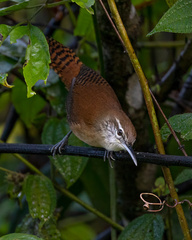
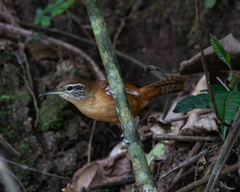
Long-billed Wren

Long-billed Wren

Cantorchilus longirostris

Silhouette: Matt Wilkins · PhyloPic

LCLeast ConcernNTVUENCR Endemic
Daily sighting probability ~10% · With luck
at Tijuca National Park

In 3 days ~30% in a week ~60%

317 Verified sightings at Tijuca National Park From 2019 to 2026
506 In all 4 parks
November Best month
☀️ Diurnal When it's spotted

About the Long-billed Wren

The long-billed wren (Cantorchilus longirostris) is a species of bird in the family Troglodytidae. It is endemic to Brazil. The long-billed wren has been treated as being conspecific with the buff-breasted wren (Cantorchilus leucotis). The latter has been suggested for elevation to species status.

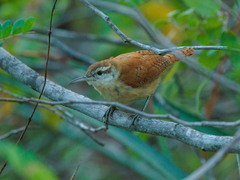
The long-billed wren is 19 to 21.5 cm (7.5 to 8.5 in) long and weighs 20 to 21 g (0.71 to 0.74 oz). The crown and nape of adults of the nominate subspecies are rich dark brown that becomes progressively more reddish to the rump; the lower back has obscure bars. Their tail is reddish brown with darker bars. They have an off-white supercilium, a darkish brown eyestripe, cheeks mottled off-white and dark gray, and a blackish malar stripe. Their throat color ranges from whitish to pale buff; their chest is reddish buff and the belly a deep rich buff. Juveniles are almost the same but their facial markings are not as distinct. C. l. bahiae is paler overall than the nominate, with the underparts' colors being much less saturated. Wikipedia →

Sounds

Song0:51

Brazil · 2024

© Daniel Hinckley · XC932480 · CC BY-NC-SA 4.0

Alarm call0:44

Brazil · 2024

© Thyago Almeida · XC895980 · CC BY-NC-SA 4.0

Call1:00

Brazil · 2022

© JAYRSON ARAUJO DE OLIVEIRA · XC753634 · CC BY-NC-SA 4.0

Global Distribution

Parks Where Found

# Park Country Daily sighting probability
1 Serra dos Órgãos National Park 🇧🇷 Brazil
~20%
2 Tijuca National Park 🇧🇷 Brazil
~10%
3 Chapada Diamantina National Park 🇧🇷 Brazil
~10%
4 Itatiaia National Park 🇧🇷 Brazil
<5%

Cities Where Found

# City Country Daily sighting probability
1 Rio de Janeiro 🇧🇷 Brazil
~20%
2 Niterói 🇧🇷 Brazil
~20%
3 Santos 🇧🇷 Brazil
~20%
4 São Paulo 🇧🇷 Brazil
<5%

Before you go

What are the chances of seeing a Long-billed Wren in Tijuca National Park?

With luck

About 10% of wildlife watchers report a Long-billed Wren sighting in Tijuca National Park on a given day, based on 317 verified sightings from GBIF citizen-science data from 2019 to 2026. It is the 54th most-seen of the 214 birds we can rate there. Over three days the chance rises to about 30%, and over a week to about 60%, if each day is a fresh chance.

When is the best time to see a Long-billed Wren in Tijuca National Park?

Any time of year

In every month with enough records, about 10% of wildlife watchers report a Long-billed Wren in Tijuca National Park on a given day, so our monthly data shows no clear season.

What time of day is best to see a Long-billed Wren?

Between 7 and 10 am

Across all the parks we cover, that three-hour window holds the most Long-billed Wren sightings with a recorded time, and about 9 in 10 of them come between 6 am and 6 pm: it is a daytime animal.

Is Tijuca National Park the best place to see a Long-billed Wren?

2nd of 4

Of the 4 parks where we can rate Long-billed Wren sightings, Tijuca National Park ranks 2nd at about 10%. The best odds are in Serra dos Órgãos National Park (Brazil, about 20%).

Where does the Long-billed Wren sighting chance come from?

GBIF citizen-science records

It is estimated from how often the Long-billed Wren is recorded against all the birds logged in Tijuca National Park (317 verified sightings from 2019 to 2026), calibrated against known sighting rates. Figures are rounded to the nearest 10% because citizen-science data supports honest approximations, not decimals, and months with records from fewer than five people show "—". How it works.

← Back to Tijuca National Park