Large Hairy Armadillo

Large Hairy Armadillo

Chaetophractus villosus

Silhouette: Celeste Luna · PhyloPic

LCLeast ConcernNTVUENCR
Daily sighting probability ~20% · Possible
at Torres del Paine National Park

In 3 days ~60% in a week ~90%

18 Verified sightings at Torres del Paine National Park From 2019 to 2026
164 In all 2 parks
June Best month
☀️ Diurnal When it's spotted

About the Large Hairy Armadillo

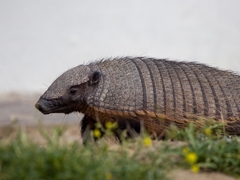
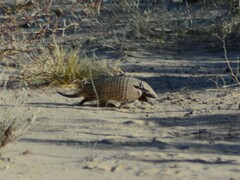
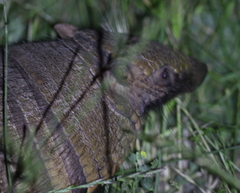
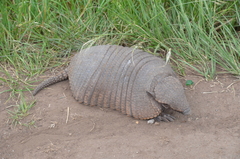
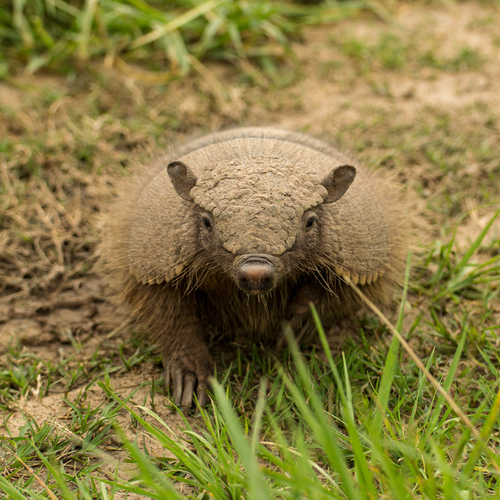
The big (or large) hairy armadillo (Chaetophractus villosus) is one of the largest and most numerous armadillos in South America. It lives from sea level to altitudes of up to 1,300 meters across the southern portion of South America, and can be found in grasslands, forests, and savannahs, and has even started claiming agricultural areas as its home. It is an accomplished digger and spends most of its time below ground. It makes both temporary and long-term burrows, depending on its food source. In Spanish it is colloquially known as peludo.

Armadillos are protected from predators by a series of thin, bony plates along the head and back. They reach sexual maturity at around 9 months and have been known to live over 30 years in captivity. Though this animal is routinely harvested for its meat and its shell, or simply killed by farmers, it has shown resiliency, and populations seem to be handling this exploitation well. Currently, no protective practices are in place for this armadillo, but it does live in many protected areas. This species of armadillo is a preferred research animal due to its adaptability to laboratory settings, and relative hardiness in situations of stress.

��2�... Wikipedia →
Global Distribution

Parks Where Found

# Park Country Daily sighting probability
1 Península Valdés 🇦🇷 Argentina
~80%
2 Torres del Paine National Park 🇨🇱 Chile
~20%

Zoos & Centres Where Found

# Zoo / Centre Country
1 Moscow Zoo 🇷🇺 Russia In captivity
2 National Zoological Park 🇺🇸 United States In captivity
3 ZooParc de Beauval 🇫🇷 France In captivity
4 Columbus Zoo and Aquarium 🇺🇸 United States In captivity
5 Tallinn Zoo 🇪🇪 Estonia In captivity
6 Parco Natura Viva 🇮🇹 Italy In captivity
7 Edinburgh Zoo 🇬🇧 United Kingdom In captivity
8 Lisbon Zoo 🇵🇹 Portugal In captivity
9 Parken Zoo 🇸🇪 Sweden In captivity
10 Budapest Zoo & Botanical Garden 🇭🇺 Hungary In captivity
11 Faunia 🇪🇸 Spain In captivity
12 bioparco 🇮🇹 Italy In captivity
13 Aquazoo Friesland 🇳🇱 Netherlands In captivity
14 Ménagerie du Jardin des Plantes 🇫🇷 France In captivity
15 Zoologico Mundo Andino - Tipon 🇵🇪 Peru In captivity
16 Bioparc Fuengirola 🇪🇸 Spain In captivity
17 Munkholm Zoo 🇩🇰 Denmark In captivity
18 Adventure Aquarium 🇺🇸 United States In captivity
19 Lakeland Wildlife Oasis 🇬🇧 United Kingdom In captivity
20 Familiepark Harry Malter 🇧🇪 Belgium In captivity

Before you go

What are the chances of seeing a Large Hairy Armadillo in Torres del Paine National Park?

Possible

About 20% of wildlife watchers report a Large Hairy Armadillo sighting in Torres del Paine National Park on a given day, based on 18 verified sightings from GBIF citizen-science data from 2019 to 2026. It is the 7th most-seen of the 8 mammals we can rate there. Over three days the chance rises to about 60%, and over a week to about 90%, if each day is a fresh chance.

When is the best time to see a Large Hairy Armadillo in Torres del Paine National Park?

June

In that month about 60% of wildlife watchers report a Large Hairy Armadillo in Torres del Paine National Park on a given day, against under 5% in April and September–October, the lowest months.

What time of day is best to see a Large Hairy Armadillo?

Between 2 and 5 pm

Across all the parks we cover, that three-hour window holds the most Large Hairy Armadillo sightings with a recorded time, and about 7 in 10 of them come between 6 am and 6 pm: it is a daytime animal.

Is Torres del Paine National Park the best place to see a Large Hairy Armadillo?

2nd of 2

Of the 2 parks where we can rate Large Hairy Armadillo sightings, Torres del Paine National Park ranks 2nd at about 20%. The best odds are in Península Valdés (Argentina, about 80%).

Where does the Large Hairy Armadillo sighting chance come from?

GBIF citizen-science records

It is estimated from how often the Large Hairy Armadillo is recorded against all the mammals logged in Torres del Paine National Park (18 verified sightings from 2019 to 2026), calibrated against known sighting rates. Figures are rounded to the nearest 10% because citizen-science data supports honest approximations, not decimals, and months with records from fewer than five people show "—". How it works.

← Back to Torres del Paine National Park