


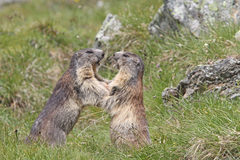


Completed


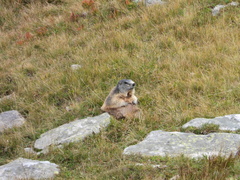

Alpine Marmot
Marmota marmota
Silhouette: T. Michael Keesey · PhyloPic
- KingdomAnimalia (Animals)
- PhylumChordata (Chordates)
- ClassMammalia (Mammals)
- OrderRodentia (Rodents)
- FamilySciuridae (Squirrels)
- GenusMarmota (Marmots)
- SpeciesMarmota marmota (Alpine Marmot)
In 3 days ~70% in a week >90%
33 Verified sightings at Triglav National Park From 2019 to 2026
2,125 In all 9 parks
June Best month
☀️ Diurnal When it's spotted

Completed
About the Alpine Marmot
The alpine marmot (Marmota marmota) is a large ground-dwelling squirrel, from the genus of marmots. It is found in high numbers in mountainous areas of central and southern Europe, at heights between 800 and 3,200 m (2,600–10,500 ft) in the Alps, Carpathians, Tatras and Northern Apennines. In 1948 they were reintroduced with success in the Pyrenees, where the alpine marmot had disappeared at end of the Pleistocene epoch.
The alpine marmot originates as an animal of Pleistocene cold steppe, exquisitely adapted to this ice-age climate. As such, alpine marmots are excellent diggers, able to penetrate soil that even a pickaxe would have difficulty with, and spend up to nine months per year in hibernation.
Since the disappearance of the Pleistocene cold steppe, the alpine marmot persists in the high altitude alpine meadow. During the colonisation of Alpine habitat, the alpine marmot has lost most of its genetic diversity through a bottleneck effect. It could not rebuild its genetic diversity ever since, as its lifestyle adapted to the Ice Age climate slowed its rate of genomic evolution. The alpine marmot is one of the least genetically diverse wild-living animals.
��2... Wikipedia →
Recent sightings of Alpine Marmot in Triglav National Park
LIVEiNaturalistGlobal Distribution
Parks Where Found
| # | Park | Country | Daily sighting probability |
|---|---|---|---|
| 1 | Vanoise National Park | 🇫🇷 France | |
| 2 | Hohe Tauern National Park | 🇦🇹 Austria | |
| 3 | Mercantour National Park | 🇫🇷 France | |
| 4 | Ecrins National Park | 🇫🇷 France | |
| 5 | Ordesa y Monte Perdido National Park | 🇪🇸 Spain | |
| 6 | Aigüestortes National Park | 🇪🇸 Spain | |
| 7 | Pyrénées National Park | 🇫🇷 France | |
| 8 | Tatra National Park | 🇸🇰 Slovakia | |
| 9 | Triglav National Park | 🇸🇮 Slovenia |
Zoos & Centres Where Found
Closest Relatives at Triglav National Park




Before you go
What are the chances of seeing an Alpine Marmot in Triglav National Park?
Likely
About 40% of wildlife watchers report an Alpine Marmot sighting in Triglav National Park on a given day, based on 33 verified sightings from GBIF citizen-science data from 2019 to 2026. It is the 5th most-seen of the 12 mammals we can rate there. Over three days the chance rises to about 70%, and over a week to over 90%, if each day is a fresh chance.
When is the best time to see an Alpine Marmot in Triglav National Park?
June to September
In those months about 40% of wildlife watchers report an Alpine Marmot in Triglav National Park on a given day, against under 5% in March–April and October, the lowest months.
What time of day is best to see an Alpine Marmot?
Between 1 and 4 pm
Across all the parks we cover, that three-hour window holds the most Alpine Marmot sightings with a recorded time, and about 9 in 10 of them come between 6 am and 6 pm: it is a daytime animal.
Is Triglav National Park the best place to see an Alpine Marmot?
9th of 9
Of the 9 parks where we can rate Alpine Marmot sightings, Triglav National Park ranks 9th at about 40%. The best odds are in Vanoise National Park (France, about 90%), Hohe Tauern National Park (Austria, about 90%) and Mercantour National Park (France, about 80%). All parks ranked.
Where does the Alpine Marmot sighting chance come from?
GBIF citizen-science records
It is estimated from how often the Alpine Marmot is recorded against all the mammals logged in Triglav National Park (33 verified sightings from 2019 to 2026), calibrated against known sighting rates. Figures are rounded to the nearest 10% because citizen-science data supports honest approximations, not decimals, and months with records from fewer than five people show "—". How it works.
