Lesser Horseshoe Bat

Lesser Horseshoe Bat

Rhinolophus hipposideros

Silhouette: Margot Michaud · PhyloPic

LCLeast ConcernNTVUENCR
Daily sighting probability ~10% · With luck
at Triglav National Park

In 3 days ~30% in a week ~50%

13 Verified sightings at Triglav National Park From 2019 to 2026
207 In all 5 parks
September Best month
☀️🌙 Day & Night When it's spotted

About the Lesser Horseshoe Bat

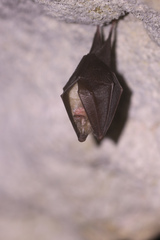
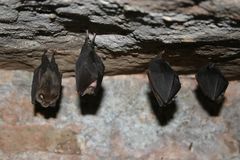
The lesser horseshoe bat (Rhinolophus hipposideros) is a type of small European and North African insectivorous bat, related to its larger cousin, the greater horseshoe bat. As with all horseshoe bats, the species gets its name from its distinctive horseshoe-shaped noseleaf.

The lesser horseshoe bat is one of the world's smallest bats, weighing only 5 to 9 grams (0.18 to 0.32 oz), with a wingspan of 192–254 millimetres (7.6–10.0 in) and a body length of 35–45 millimetres (1.4–1.8 in). It has strong feet that it uses to grasp rocks and branches, and can see well in spite of its small eyes. Like most bats, lesser horseshoe bats live in colonies and hunt their prey by echolocation, emitting ultrasound from specialized round pads in their mouth.

The base of its fur, which is soft and fluffy, is light grey in colour, with dorsal side fur smoky brown and the ventral side grey, with the exception of juvenile bats which are entirely dark grey. Ears and wing membranes are a light greyish brown.

When hunting they are quick and agile, often flying within five metres of the ground while avoiding contact with bushes and shrubs. The lesser horseshoe bat eats small insects... Wikipedia →

Sounds

Echolocation0:29

France · 2019

© Olivier SWIFT, Ludivine DELAMARE · XC1104195 · CC BY-NC-SA 4.0

Recording0:12

Portugal · 2021

© neilfletcher · iNaturalist · CC BY-NC 4.0

Recording0:48

Germany · 2026

© Stefan Gey · iNaturalist · CC BY-NC 4.0

Global Distribution

Parks Where Found

# Park Country Daily sighting probability
1 Cévennes National Park 🇫🇷 France
~20%
2 Mercantour National Park 🇫🇷 France
~20%
3 Triglav National Park 🇸🇮 Slovenia
~10%
4 Pyrénées National Park 🇫🇷 France
~10%
5 Snowdonia National Park 🇬🇧 United Kingdom
~10%

Zoos & Centres Where Found

# Zoo / Centre Country
1 Cotswold Wildlife Park 🇬🇧 United Kingdom In captivity

Before you go

What are the chances of seeing a Lesser Horseshoe Bat in Triglav National Park?

With luck

About 10% of wildlife watchers report a Lesser Horseshoe Bat sighting in Triglav National Park on a given day, based on 13 verified sightings from GBIF citizen-science data from 2019 to 2026. It is the 12th most-seen of the 12 mammals we can rate there. Over three days the chance rises to about 30%, and over a week to about 50%, if each day is a fresh chance.

When is the best time to see a Lesser Horseshoe Bat in Triglav National Park?

September

In that month about 20% of wildlife watchers report a Lesser Horseshoe Bat in Triglav National Park on a given day, against under 5% in June and November–March, the lowest months.

What time of day is best to see a Lesser Horseshoe Bat?

Between 1 and 4 pm

Across all the parks we cover, that three-hour window holds the most Lesser Horseshoe Bat sightings with a recorded time, and about 6 in 10 of them come between 6 am and 6 pm: it is seen both by day and at night.

Is Triglav National Park the best place to see a Lesser Horseshoe Bat?

3rd of 5

Of the 5 parks where we can rate Lesser Horseshoe Bat sightings, Triglav National Park ranks 3rd at about 10%. The best odds are in Cévennes National Park (France, about 20%) and Mercantour National Park (France, about 20%).

Where does the Lesser Horseshoe Bat sighting chance come from?

GBIF citizen-science records

It is estimated from how often the Lesser Horseshoe Bat is recorded against all the mammals logged in Triglav National Park (13 verified sightings from 2019 to 2026), calibrated against known sighting rates. Figures are rounded to the nearest 10% because citizen-science data supports honest approximations, not decimals, and months with records from fewer than five people show "—". How it works.

← Back to Triglav National Park