Mountain Bumble Bee

Mountain Bumble Bee

Bombus monticola

Daily sighting probability ~10% · With luck
at Triglav National Park

In 3 days ~20% in a week ~50%

7 Verified sightings at Triglav National Park From 2019 to 2026
143 In all 5 parks
June Best month
☀️ Diurnal When it's spotted

About the Mountain Bumble Bee

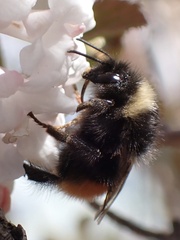
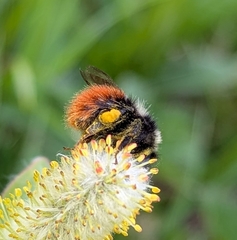
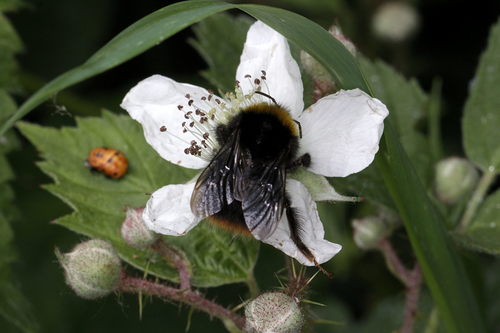
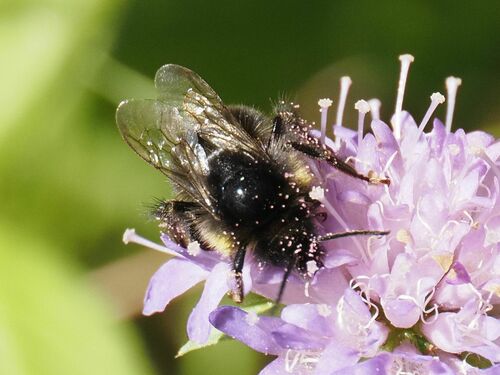
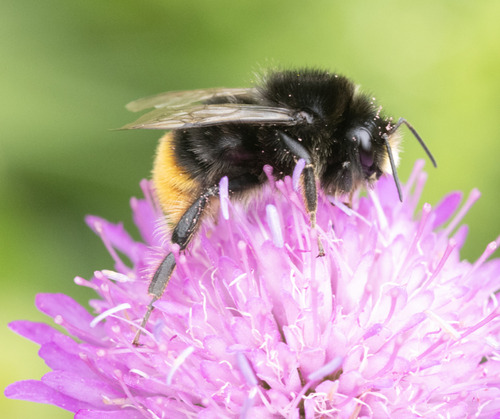
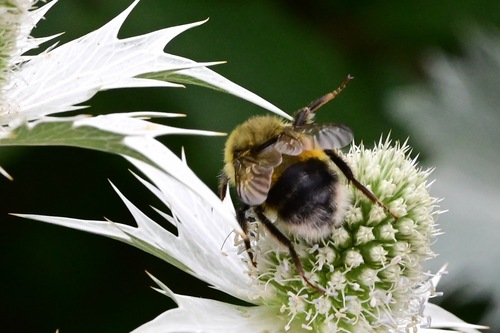
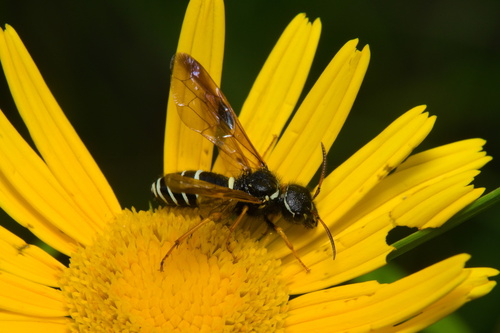
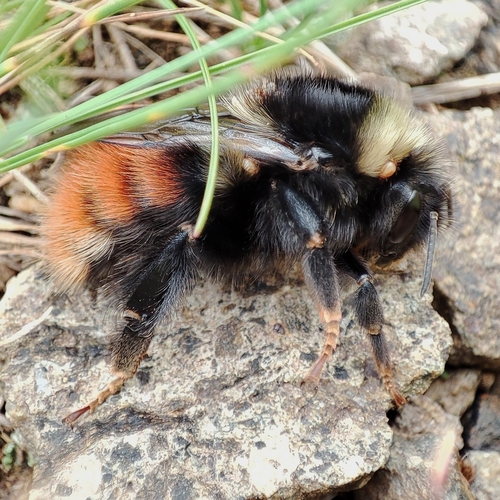
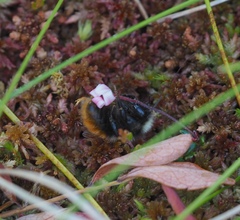
Bombus monticola, the bilberry bumblebee, blaeberry bumblebee or mountain bumblebee, is a species of bumblebee found in Europe. The bilberry bumblebee is rather small and compact, with a broad head and a short tongue. The queens have an average length of 16 mm (0.63 in), and a wingspan of 32 mm (1.3 in). The corresponding lengths of the other castes are 12 mm (0.47 in) (worker) and 14 mm (0.55 in) (male). In the nominate subspecies, the thorax is black, with the exception of a yellow collar (quite broad on the males) and on the edge of the scutellum. The first, and the frontal part of the second terga (abdominal segments) are black, as is the final tergite, but the rest of the abdomen is yellow to red.

The bumblebee is normally a highland species, often found on bilberry, cranberry, and cowberry (Vaccinium vitis-idaea). It is a pollen storer; it actively feeds the larvae from a central pollen storage, rather than providing each larval cell with its own pollen container. It nests underground in the abandoned nesting burrows of small mammals, the relatively small nests frequently house less than 50 workers and their life cycle is 3–4 months. In Great... Wikipedia →
Global Distribution

Parks Where Found

# Park Country Daily sighting probability
1 Cairngorms National Park 🇬🇧 United Kingdom
~30%
2 Hohe Tauern National Park 🇦🇹 Austria
~20%
3 Snowdonia National Park 🇬🇧 United Kingdom
~10%
4 Triglav National Park 🇸🇮 Slovenia
~10%
5 Pyrénées National Park 🇫🇷 France
~10%

Before you go

What are the chances of seeing a Mountain Bumble Bee in Triglav National Park?

With luck

About 10% of wildlife watchers report a Mountain Bumble Bee sighting in Triglav National Park on a given day, based on 7 verified sightings from GBIF citizen-science data from 2019 to 2026. It is the 212th most-seen of the 260 insects we can rate there. Over three days the chance rises to about 20%, and over a week to about 50%, if each day is a fresh chance.

When is the best time to see a Mountain Bumble Bee in Triglav National Park?

June

In that month about 20% of wildlife watchers report a Mountain Bumble Bee in Triglav National Park on a given day, against under 5% in August to May, the lowest months.

What time of day is best to see a Mountain Bumble Bee?

Between 11 am and 2 pm

Across all the parks we cover, that three-hour window holds the most Mountain Bumble Bee sightings with a recorded time, and about 9 in 10 of them come between 6 am and 6 pm: it is a daytime animal.

Is Triglav National Park the best place to see a Mountain Bumble Bee?

4th of 5

Of the 5 parks where we can rate Mountain Bumble Bee sightings, Triglav National Park ranks 4th at about 10%. The best odds are in Cairngorms National Park (United Kingdom, about 30%), Hohe Tauern National Park (Austria, about 20%) and Snowdonia National Park (United Kingdom, about 10%).

Which relatives of the Mountain Bumble Bee live in Triglav National Park?

Same genus: Bombus

The closest relatives of the Mountain Bumble Bee that you can see in Triglav National Park (genus Bombus, Bumble Bees) are Common Carder Bumble Bee (about 20%), Early Bumble Bee (about 10%) and Broken-Belted Bumble Bee (about 10%), with each one's daily chance of a sighting.

Where does the Mountain Bumble Bee sighting chance come from?

GBIF citizen-science records

It is estimated from how often the Mountain Bumble Bee is recorded against all the insects logged in Triglav National Park (7 verified sightings from 2019 to 2026), calibrated against known sighting rates. Figures are rounded to the nearest 10% because citizen-science data supports honest approximations, not decimals, and months with records from fewer than five people show "—". How it works.

← Back to Triglav National Park