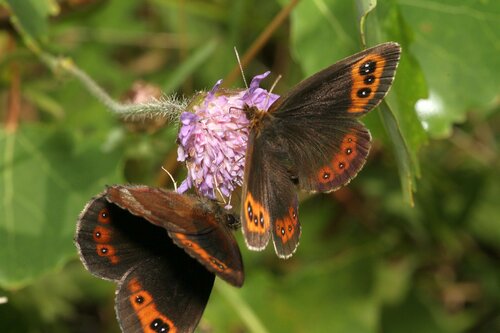
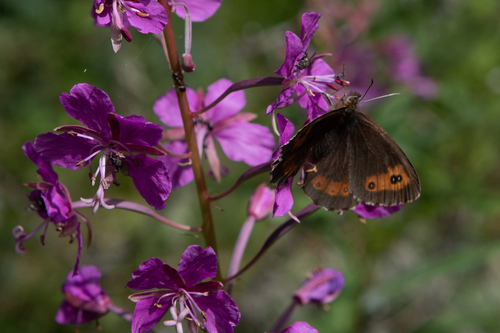
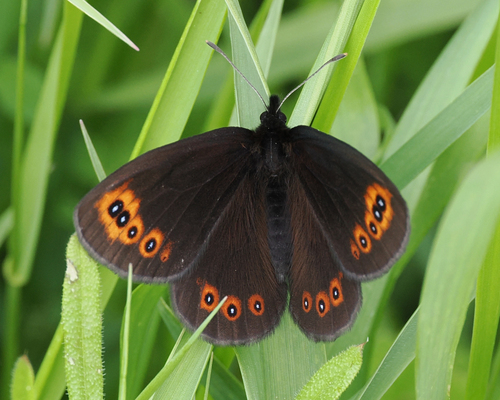
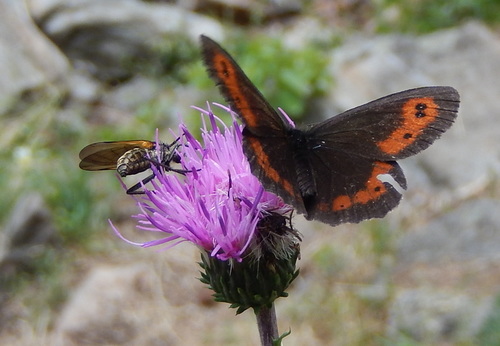
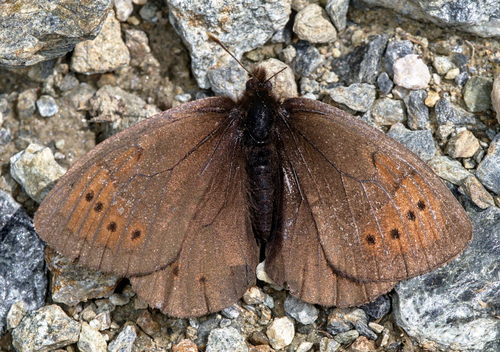
Swiss Brassy Ringlet

Swiss Brassy Ringlet

Erebia tyndarus

Daily sighting probability ~10% · With luck
at Triglav National Park

In 3 days ~30% in a week ~60%

20 Verified sightings at Triglav National Park From 2019 to 2026
218 In all 7 parks
August Best month
☀️ Diurnal When it's spotted

About the Swiss Brassy Ringlet

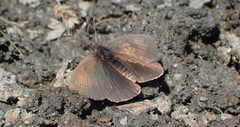
Erebia tyndarus, the Swiss brassy ringlet, is a European brush-footed butterfly species of the subfamily Satyrinae. The Swiss brassy ringlet belongs to the brassy ringlet group of its genus Erebia. These are found in taiga and alpine habitat across Eurasia, with one population in comparatively recent times colonizing North America. The brassy ringlet group, like many Erebia, has a complicated taxonomy, with scores of "variants" having been named in the late 19th and early 20th century. Most of these in fact were simply aberrations, local or seasonal forms. As this was realized, the brassy ringlets of the Alps and Pyrenees were united in E. tyndarus, either as a superspecies or as a species.

In recent times, this question has been restudied, including the DNA sequence data available nowadays. The view that only a single species of this non-migratory butterfly with restricted habitat preferences occurs in far-flung localities like the Sierra Nevada of southern Spain or the Julian Alps of Slovenia is generally considered obsolete.

Rather, it seems that quite a few proper species are involved. The Swiss brassy ringlet in particular is part of a... Wikipedia →
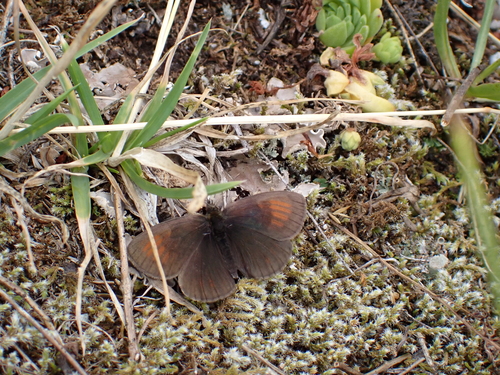
Global Distribution

Parks Where Found

# Park Country Daily sighting probability
1 Aigüestortes National Park 🇪🇸 Spain
~20%
2 Sierra Nevada National Park 🇪🇸 Spain
~10%
3 Pyrénées National Park 🇫🇷 France
~10%
4 Triglav National Park 🇸🇮 Slovenia
~10%
5 Rocky Mountain National Park 🇺🇸 United States
~10%
6 Cévennes National Park 🇫🇷 France
~10%
7 Yellowstone National Park 🇺🇸 United States
<5%

Before you go

What are the chances of seeing a Swiss Brassy Ringlet in Triglav National Park?

With luck

About 10% of wildlife watchers report a Swiss Brassy Ringlet sighting in Triglav National Park on a given day, based on 20 verified sightings from GBIF citizen-science data from 2019 to 2026. It is the 155th most-seen of the 260 insects we can rate there. Over three days the chance rises to about 30%, and over a week to about 60%, if each day is a fresh chance.

When is the best time to see a Swiss Brassy Ringlet in Triglav National Park?

July and August

In those months about 20% of wildlife watchers report a Swiss Brassy Ringlet in Triglav National Park on a given day, against under 5% in September to June, the lowest months.

What time of day is best to see a Swiss Brassy Ringlet?

Between 11 am and 2 pm

Across all the parks we cover, that three-hour window holds the most Swiss Brassy Ringlet sightings with a recorded time, and about 9 in 10 of them come between 6 am and 6 pm: it is a daytime animal.

Which relatives of the Swiss Brassy Ringlet live in Triglav National Park?

Same genus: Erebia

The closest relatives of the Swiss Brassy Ringlet that you can see in Triglav National Park (genus Erebia, Alpines) are Scotch Argus (about 30%), Arran Brown (about 20%) and Woodland Ringlet (about 20%), with each one's daily chance of a sighting.

Where does the Swiss Brassy Ringlet sighting chance come from?

GBIF citizen-science records

It is estimated from how often the Swiss Brassy Ringlet is recorded against all the insects logged in Triglav National Park (20 verified sightings from 2019 to 2026), calibrated against known sighting rates. Figures are rounded to the nearest 10% because citizen-science data supports honest approximations, not decimals, and months with records from fewer than five people show "—". How it works.

← Back to Triglav National Park