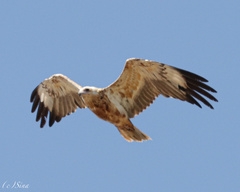
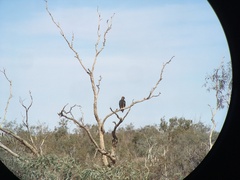
Black-breasted Kite

Black-breasted Kite

Hamirostra melanosternon

Silhouette: Sheatherius · PhyloPic

LCLeast ConcernNTVUENCR Endemic
Daily sighting probability ~10% · With luck
at Uluru-Kata Tjuta National Park

In 3 days ~40% in a week ~70%

66 Verified sightings at Uluru-Kata Tjuta National Park From 2019 to 2026
135 In all 2 parks
April Best month
☀️ Diurnal When it's spotted

About the Black-breasted Kite

The black-breasted buzzard (Hamirostra melanosternon) is a large raptor endemic to mainland Australia. First described by John Gould in 1841, it forms part of the family Accipitridae (hawks and eagles) and is most closely related to the square-tailed kite (Lophoictinia isura). It is a versatile hunter known for its special skill in cracking eggs. The species is common throughout most of its range.

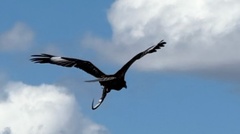
Intermediate in body size between the well-known larger wedge-tailed eagle (Aquila audax) and the smaller little eagle (Hieraaetus morphnoides), the black-breasted buzzard is one of Australia's largest birds of prey and one of the world's largest kites alongside the red kite, which is slightly less heavy but has a longer total length. An adult black-breasted buzzard measures 51 to 61 cm (20 to 24 in) in height including its short square tail. The buzzard's outstretched wingspan measures 141 to 156 cm (4 ft 8 in to 5 ft 1 in), rendering the bird distinctive in flight as its wings are conspicuously long relative to its stout body and tail. Buzzards appear sexually monomorphic (identical in physical appearance), although the adult female is slightly larger, weighing approximately... Wikipedia →

Global Distribution

Parks Where Found

# Park Country Daily sighting probability
1 Uluru-Kata Tjuta National Park 🇦🇺 Australia
~10%
2 Kakadu National Park 🇦🇺 Australia
<5%

Zoos & Centres Where Found

# Zoo / Centre Country
1 Territory Wildlife Park 🇦🇺 Australia In captivity
2 Alice Springs Desert Park 🇦🇺 Australia In captivity
3 Healesville Sanctuary 🇦🇺 Australia In captivity
4 Currumbin Wildlife Sanctuary 🇦🇺 Australia In captivity
5 Sydney Zoo 🇦🇺 Australia In captivity
6 Adelaide Zoo 🇦🇺 Australia In captivity
7 Gorge Wildlife Park 🇦🇺 Australia In captivity
8 Featherdale Sydney Wildlife Park 🇦🇺 Australia In captivity
9 Wild Life Sydney 🇦🇺 Australia In captivity
10 Caversham Wildlife Park 🇦🇺 Australia In captivity
11 Kangaroo Island Wildlife Park 🇦🇺 Australia In captivity

Before you go

What are the chances of seeing a Black-breasted Kite in Uluru-Kata Tjuta National Park?

With luck

About 10% of wildlife watchers report a Black-breasted Kite sighting in Uluru-Kata Tjuta National Park on a given day, based on 66 verified sightings from GBIF citizen-science data from 2019 to 2026. It is the 33rd most-seen of the 84 birds we can rate there. Over three days the chance rises to about 40%, and over a week to about 70%, if each day is a fresh chance.

When is the best time to see a Black-breasted Kite in Uluru-Kata Tjuta National Park?

April

In that month about 30% of wildlife watchers report a Black-breasted Kite in Uluru-Kata Tjuta National Park on a given day, against under 5% in October, the lowest month. That is one of Uluru-Kata Tjuta National Park's driest months, with about 10 mm of rain against 65 mm in January.

What time of day is best to see a Black-breasted Kite?

Between 10 am and 1 pm

Across all the parks we cover, that three-hour window holds the most Black-breasted Kite sightings with a recorded time, and about 9 in 10 of them come between 6 am and 6 pm: it is a daytime animal.

Is Uluru-Kata Tjuta National Park the best place to see a Black-breasted Kite?

Yes

Of the 2 parks where we can rate Black-breasted Kite sightings, Uluru-Kata Tjuta National Park has the highest daily chance: about 10%. Next come Kakadu National Park (Australia, under 5%).

Where does the Black-breasted Kite sighting chance come from?

GBIF citizen-science records

It is estimated from how often the Black-breasted Kite is recorded against all the birds logged in Uluru-Kata Tjuta National Park (66 verified sightings from 2019 to 2026), calibrated against known sighting rates. Figures are rounded to the nearest 10% because citizen-science data supports honest approximations, not decimals, and months with records from fewer than five people show "—". How it works.

← Back to Uluru-Kata Tjuta National Park