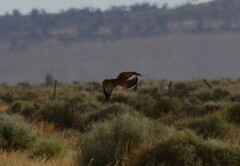
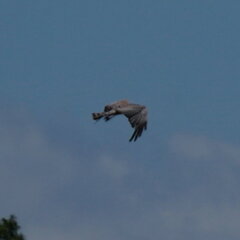
Spotted Harrier

Spotted Harrier

Circus assimilis

Silhouette: Shyamal · PhyloPic

LCLeast ConcernNTVUENCR
Daily sighting probability <5% · Rare
at Uluru-Kata Tjuta National Park

In 3 days ~10% in a week ~20%

8 Verified sightings at Uluru-Kata Tjuta National Park From 2019 to 2026
90 In all 4 parks
February Best month
☀️ Diurnal When it's spotted

About the Spotted Harrier

The spotted harrier (Circus assimilis) also known as the smoke hawk, is a large Australasian bird of prey belonging to the family Accipitridae. The spotted harrier belongs to the family Accipitridae. Accipitridae is the largest family in the order Accipitriformes and encompasses many of the diurnal birds of prey including hawks and eagles. It is one of the largest avian families with 233 species in 67 genera included in the family worldwide.

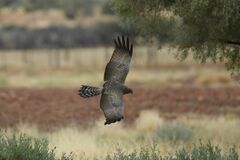
The spotted harrier is a medium-sized, slender bird of prey with adult females reaching 58–61 cm. Both adults and juvenile birds have an owl-like facial ruff that creates the appearance of a short, broad head as well as long yellow legs. The spotted harrier's wings feature prominent black tips and the tail is prominently barred and slightly wedge shaped.

Adult males are much smaller than the females only growing to 50–55 cm. Adult birds have blue to grey upper parts with a chestnut face and underparts that feature numerous white spots. Juvenile birds in their first year of life are mostly a dark brown and buff on their upperparts with pale buff underparts that feature brown streaks across the chest and stomach... Wikipedia →

Sounds

Call0:38

Indonesia · 2014

© Frank Lambert · XC194155 · CC BY-NC-ND 4.0

Global Distribution

Parks Where Found

# Park Country Daily sighting probability
1 Ningaloo Marine Park 🇦🇺 Australia
~10%
2 Cape Range 🇦🇺 Australia
~10%
3 Uluru-Kata Tjuta National Park 🇦🇺 Australia
<5%
4 Hattah-Kulkyne National Park 🇦🇺 Australia
<5%

Cities Where Found

# City Country Daily sighting probability
1 Brisbane 🇦🇺 Australia
<5%
2 Perth 🇦🇺 Australia
<5%

Zoos & Centres Where Found

# Zoo / Centre Country
1 Kangaroo Island Wildlife Park 🇦🇺 Australia In captivity

Before you go

What are the chances of seeing a Spotted Harrier in Uluru-Kata Tjuta National Park?

Rare

Under 5% of wildlife watchers report a Spotted Harrier sighting in Uluru-Kata Tjuta National Park on a given day, based on 8 verified sightings from GBIF citizen-science data from 2019 to 2026. It is the 69th most-seen of the 84 birds we can rate there. Over three days the chance rises to about 10%, and over a week to about 20%, if each day is a fresh chance.

When is the best time to see a Spotted Harrier in Uluru-Kata Tjuta National Park?

January–February and September

In those months about 10% of wildlife watchers report a Spotted Harrier in Uluru-Kata Tjuta National Park on a given day, against under 5% in March–August and October–December, the lowest months. Those are among Uluru-Kata Tjuta National Park's wettest months, with about 30 mm of rain a month against almost none in July.

What time of day is best to see a Spotted Harrier?

Between 8 and 11 am

Across all the parks we cover, that three-hour window holds the most Spotted Harrier sightings with a recorded time, and about 9 in 10 of them come between 6 am and 6 pm: it is a daytime animal.

Is Uluru-Kata Tjuta National Park the best place to see a Spotted Harrier?

3rd of 4

Of the 4 parks where we can rate Spotted Harrier sightings, Uluru-Kata Tjuta National Park ranks 3rd at under 5%. The best odds are in Ningaloo Marine Park (Australia, about 10%) and Cape Range (Australia, about 10%).

Where does the Spotted Harrier sighting chance come from?

GBIF citizen-science records

It is estimated from how often the Spotted Harrier is recorded against all the birds logged in Uluru-Kata Tjuta National Park (8 verified sightings from 2019 to 2026), calibrated against known sighting rates. Figures are rounded to the nearest 10% because citizen-science data supports honest approximations, not decimals, and months with records from fewer than five people show "—". How it works.

← Back to Uluru-Kata Tjuta National Park