Dromedary Camel

Dromedary Camel

Camelus dromedarius

Silhouette: Steven Traver · PhyloPic

Daily sighting probability ~30% · Possible
at Uluru-Kata Tjuta National Park

In 3 days ~70% in a week ~90%

16 Verified sightings at Uluru-Kata Tjuta National Park From 2019 to 2026
16 In 1 park
May Best month
☀️ Diurnal When it's spotted

About the Dromedary Camel

The dromedary (Camelus dromedarius), also known as the dromedary camel, Arabian camel and one-humped camel, is a large camel of the genus Camelus with one hump on its back. It is the tallest of the three camel species; adult males stand 1.8–2.4 m (5.9–7.9 ft) at the shoulder, while females are 1.7–1.9 m (5.6–6.2 ft) tall. Males typically weigh between 400 and 690 kg (880 and 1,520 lb), and females weigh between 300 and 540 kg (660 and 1,190 lb).

The dromedary's distinctive features include its long, curved neck, narrow chest, a single hump, and long hairs on the throat, shoulders, and hump. The coat is generally a shade of brown. The hump is 20 cm (7.9 in) tall or more, and is made of fat bound together by fibrous tissue.

The dromedary feeds on foliage and desert vegetation; several adaptations, such as the ability to tolerate losing more than 30% of its total water content, allow it to thrive in its desert habitat. Mating occurs annually and peaks in the rainy season; females bear a single calf after a gestation of 15 months. It is mainly active during daylight hours and forms herds of about 20 individuals, which are led by a dominant male.

The dromedary has not occurred naturally in the wild for nearly 2,000 years. It was probably first domesticated in the Arabian Peninsula about 4,000 years ago. In the wild, the dromedary inhabited arid regions, including the Sahara. The domesticated dromedary is kept in the semiarid to arid regions of the Old World, mainly in Africa, the Arabian Peninsula and the Thar desert in Pakistan and India. A feral population occurs in Australia. Products of the dromedary, including its meat and milk, support several North African tribes; it is also commonly used for riding and as a pack animal. Wikipedia →

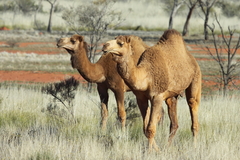
Sounds

Call0:24

Morocco · 2011

© Lars Lachmann · XC1045382 · CC BY-NC-SA 4.0

Global Distribution

Parks Where Found

# Park Country Daily sighting probability
1 Uluru-Kata Tjuta National Park 🇦🇺 Australia
~30%

More parks will be added in future updates.

Zoos & Centres Where Found

# Zoo / Centre Country
1 Busch Gardens Tampa 🇺🇸 United States In captivity
2 San Diego Zoo 🇺🇸 United States In captivity
3 Pairi Daiza 🇧🇪 Belgium In captivity
4 Yangon Zoological Gardens 🇲🇲 Myanmar (Burma) In captivity
5 ZooParc de Beauval 🇫🇷 France In captivity
6 Tierpark Berlin 🇩🇪 Germany In captivity
7 Cleveland Metroparks Zoo 🇺🇸 United States In captivity
8 California Academy of Sciences 🇺🇸 United States In captivity
9 Australia Zoo 🇦🇺 Australia In captivity
10 Cabarceno Natural Park 🇪🇸 Spain In captivity
11 Melaka Zoo and Bird Park 🇲🇾 Malaysia In captivity
12 Réserve africaine de Sigean 🇫🇷 France In captivity
13 Olomouc Zoo 🇨🇿 Czechia In captivity
14 Abilene Zoological Gardens 🇺🇸 United States In captivity
15 Zoobotánico Jerez 🇪🇸 Spain In captivity
16 Taronga Western Plains Zoo 🇦🇺 Australia In captivity
17 Vinpearl Safari 🇻🇳 Vietnam In captivity
18 Bioparque Estrella 🇲🇽 Mexico In captivity
19 Zoo Miami 🇺🇸 United States In captivity
20 Mohamed bin Zayed Nature Reserve 🇧🇭 Bahrain In captivity
21 San Diego Zoo Safari Park 🇺🇸 United States In captivity
22 Werribee Open Range Zoo 🇦🇺 Australia In captivity
23 Taman Safari Indonesia 🇮🇩 Indonesia In captivity
24 Al Ain Zoo 🇦🇪 United Arab Emirates In captivity
25 Safaripark Beekse Bergen 🇳🇱 Netherlands In captivity
26 Ponderosa Adventure Park 🇨🇷 Costa Rica In captivity
27 Toronto Zoo 🇨🇦 Canada In captivity
28 Taman Safari Bogor 🇮🇩 Indonesia In captivity
29 Taipei Zoo 🇹🇼 Taiwan In captivity
30 Global Wildlife Center 🇺🇸 United States In captivity
31 La Reserva del Castillo de las Guardas 🇪🇸 Spain In captivity
32 Living Desert Zoo and Gardens 🇺🇸 United States In captivity
33 Jallo Park 🇵🇰 Pakistan In captivity
34 Serengeti Park 🇩🇪 Germany In captivity
35 Columbus Zoo and Aquarium 🇺🇸 United States In captivity
36 Grant's Farm 🇺🇸 United States In captivity
37 Bronx Zoo 🇺🇸 United States In captivity
38 Wildlife Safari 🇺🇸 United States In captivity
39 Khao Kheow Open Zoo 🇹🇭 Thailand In captivity
40 Longleat Safari and Adventure Park 🇬🇧 United Kingdom In captivity
41 Kansas City Zoo 🇺🇸 United States In captivity
42 Planète Sauvage 🇫🇷 France In captivity
43 Ecological Center of Sonora 🇲🇽 Mexico In captivity
44 Zoofari 🇲🇽 Mexico In captivity
45 Virginia Safari Park 🇺🇸 United States In captivity
46 Parc zoologique de Montpellier 🇫🇷 France In captivity
47 Safari Madrid 🇪🇸 Spain In captivity
48 Sedgwick County Zoo 🇺🇸 United States In captivity
49 Parque y Zoológico Nacional Arquitecto Manuel Valverde Podestá 🇩🇴 Dominican Republic In captivity
50 Zoo Gdańsk 🇵🇱 Poland In captivity

Closest Relatives at Uluru-Kata Tjuta National Park

No species of the same family or order lives in Uluru-Kata Tjuta National Park, so these are its closest relatives here: other mammals.

Before you go

What are the chances of seeing a Dromedary Camel in Uluru-Kata Tjuta National Park?

Possible

About 30% of wildlife watchers report a Dromedary Camel sighting in Uluru-Kata Tjuta National Park on a given day, based on 16 verified sightings from GBIF citizen-science data from 2019 to 2026. Over three days the chance rises to about 70%, and over a week to about 90%, if each day is a fresh chance.

When is the best time to see a Dromedary Camel in Uluru-Kata Tjuta National Park?

May

In that month about 50% of wildlife watchers report a Dromedary Camel in Uluru-Kata Tjuta National Park on a given day, against under 5% in February, April, September and December, the lowest months.

What time of day is best to see a Dromedary Camel?

Between 1 and 4 pm

Across all the parks we cover, that three-hour window holds the most Dromedary Camel sightings with a recorded time, and about 9 in 10 of them come between 6 am and 6 pm: it is a daytime animal.

Where else can you see a Dromedary Camel?

Only Uluru-Kata Tjuta National Park, in our data

Uluru-Kata Tjuta National Park is the only park on Wallace's Line with enough records to rate Dromedary Camel sightings: about 30% of wildlife watchers there report one on a given day.

Where does the Dromedary Camel sighting chance come from?

GBIF citizen-science records

It is estimated from how often the Dromedary Camel is recorded against all the mammals logged in Uluru-Kata Tjuta National Park (16 verified sightings from 2019 to 2026), calibrated against known sighting rates. Figures are rounded to the nearest 10% because citizen-science data supports honest approximations, not decimals, and months with records from fewer than five people show "—". How it works.

← Back to Uluru-Kata Tjuta National Park