Inland Thornbill

Inland Thornbill

Acanthiza apicalis

Silhouette: Matt Wilkins (photo by Patrick Kavanagh) · PhyloPic

LCLeast ConcernNTVUENCR Endemic
Daily sighting probability ~10% · With luck
at Uluru-Kata Tjuta National Park

In 3 days ~20% in a week ~50%

37 Verified sightings at Uluru-Kata Tjuta National Park From 2019 to 2026
666 In all 3 parks
September Best month
🌅 Crepuscular When it's spotted

About the Inland Thornbill

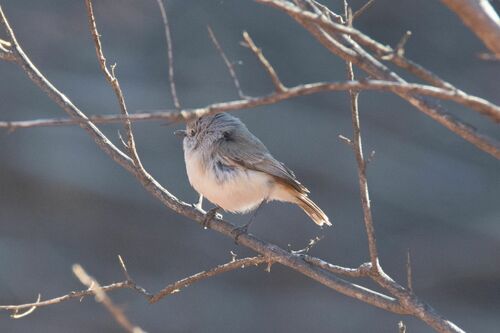
The inland thornbill (Acanthiza apicalis) was originally described by English ornithologist John Gould in The Birds of Australia. Inland thornbills are within the order passerines. The inland thornbill belongs to the genus Acanthiza, which now has three more species than the eleven outlined by Gould in The Birds of Australia. The Noongar people of southwestern Western Australia call A. apicalis "Djoobi-Djoolbang". The inland thornbill is also known as the broad-tail thornbill and presently contains several subspecies that were once considered independent species. The word apicalis comes from the Latin for 'tipped'.

Early classification of the Acanthiza, or thornbill genus, was inconsistent with the currently accepted taxonomy. Historically, researchers recognised 10 -17 species in 1 – 3 genera. Separate traditional species of Thornbill have now been more accurately classified as subspecies than discrete species; however, the evolutionary relationships between inland thornbills and other Acanthizae are complicated. For example, the relationship between the inland thornbill and the brown thornbill (A. pusilla) and the mountain thornbill (A. katherina) is... Wikipedia →

Sounds

Call0:21

Australia · 2021

© Marc Anderson · XC1071032 · CC BY-NC-ND 4.0

Song0:22

Australia · 2025

© Niall Perrins · XC992519 · CC BY-NC-SA 4.0

Call0:32

Australia · 2021

© Drew Davison · XC638377 · CC BY-NC-SA 4.0

Global Distribution

Parks Where Found

# Park Country Daily sighting probability
1 Flinders Ranges National Park 🇦🇺 Australia
~60%
2 Hattah-Kulkyne National Park 🇦🇺 Australia
~20%
3 Uluru-Kata Tjuta National Park 🇦🇺 Australia
~10%

Cities Where Found

# City Country Daily sighting probability
1 Perth 🇦🇺 Australia
<5%

Before you go

What are the chances of seeing an Inland Thornbill in Uluru-Kata Tjuta National Park?

With luck

About 10% of wildlife watchers report an Inland Thornbill sighting in Uluru-Kata Tjuta National Park on a given day, based on 37 verified sightings from GBIF citizen-science data from 2019 to 2026. It is the 48th most-seen of the 84 birds we can rate there. Over three days the chance rises to about 20%, and over a week to about 50%, if each day is a fresh chance.

When is the best time to see an Inland Thornbill in Uluru-Kata Tjuta National Park?

September

In that month about 20% of wildlife watchers report an Inland Thornbill in Uluru-Kata Tjuta National Park on a given day, against under 5% in January, August and November, the lowest months.

What time of day is best to see an Inland Thornbill?

Between 3 and 6 am

Across all the parks we cover, that three-hour window holds the most Inland Thornbill sightings with a recorded time, and about 6 in 10 of them come between 6 pm and 6 am: it is most active around dawn and dusk.

Is Uluru-Kata Tjuta National Park the best place to see an Inland Thornbill?

3rd of 3

Of the 3 parks where we can rate Inland Thornbill sightings, Uluru-Kata Tjuta National Park ranks 3rd at about 10%. The best odds are in Flinders Ranges National Park (Australia, about 60%) and Hattah-Kulkyne National Park (Australia, about 20%).

Where does the Inland Thornbill sighting chance come from?

GBIF citizen-science records

It is estimated from how often the Inland Thornbill is recorded against all the birds logged in Uluru-Kata Tjuta National Park (37 verified sightings from 2019 to 2026), calibrated against known sighting rates. Figures are rounded to the nearest 10% because citizen-science data supports honest approximations, not decimals, and months with records from fewer than five people show "—". How it works.

← Back to Uluru-Kata Tjuta National Park