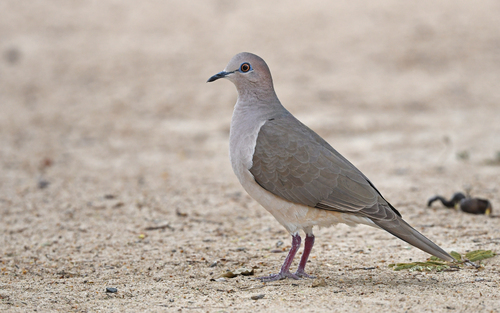
Maroon-chested Ground-dove

Maroon-chested Ground-dove

Claravis mondetoura

Silhouette: Sheatherius · PhyloPic

Daily sighting probability ~10% · With luck
at Volcán Barú National Park

In 3 days ~20% in a week ~40%

144 Verified sightings at Volcán Barú National Park From 2019 to 2026
471 In all 5 parks
November Best month
☀️ Diurnal When it's spotted

About the Maroon-chested Ground-dove

The maroon-chested ground dove (Paraclaravis mondetoura) is a species of bird in the family Columbidae. It is native to the American Cordillera of Central and South America. The maroon-chested ground dove was originally placed in genus Claravis but a 2018 publication created the current genus Paraclaravis for it and the purple-winged ground dove (P. geoffroyi). The International Ornithological Committee (IOC) and Howard and Moore taxonomies treat it as monotypic. However, the Clements taxonomy and the Handbook of the Birds of the World ascribe these six subspecies to it:

The Cornell Lab of Ornithology's Birds of the World account cautions that some of the subspecies were described from very small samples and may reflect individual, not subspecific, variation. Males of the maroon-chested ground dove are 18 to 24 cm (7.1 to 9.4 in) long and females

19 to 22 cm (7.5 to 8.7 in). Both sexes weigh between 89... Wikipedia →

Sounds

Recording

© Manuel Espejo · XCXC883388 · CC BY-NC-SA 4.0

Recording

© Alberto Peña · XCXC703052 · CC BY-NC-SA 4.0

Recording

© Alfonso Auerbach · XCXC432246 · CC BY-NC-SA 4.0

Global Distribution

Parks Where Found

# Park Country Daily sighting probability
1 Irazú Volcano National Park 🇨🇷 Costa Rica
~20%
2 Volcán Barú National Park 🇵🇦 Panama
~10%
3 La Amistad International Park (Panama) 🇵🇦 Panama
<5%
4 Los Quetzales National Park 🇨🇷 Costa Rica
<5%
5 Tapantí-Macizo de la Muerte National Park 🇨🇷 Costa Rica
<5%

Before you go

What are the chances of seeing a Maroon-chested Ground-dove in Volcán Barú National Park?

With luck

About 10% of wildlife watchers report a Maroon-chested Ground-dove sighting in Volcán Barú National Park on a given day, based on 144 verified sightings from GBIF citizen-science data from 2019 to 2026. It is the 117th most-seen of the 296 birds we can rate there. Over three days the chance rises to about 20%, and over a week to about 40%, if each day is a fresh chance.

When is the best time to see a Maroon-chested Ground-dove in Volcán Barú National Park?

August and November

In those months about 20% of wildlife watchers report a Maroon-chested Ground-dove in Volcán Barú National Park on a given day, against under 5% in May and December–January, the lowest months.

What time of day is best to see a Maroon-chested Ground-dove?

Between 8 and 11 am

Across all the parks we cover, that three-hour window holds the most Maroon-chested Ground-dove sightings with a recorded time, and about 8 in 10 of them come between 6 am and 6 pm: it is a daytime animal.

Is Volcán Barú National Park the best place to see a Maroon-chested Ground-dove?

2nd of 5

Of the 5 parks where we can rate Maroon-chested Ground-dove sightings, Volcán Barú National Park ranks 2nd at about 10%. The best odds are in Irazú Volcano National Park (Costa Rica, about 20%).

Where does the Maroon-chested Ground-dove sighting chance come from?

GBIF citizen-science records

It is estimated from how often the Maroon-chested Ground-dove is recorded against all the birds logged in Volcán Barú National Park (144 verified sightings from 2019 to 2026), calibrated against known sighting rates. Figures are rounded to the nearest 10% because citizen-science data supports honest approximations, not decimals, and months with records from fewer than five people show "—". How it works.
← Back to Volcán Barú National Park