White-tailed Emerald

White-tailed Emerald

Microchera chionura

Silhouette: Andy Wilson · PhyloPic

LCLeast ConcernNTVUENCR
Daily sighting probability ~10% · With luck
at Volcán Barú National Park

In 3 days ~20% in a week ~40%

109 Verified sightings at Volcán Barú National Park From 2019 to 2026
1,182 In all 5 parks
May Best month
☀️ Diurnal When it's spotted

About the White-tailed Emerald

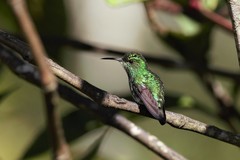
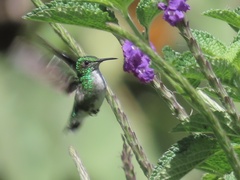
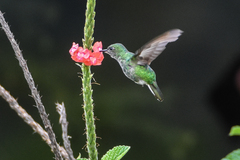
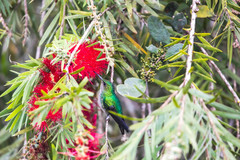
The white-tailed emerald (Microchera chionura) is a species of hummingbird in the "emeralds", tribe Trochilini of subfamily Trochilinae. It is native to the Talamancan montane forests. The white-tailed emerald was formerly placed with the coppery-headed emerald in the genus Elvira. A molecular phylogenetic study published in 2014 found that these two species were closely related to the snowcap in the then-monospecific genus Microchera. The International Ornithological Committee and the Clements taxonomy placed the three species together in Microchera which has priority. However, BirdLife International's Handbook of the Birds of the World retains them in Elvira.

The white-tailed emerald is monotypic. The white-tailed emerald is 7.5 to 8 cm (3.0 to 3.1 in) long. Males weigh about 3.3 g (0.12 oz) and females 3.1 g (0.11 oz). Both sexes have an almost straight black bill whose mandible has a pinkish base. The adult male has bronzy green upperparts that becomes dark copper-bronze on the uppertail coverts. Its central two pairs of tail feathers are copper-bronze and the other three pairs white with black tips. It has a glittering green throat... Wikipedia →

Sounds

Call0:36

Costa Rica · 2016

© Frank T Spooner · XC362253 · CC BY-NC-SA 4.0

Global Distribution

Parks Where Found

# Park Country Daily sighting probability
1 Chirripó National Park 🇨🇷 Costa Rica
~30%
2 Volcán Barú National Park 🇵🇦 Panama
~10%
3 La Amistad International Park (Panama) 🇵🇦 Panama
~10%
4 Los Quetzales National Park 🇨🇷 Costa Rica
<5%
5 Tapantí-Macizo de la Muerte National Park 🇨🇷 Costa Rica
<5%

Before you go

What are the chances of seeing a White-tailed Emerald in Volcán Barú National Park?

With luck

About 10% of wildlife watchers report a White-tailed Emerald sighting in Volcán Barú National Park on a given day, based on 109 verified sightings from GBIF citizen-science data from 2019 to 2026. It is the 129th most-seen of the 296 birds we can rate there. Over three days the chance rises to about 20%, and over a week to about 40%, if each day is a fresh chance.

When is the best time to see a White-tailed Emerald in Volcán Barú National Park?

January–March and May–August

In those months about 10% of wildlife watchers report a White-tailed Emerald in Volcán Barú National Park on a given day, against under 5% in April and September–December, the lowest months.

What time of day is best to see a White-tailed Emerald?

Between 8 and 11 am

Across all the parks we cover, that three-hour window holds the most White-tailed Emerald sightings with a recorded time, and about 9 in 10 of them come between 6 am and 6 pm: it is a daytime animal.

Is Volcán Barú National Park the best place to see a White-tailed Emerald?

2nd of 5

Of the 5 parks where we can rate White-tailed Emerald sightings, Volcán Barú National Park ranks 2nd at about 10%. The best odds are in Chirripó National Park (Costa Rica, about 30%).

Which relatives of the White-tailed Emerald live in Volcán Barú National Park?

Same family: Trochilidae

The closest relatives of the White-tailed Emerald that you can see in Volcán Barú National Park (family Trochilidae, Hummingbirds) are White-throated Mountain-gem (about 70%), Lesser Violetear (about 60%) and Scintillant Hummingbird (about 50%), with each one's daily chance of a sighting.

Where does the White-tailed Emerald sighting chance come from?

GBIF citizen-science records

It is estimated from how often the White-tailed Emerald is recorded against all the birds logged in Volcán Barú National Park (109 verified sightings from 2019 to 2026), calibrated against known sighting rates. Figures are rounded to the nearest 10% because citizen-science data supports honest approximations, not decimals, and months with records from fewer than five people show "—". How it works.

← Back to Volcán Barú National Park