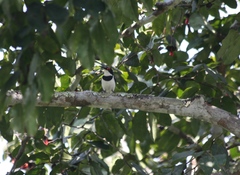
Brown-throated Wattle-eye

Brown-throated Wattle-eye

Platysteira cyanea

Silhouette: Sheatherius · PhyloPic

LCLeast ConcernNTVUENCR
Daily sighting probability <5% · Rare
at Volcanoes National Park

In 3 days ~10%

8 Verified sightings at Volcanoes National Park From 2019 to 2026
2,527 In all 13 parks
March Best month
☀️ Diurnal When it's spotted

About the Brown-throated Wattle-eye

The brown-throated wattle-eye (Platysteira cyanea), also known as the common wattle-eye or scarlet-spectacled wattle-eye, is a small, insectivorous passerine bird. The wattle-eyes were previously classed as a subfamily of the Old World flycatcher family Muscicapidae, but are now usually separated from that group.

This species breeds in west, central and northeast tropical Africa. This common species is found in secondary forest and other woodland areas, including gardens. The eggs are laid in a small neat lichen and cobweb cup low in a tree or bush.

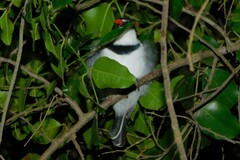
The adult brown-throated wattle-eye is a stout bird about 14 cm (5.5 in) long. The breeding male has glossy black upperparts, and white underparts with a neat black breast band. There is a strong white wingbar, and fleshy red wattles above the eye.

The females are grey-black above, and also have the white wing bar and red wattles. There is a small patch of white below the bill, and the throat and breast are maroon, separated from the white belly by the black breast band. Young males are washed-out, greyer versions of the female.

These active insect-eating birds are found in pairs or small groups. The ringing call of the brown-throated wattle-eye is a very characteristic six note doo-dd-dum-di-do-do. Wikipedia →

Sounds

Song0:48

Senegal · 2026

© Peter Boesman · XC1081339 · CC BY-NC-ND 4.0

Call0:57

Tanzania · 2021

© Abdulrahman Adam · XC666375 · CC BY-NC-SA 4.0

Song0:46

Gabon · 2024

© Paul Lenrumé · XC927173 · CC BY-NC-SA 4.0

Global Distribution

Parks Where Found

# Park Country Daily sighting probability
1 Kibale National Park 🇺🇬 Uganda
~40%
2 Bwindi Impenetrable National Park 🇺🇬 Uganda
~30%
3 Niokolo-Koba National Park 🇸🇳 Senegal
~30%
4 Queen Elizabeth National Park 🇺🇬 Uganda
~20%
5 Murchison Falls National Park 🇺🇬 Uganda
~10%
6 Virunga National Park 🇨🇩 Democratic Republic of the Congo
~10%
7 Lake Mburo National Park 🇺🇬 Uganda
~10%
8 Masai Mara National Reserve 🇰🇪 Kenya
~10%
9 Nyungwe National Park 🇷🇼 Rwanda
~10%
10 Akagera National Park 🇷🇼 Rwanda
<5%
11 Semuliki National Park 🇺🇬 Uganda
<5%
12 Volcanoes National Park 🇷🇼 Rwanda
<5%
13 Serengeti National Park 🇹🇿 Tanzania
<5%

Cities Where Found

# City Country Daily sighting probability
1 Yaoundé 🇨🇲 Cameroon
~30%
2 Brazzaville 🇨🇬 Republic of the Congo
~20%
3 Abuja 🇳🇬 Nigeria
~20%
4 Kampala 🇺🇬 Uganda
~10%
5 Serrekunda 🇬🇲 Gambia
~10%
6 Freetown 🇸🇱 Sierra Leone
~10%
7 Lagos 🇳🇬 Nigeria
~10%
8 Monrovia 🇱🇷 Liberia
~10%
9 Accra 🇬🇭 Ghana
<5%
10 Kigali 🇷🇼 Rwanda
<5%

Before you go

What are the chances of seeing a Brown-throated Wattle-eye in Volcanoes National Park?

Rare

Under 5% of wildlife watchers report a Brown-throated Wattle-eye sighting in Volcanoes National Park on a given day, based on 8 verified sightings from GBIF citizen-science data from 2019 to 2026. It is the 130th most-seen of the 156 birds we can rate there. Over three days the chance rises to about 10%, if each day is a fresh chance.

When is the best time to see a Brown-throated Wattle-eye in Volcanoes National Park?

March

In that month about 10% of wildlife watchers report a Brown-throated Wattle-eye in Volcanoes National Park on a given day, against under 5% in April to February, the lowest months.

What time of day is best to see a Brown-throated Wattle-eye?

Between 1 and 4 pm

Across all the parks we cover, that three-hour window holds the most Brown-throated Wattle-eye sightings with a recorded time, and about 9 in 10 of them come between 6 am and 6 pm: it is a daytime animal.

Which relatives of the Brown-throated Wattle-eye live in Volcanoes National Park?

Same family: Platysteiridae

The closest relatives of the Brown-throated Wattle-eye that you can see in Volcanoes National Park (family Platysteiridae, Wattle-eyes and Batises) are Rwenzori Batis (about 30%) and Chinspot Batis (about 10%), with each one's daily chance of a sighting.

Where does the Brown-throated Wattle-eye sighting chance come from?

GBIF citizen-science records

It is estimated from how often the Brown-throated Wattle-eye is recorded against all the birds logged in Volcanoes National Park (8 verified sightings from 2019 to 2026), calibrated against known sighting rates. Figures are rounded to the nearest 10% because citizen-science data supports honest approximations, not decimals, and months with records from fewer than five people show "—". How it works.

← Back to Volcanoes National Park