Lagden's Bushshrike

Lagden's Bushshrike

Malaconotus lagdeni

Silhouette: Sheatherius · PhyloPic

LCNTNear ThreatenedVUENCR
Daily sighting probability <5% · Rare
at Volcanoes National Park

In 3 days ~10% in a week ~20%

12 Verified sightings at Volcanoes National Park From 2019 to 2026
166 In all 4 parks
September Best month
☀️🌙 Day & Night When it's spotted

About the Lagden's Bushshrike

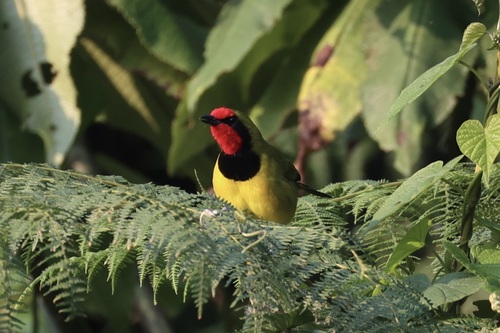
Lagden's bushshrike (Malaconotus lagdeni) is a bird species in the bushshrike family (Malaconotidae) native to Africa. It is a stocky bird with yellow or orange-yellow underparts, olive green upperparts, a grey head and heavy bill. Two subspecies are recognised.

Richard Bowdler Sharpe described the species in 1884 as Laniarius lagdeni, from a specimen collected in the vicinity of Kumasi in Ghana. However there were no further sightings of the species in this locale for the whole 20th century. He named it in honour of Sir Godfrey Yeatman Lagden, an English diplomat who served as Chief Clerk to the Secretary of the State of Transvaal and Secretary to Sir Owen Lanyon.

There are two disjunct populations, classified as separate subspecies: Malaconotus lagdeni lagdeni, from eastern Sierra Leone, through Liberia, Ivory Coast and southern Ghana to western Togo, and Malaconotus lagdeni centralis, in the Albertine Rift montane forests. The western subspecies has more orange tinge on the underparts while the central African subspecies has none.

Lagden's bushshrike is a stocky bird some 23 cm long with a heavy black bill. The adult male and female are similar... Wikipedia →


Sounds

Song0:17

Ivory Coast · 1990

© Nature sounds by Simply Birding · XC651044 · CC BY-NC-ND 4.0

Global Distribution

Parks Where Found

# Park Country Daily sighting probability
1 Bwindi Impenetrable National Park 🇺🇬 Uganda
<5%
2 Nyungwe National Park 🇷🇼 Rwanda
<5%
3 Volcanoes National Park 🇷🇼 Rwanda
<5%
4 Virunga National Park 🇨🇩 Democratic Republic of the Congo
<5%

Before you go

What are the chances of seeing a Lagden's Bushshrike in Volcanoes National Park?

Rare

Under 5% of wildlife watchers report a Lagden's Bushshrike sighting in Volcanoes National Park on a given day, based on 12 verified sightings from GBIF citizen-science data from 2019 to 2026. It is the 112th most-seen of the 156 birds we can rate there. Over three days the chance rises to about 10%, and over a week to about 20%, if each day is a fresh chance.

When is the best time to see a Lagden's Bushshrike in Volcanoes National Park?

September

In that month about 20% of wildlife watchers report a Lagden's Bushshrike in Volcanoes National Park on a given day, against under 5% in October to August, the lowest months.

What time of day is best to see a Lagden's Bushshrike?

Between midnight and 3 am

Across all the parks we cover, that three-hour window holds the most Lagden's Bushshrike sightings with a recorded time, and about 7 in 10 of them come between 6 am and 6 pm: it is seen both by day and at night.

Is Volcanoes National Park the best place to see a Lagden's Bushshrike?

Among the best

Of the 4 parks where we can rate Lagden's Bushshrike sightings, Volcanoes National Park ranks 3rd at under 5%, level with the leaders once rounded. The best odds are in Bwindi Impenetrable National Park (Uganda, under 5%) and Nyungwe National Park (Rwanda, under 5%).

Which relatives of the Lagden's Bushshrike live in Volcanoes National Park?

Same family: Malaconotidae

The closest relatives of the Lagden's Bushshrike that you can see in Volcanoes National Park (family Malaconotidae, Bushshrikes and Allies) are Tropical Boubou (about 30%), Northern Puffback (about 20%) and Doherty's Bushshrike (about 20%), with each one's daily chance of a sighting.

Where does the Lagden's Bushshrike sighting chance come from?

GBIF citizen-science records

It is estimated from how often the Lagden's Bushshrike is recorded against all the birds logged in Volcanoes National Park (12 verified sightings from 2019 to 2026), calibrated against known sighting rates. Figures are rounded to the nearest 10% because citizen-science data supports honest approximations, not decimals, and months with records from fewer than five people show "—". How it works.

← Back to Volcanoes National Park