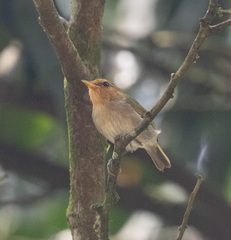
Red-faced Woodland-Warbler

Red-faced Woodland-Warbler

Phylloscopus laetus

Silhouette: Jiekun He · PhyloPic

LCLeast ConcernNTVUENCR
Daily sighting probability ~20% · Possible
at Volcanoes National Park

In 3 days ~50% in a week ~80%

106 Verified sightings at Volcanoes National Park From 2019 to 2026
1,418 In all 4 parks
July Best month
☀️ Diurnal When it's spotted

About the Red-faced Woodland-Warbler

The red-faced woodland warbler (Phylloscopus laetus) is a species of leaf warbler in the family Phylloscopidae. It forms a superspecies with the closely related yellow-throated woodland warbler and the Laura's woodland warbler.

It is endemic to the Albertine Rift montane forests. Two subspecies are recognised, the nominate P. l. laetus ranges from Western Uganda and eastern Democratic Republic of the Congo (the Ruwenzori Mountains), south through SW Uganda, western Rwanda and western Burundi. The second subspecies, P. l. schoutedeni, has a more restricted range, being confined to Mt. Kabobo in eastern DRC. It is one of several species known as Albertine Rift Valley endemics. Overall the species has a total range of 77,000 square kilometres (29000 sq mi). Its natural habitat is highland forest between 1200–3100 m, especially in bamboo; it also occurs in areas of secondary forest.

The red-faced woodland warbler is a medium-sized (11 cm) warbler with a distinctive reddish face, which is richer on P. l. schoutedeni. Overall the rest of the plumage is greenish above with a paler off-white belly and rump.

Little is known about the breeding biology of this species. Two or three eggs are laid in a ball nest suspended in a tangle of vines in shrubs and trees (up to 10 m above the ground). Both parents care for the young. Red-faced woodland warblers feed on insects and other invertebrates, particularly bugs, beetles and spiders. They hunt in pairs and will sometimes join small feeding flocks.

The red-faced woodland warbler is not considered threatened by human activities. It has a small worldwide range but is relatively common where it occurs. It is classified as least concern by the IUCN. Wikipedia →

Sounds

Song0:31

Burundi · 2025

© Bram Piot · XC1021972 · CC BY-NC-SA 4.0

Call0:20

Rwanda · 2014

© Pritam Baruah · XC194621 · CC BY-NC-SA 4.0

Song0:13

Uganda · 2022

© Peter Boesman · XC739906 · CC BY-NC-ND 4.0

Global Distribution

Parks Where Found

# Park Country Daily sighting probability
1 Nyungwe National Park 🇷🇼 Rwanda
~40%
2 Bwindi Impenetrable National Park 🇺🇬 Uganda
~30%
3 Volcanoes National Park 🇷🇼 Rwanda
~20%
4 Virunga National Park 🇨🇩 Democratic Republic of the Congo
~10%

Before you go

What are the chances of seeing a Red-faced Woodland-Warbler in Volcanoes National Park?

Possible

About 20% of wildlife watchers report a Red-faced Woodland-Warbler sighting in Volcanoes National Park on a given day, based on 106 verified sightings from GBIF citizen-science data from 2019 to 2026. It is the 52nd most-seen of the 156 birds we can rate there. Over three days the chance rises to about 50%, and over a week to about 80%, if each day is a fresh chance.

When is the best time to see a Red-faced Woodland-Warbler in Volcanoes National Park?

July

In that month about 40% of wildlife watchers report a Red-faced Woodland-Warbler in Volcanoes National Park on a given day, against about 10% in March–May and October–December, the lowest months. That is one of Volcanoes National Park's driest months, with about 20 mm of rain against 250 mm in April.

What time of day is best to see a Red-faced Woodland-Warbler?

Between 8 and 11 am

Across all the parks we cover, that three-hour window holds the most Red-faced Woodland-Warbler sightings with a recorded time, and about 9 in 10 of them come between 6 am and 6 pm: it is a daytime animal.

Is Volcanoes National Park the best place to see a Red-faced Woodland-Warbler?

3rd of 4

Of the 4 parks where we can rate Red-faced Woodland-Warbler sightings, Volcanoes National Park ranks 3rd at about 20%. The best odds are in Nyungwe National Park (Rwanda, about 40%) and Bwindi Impenetrable National Park (Uganda, about 30%).

Where does the Red-faced Woodland-Warbler sighting chance come from?

GBIF citizen-science records

It is estimated from how often the Red-faced Woodland-Warbler is recorded against all the birds logged in Volcanoes National Park (106 verified sightings from 2019 to 2026), calibrated against known sighting rates. Figures are rounded to the nearest 10% because citizen-science data supports honest approximations, not decimals, and months with records from fewer than five people show "—". How it works.

← Back to Volcanoes National Park