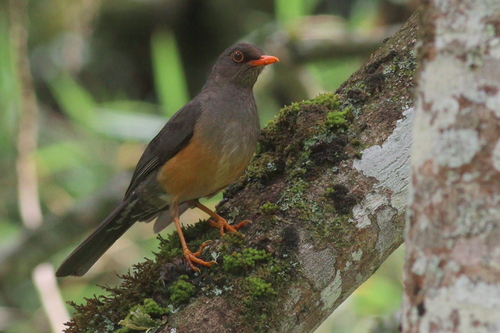
Ruwenzori Hill Babbler

Ruwenzori Hill Babbler

Pseudoalcippe atriceps

LCLeast ConcernNTVUENCR
Daily sighting probability ~20% · Possible
at Volcanoes National Park

In 3 days ~60% in a week ~90%

124 Verified sightings at Volcanoes National Park From 2019 to 2026
971 In all 4 parks
July Best month

About the Ruwenzori Hill Babbler

The Rwenzori hill babbler (Sylvia atriceps) is a species of passerine bird in the family Sylviidae that is found in Africa. The Rwenzori hill babbler was described by the English zoologist Richard Bowdler Sharpe in 1902 and given the binomial name Turdinus atriceps. The type locality is the Rwenzori Mountains on the border between Uganda and the Democratic Republic of the Congo. The specific epithet atriceps is from the Latin ater for "black" and -ceps for "capped" or "headed". The Rwenzori hill babbler was formerly considered to be a conspecific with the African hill babbler. The species is monotypic. Wikipedia →

Sounds

Song0:30

Uganda · 2022

© Peter Boesman · XC739959 · CC BY-NC-ND 4.0

Song0:23

Uganda · 2015

© Martin St-Michel · XC234728 · CC BY-NC-SA 4.0

Song1:00

Congo (Democratic Republic) · 2012

© Josh Engel · XC105605 · CC BY-NC-ND 2.5

Global Distribution

Parks Where Found

# Park Country Daily sighting probability
1 Nyungwe National Park 🇷🇼 Rwanda
~30%
2 Volcanoes National Park 🇷🇼 Rwanda
~20%
3 Bwindi Impenetrable National Park 🇺🇬 Uganda
~20%
4 Virunga National Park 🇨🇩 Democratic Republic of the Congo
~20%

Before you go

What are the chances of seeing a Ruwenzori Hill Babbler in Volcanoes National Park?

Possible

About 20% of wildlife watchers report a Ruwenzori Hill Babbler sighting in Volcanoes National Park on a given day, based on 124 verified sightings from GBIF citizen-science data from 2019 to 2026. It is the 43rd most-seen of the 156 birds we can rate there. Over three days the chance rises to about 60%, and over a week to about 90%, if each day is a fresh chance.

When is the best time to see a Ruwenzori Hill Babbler in Volcanoes National Park?

June to August

In those months about 40% of wildlife watchers report a Ruwenzori Hill Babbler in Volcanoes National Park on a given day, against about 10% in March–April and October–November, the lowest months. Those are among Volcanoes National Park's driest months, with about 45 mm of rain a month against 250 mm in April.

Is Volcanoes National Park the best place to see a Ruwenzori Hill Babbler?

2nd of 4

Of the 4 parks where we can rate Ruwenzori Hill Babbler sightings, Volcanoes National Park ranks 2nd at about 20%. The best odds are in Nyungwe National Park (Rwanda, about 30%).

Which relatives of the Ruwenzori Hill Babbler live in Volcanoes National Park?

Same order: Passeriformes

The closest relatives of the Ruwenzori Hill Babbler that you can see in Volcanoes National Park (order Passeriformes, Perching Birds) are Streaky Seedeater (about 90%), Chubb's Cisticola (about 80%) and Common Bulbul (about 70%), with each one's daily chance of a sighting.

Where does the Ruwenzori Hill Babbler sighting chance come from?

GBIF citizen-science records

It is estimated from how often the Ruwenzori Hill Babbler is recorded against all the birds logged in Volcanoes National Park (124 verified sightings from 2019 to 2026), calibrated against known sighting rates. Figures are rounded to the nearest 10% because citizen-science data supports honest approximations, not decimals, and months with records from fewer than five people show "—". How it works.

← Back to Volcanoes National Park