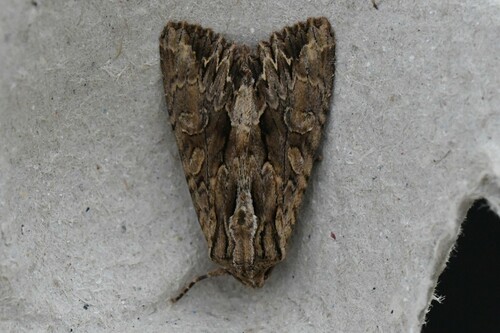
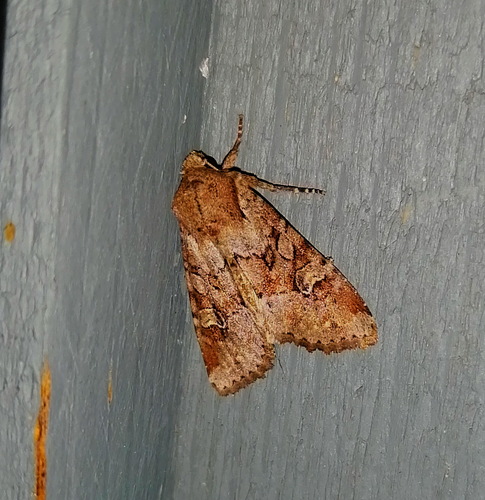
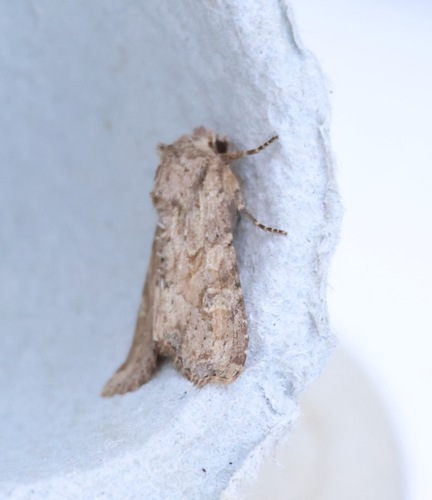
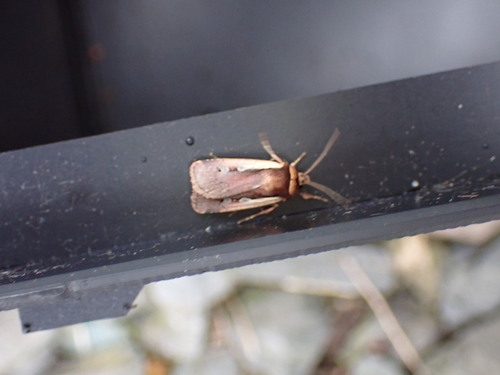
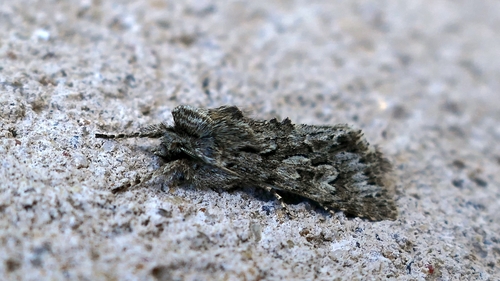
Clouded-Bordered Brindle

Clouded-Bordered Brindle

Apamea crenata

Daily sighting probability <5% · Rare
at Wadden Sea National Park

In 3 days ~10% in a week ~20%

9 Verified sightings at Wadden Sea National Park From 2019 to 2026
32 In all 3 parks
June Best month
☀️🌙 Day & Night When it's spotted

About the Clouded-Bordered Brindle

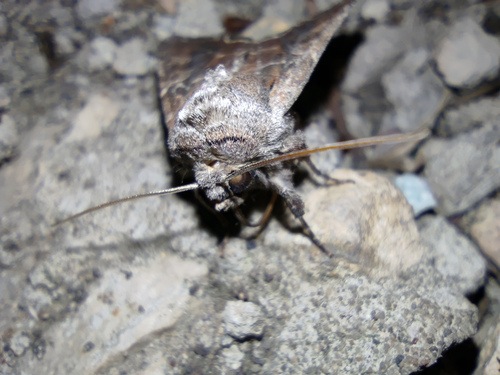
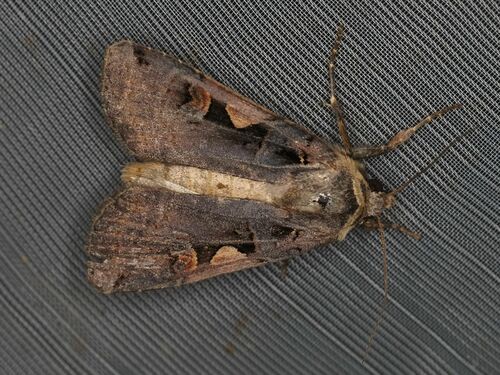
Apamea crenata, known as the clouded-bordered brindle, is a moth in the family Noctuidae. It is distributed throughout the Palearctic realm. In the North it crosses the Arctic Circle, in the Mediterranean it is found only in cool locations and mountains avoiding very hot areas. In the Alps, it rises to an altitude of about 2000 metres.

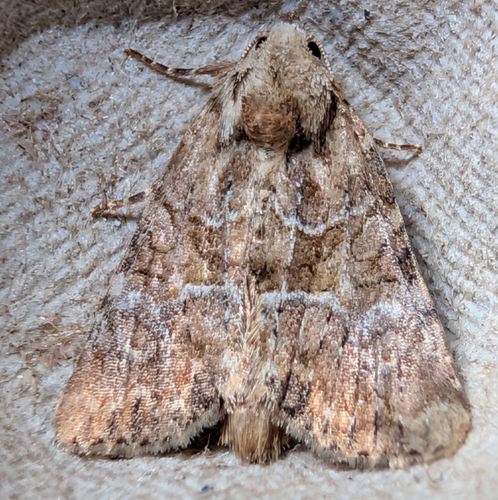
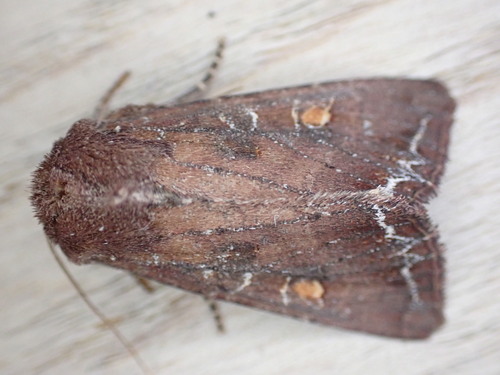
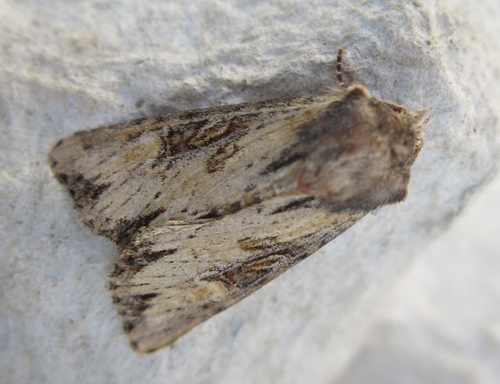
This species has a wingspan of 36 to 44 mm. The forewings are pale brown with darker patches along the margins, usually with prominent markings at the base and tornus. The hindwings are grayish with darker venation. Melanic forms occur fairly frequently.

Forewing pale lilac grey, often washed with pale brownish; the veins paler: costal area tinged with purplish grey; inner margin with white, and with a strong black streak near base: inner and outer lines double, brownish, the outer followed by a double row of dark brown vein dots with a white dot between; claviform stigma brown, with darker outline; orbicular generally elongate and narrow, sometimes shortened and rounder, with centre brown as in reniform and pale outline, the outer half of the reniform paler than the inner, and the lower... Wikipedia →
Global Distribution

Parks Where Found

# Park Country Daily sighting probability
1 Snowdonia National Park 🇬🇧 United Kingdom
~10%
2 Cairngorms National Park 🇬🇧 United Kingdom
~10%
3 Wadden Sea National Park 🇩🇪 Germany
<5%

Cities Where Found

# City Country Daily sighting probability
1 Liverpool 🇬🇧 United Kingdom
~10%
2 Manchester 🇬🇧 United Kingdom
~10%
3 Moscow 🇷🇺 Russia
<5%

Before you go

What are the chances of seeing a Clouded-Bordered Brindle in Wadden Sea National Park?

Rare

Under 5% of wildlife watchers report a Clouded-Bordered Brindle sighting in Wadden Sea National Park on a given day, based on 9 verified sightings from GBIF citizen-science data from 2019 to 2026. It is the 536th most-seen of the 818 insects we can rate there. Over three days the chance rises to about 10%, and over a week to about 20%, if each day is a fresh chance.

When is the best time to see a Clouded-Bordered Brindle in Wadden Sea National Park?

June

In that month about 10% of wildlife watchers report a Clouded-Bordered Brindle in Wadden Sea National Park on a given day, against under 5% in July to May, the lowest months.

What time of day is best to see a Clouded-Bordered Brindle?

Between 6 and 9 am

Across all the parks we cover, that three-hour window holds the most Clouded-Bordered Brindle sightings with a recorded time, and about 6 in 10 of them come between 6 am and 6 pm: it is seen both by day and at night.

Is Wadden Sea National Park the best place to see a Clouded-Bordered Brindle?

3rd of 3

Of the 3 parks where we can rate Clouded-Bordered Brindle sightings, Wadden Sea National Park ranks 3rd at under 5%. The best odds are in Snowdonia National Park (United Kingdom, about 10%) and Cairngorms National Park (United Kingdom, about 10%).

Which relatives of the Clouded-Bordered Brindle live in Wadden Sea National Park?

Same genus: Apamea

The closest relatives of the Clouded-Bordered Brindle that you can see in Wadden Sea National Park (genus Apamea) are Dark Arches (about 10%) and Bordered Apamea Moth (about 10%), with each one's daily chance of a sighting.

Where does the Clouded-Bordered Brindle sighting chance come from?

GBIF citizen-science records

It is estimated from how often the Clouded-Bordered Brindle is recorded against all the insects logged in Wadden Sea National Park (9 verified sightings from 2019 to 2026), calibrated against known sighting rates. Figures are rounded to the nearest 10% because citizen-science data supports honest approximations, not decimals, and months with records from fewer than five people show "—". How it works.

← Back to Wadden Sea National Park