Rock Pipit

Rock Pipit

Anthus petrosus

Silhouette: Susan Murphy (original photograph), T. Michael Keesey (vectorization) · PhyloPic

LCLeast ConcernNTVUENCR
Daily sighting probability ~10% · With luck
at Wadden Sea National Park

In 3 days ~30% in a week ~60%

994 Verified sightings at Wadden Sea National Park From 2019 to 2026
1,083 In all 3 parks
October Best month
☀️ Diurnal When it's spotted

About the Rock Pipit

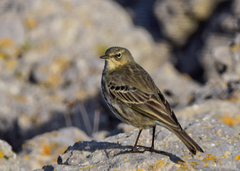
The European rock pipit (Anthus petrosus), or simply rock pipit, is a species of small passerine bird that breeds in western Europe on rocky coasts. It has streaked greyish-brown upperparts and buff underparts, and is similar in appearance to other European pipits. There are two subspecies, of which the nominate is non-migratory, and the Fennoscandian one is migratory, wintering in shoreline habitats further west and south in Europe. The European rock pipit is territorial at least in the breeding season, and year-round where it is resident. Males will sometimes enter an adjacent territory to assist the resident in repelling an intruder, behaviour only otherwise known from the African fiddler crab.

European rock pipits construct a cup nest under coastal vegetation or in cliff crevices and lay four to six speckled pale grey eggs which hatch in about two weeks with a further 16 days to fledging. Although insects are occasionally caught in flight, the pipits feed mainly on small invertebrates picked off the rocks or from shallow water.

The European rock pipit may be hunted by birds of prey, infested by parasites such as fleas, or act as an involuntary host to the common cuckoo, but overall its population is large and stable, and it is therefore evaluated as a species of least concern by the International Union for Conservation of Nature (IUCN). Wikipedia →

Sounds

Call0:36

France · 2026

© Nicolas Martinez · XC1186343 · CC BY-NC-SA 4.0

Flight call0:09

Netherlands · 2026

© Gosse Hoekstra · XC1180531 · CC BY-NC-SA 4.0

Alarm call0:23

Sweden · 2025

© Niels Krabbe · XC1002188 · CC BY-NC-SA 4.0

Global Distribution

Parks Where Found

# Park Country Daily sighting probability
1 Wadden Sea National Park 🇩🇪 Germany
~10%
2 Snowdonia National Park 🇬🇧 United Kingdom
<5%
3 Cairngorms National Park 🇬🇧 United Kingdom
<5%

Cities Where Found

# City Country Daily sighting probability
1 Dublin 🇮🇪 Ireland
~10%
2 Rotterdam [The Hague] 🇳🇱 Netherlands
<5%
3 Liverpool 🇬🇧 United Kingdom
<5%
4 Manchester 🇬🇧 United Kingdom
<5%
5 Copenhagen 🇩🇰 Denmark
<5%
6 London 🇬🇧 United Kingdom
<5%
7 Helsinki 🇫🇮 Finland
<5%
8 Prague 🇨🇿 Czechia
<5%

Before you go

What are the chances of seeing a Rock Pipit in Wadden Sea National Park?

With luck

About 10% of wildlife watchers report a Rock Pipit sighting in Wadden Sea National Park on a given day, based on 994 verified sightings from GBIF citizen-science data from 2019 to 2026. It is the 90th most-seen of the 285 birds we can rate there. Over three days the chance rises to about 30%, and over a week to about 60%, if each day is a fresh chance.

When is the best time to see a Rock Pipit in Wadden Sea National Park?

October

In that month about 30% of wildlife watchers report a Rock Pipit in Wadden Sea National Park on a given day, against under 5% in April to August, the lowest months. That is one of Wadden Sea National Park's wettest months, with about 120 mm of rain against 45 mm in April.

What time of day is best to see a Rock Pipit?

Between noon and 3 pm

Across all the parks we cover, that three-hour window holds the most Rock Pipit sightings with a recorded time, and about 9 in 10 of them come between 6 am and 6 pm: it is a daytime animal.

Is Wadden Sea National Park the best place to see a Rock Pipit?

Yes

Of the 3 parks where we can rate Rock Pipit sightings, Wadden Sea National Park has the highest daily chance: about 10%. Next come Snowdonia National Park (United Kingdom, under 5%) and Cairngorms National Park (United Kingdom, under 5%).

Where does the Rock Pipit sighting chance come from?

GBIF citizen-science records

It is estimated from how often the Rock Pipit is recorded against all the birds logged in Wadden Sea National Park (994 verified sightings from 2019 to 2026), calibrated against known sighting rates. Figures are rounded to the nearest 10% because citizen-science data supports honest approximations, not decimals, and months with records from fewer than five people show "—". How it works.

← Back to Wadden Sea National Park