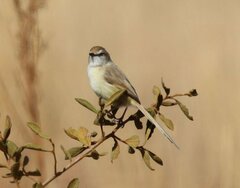
Black-chested Prinia

Black-chested Prinia

Prinia flavicans

Silhouette: Sheatherius · PhyloPic

LCLeast ConcernNTVUENCR
Daily sighting probability ~40% · Likely
at Waterberg Plateau Park

In 3 days ~80% in a week >90%

54 Verified sightings at Waterberg Plateau Park From 2019 to 2026
1,110 In all 7 parks
August Best month
☀️ Diurnal When it's spotted

About the Black-chested Prinia

The black-chested prinia (Prinia flavicans) is a species of bird in the family Cisticolidae. It is found in Angola, Botswana, Lesotho, Namibia, South Africa, Zambia, and Zimbabwe. Its natural habitat is dry savanna. Prinias are small warblers that can be distinguished from other warblers by their long tails often held in a near-vertical position. All species are sexually monomorphic. There are four species in the Prinia genus in southern Africa. The three other species are as follows: tawny-flanked prinia (Prinia subflava), Karoo prinia (Prinia maculosa), and Drakensberg prinia (Prinia hypoxantha). Of these four, the black-chested prinia is the only species that has different breeding and non-breeding plumages. The black-chested prinia is aptly named for the charcoal-colored breast band apparent in its breeding plumage.

Black-chested prinias are small, long-tailed warblers whose body sizes range from 13 to 15 centimeters. They are a pale golden-brown on their dorsal side and during the non-breeding season they have pale yellow dorsal plumage. In their alternate plumage (breeding season), they develop a black breast-band and their underparts become... Wikipedia →

Sounds

Call0:17

Namibia · 2025

© Filippo Ceccolini · XC1037330 · CC BY-NC-SA 4.0

Song0:23

South Africa · 2019

© Frank Lambert · XC516088 · CC BY-NC-ND 4.0

Alarm call0:11

South Africa · 2019

© Toby Esplin · XC453326 · CC BY-NC-SA 4.0

Global Distribution

Parks Where Found

# Park Country Daily sighting probability
1 Waterberg Plateau Park 🇳🇦 Namibia
~40%
2 Kgalagadi Transfrontier Park 🇿🇦 South Africa
~30%
3 Etosha National Park 🇳🇦 Namibia
~30%
4 Namib-Naukluft National Park 🇳🇦 Namibia
~30%
5 Pilanesberg National Park 🇿🇦 South Africa
~10%
6 Moremi Game Reserve 🇧🇼 Botswana
<5%
7 Kruger National Park 🇿🇦 South Africa
<5%

Cities Where Found

# City Country Daily sighting probability
1 Pretoria 🇿🇦 South Africa
<5%
2 Johannesburg 🇿🇦 South Africa
<5%

Before you go

What are the chances of seeing a Black-chested Prinia in Waterberg Plateau Park?

Likely

About 40% of wildlife watchers report a Black-chested Prinia sighting in Waterberg Plateau Park on a given day, based on 54 verified sightings from GBIF citizen-science data from 2019 to 2026. It is the 23rd most-seen of the 118 birds we can rate there. Over three days the chance rises to about 80%, and over a week to over 90%, if each day is a fresh chance.

When is the best time to see a Black-chested Prinia in Waterberg Plateau Park?

August

In that month about 60% of wildlife watchers report a Black-chested Prinia in Waterberg Plateau Park on a given day, against about 20% in December, the lowest month. That is one of Waterberg Plateau Park's driest months, with almost no rain against 110 mm in January. April and June have too few records to rate.

What time of day is best to see a Black-chested Prinia?

Between 8 and 11 am

Across all the parks we cover, that three-hour window holds the most Black-chested Prinia sightings with a recorded time, and about 9 in 10 of them come between 6 am and 6 pm: it is a daytime animal.

Is Waterberg Plateau Park the best place to see a Black-chested Prinia?

Yes

Of the 7 parks where we can rate Black-chested Prinia sightings, Waterberg Plateau Park has the highest daily chance: about 40%. Next come Kgalagadi Transfrontier Park (South Africa, about 30%) and Etosha National Park (Namibia, about 30%). All parks ranked.

Which relatives of the Black-chested Prinia live in Waterberg Plateau Park?

Same family: Cisticolidae

The closest relatives of the Black-chested Prinia that you can see in Waterberg Plateau Park (family Cisticolidae, Cisticolas and Allies) are Green-backed Camaroptera (about 70%), Yellow-bellied Eremomela (about 40%) and Rattling Cisticola (about 20%), with each one's daily chance of a sighting.

Where does the Black-chested Prinia sighting chance come from?

GBIF citizen-science records

It is estimated from how often the Black-chested Prinia is recorded against all the birds logged in Waterberg Plateau Park (54 verified sightings from 2019 to 2026), calibrated against known sighting rates. Figures are rounded to the nearest 10% because citizen-science data supports honest approximations, not decimals, and months with records from fewer than five people show "—". How it works.

← Back to Waterberg Plateau Park