Blue-winged Pitta

Blue-winged Pitta

Pitta moluccensis

Silhouette: PhyloPic

LCLeast ConcernNTVUENCR
Daily sighting probability <5% · Rare
at Way Kambas National Park

In 3 days ~10% in a week ~20%

9 Verified sightings at Way Kambas National Park From 2019 to 2026
730 In all 8 parks
July Best month
☀️ Diurnal When it's spotted

About the Blue-winged Pitta

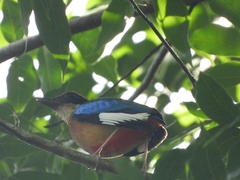
The blue-winged pitta (Pitta moluccensis) is a passerine bird in the family Pittidae. It forms a superspecies with three other pittas, the Indian pitta (P. brachyura), the fairy pitta (P. nympha) and the mangrove pitta (P. megarhyncha). A colourful bird, it has a black head with a buff stripe above the eye, a white collar, greenish upper parts, blue wings, buff underparts and a reddish vent area. Its range extends from India to Malaysia, Indonesia, southern China and the Philippines. Its habitat is moist woodland, parks and gardens and it avoids dense forest. It feeds mainly on insects and worms. It breeds in the spring, building an untidy spherical nest on the ground, often near water and between tree roots. A clutch of about five eggs is laid and incubated by both parents, hatching after about sixteen days.

The blue-winged pitta was described by the German naturalist Philipp Ludwig Statius Müller in 1776 and given the binomial name Turdus moluccensis. Statius Müller's description was based on a plate showing the "Merle des Moluques" published by Comte de Buffon in his Planches Enluminées D'Histoire Naturelle. The French name and the specific epithet moluccensis refer... Wikipedia →

Sounds

Song0:57

Vietnam · 2026

© Ding Li Yong · XC1107222 · CC BY-NC-ND 4.0

Call0:22

Thailand · 2024

© Peter Ericsson · XC897429 · CC BY-NC-SA 4.0

Song0:23

Singapore · 2025

© Joan Theng · XC1034295 · CC BY-NC-SA 4.0

Global Distribution

Parks Where Found

# Park Country Daily sighting probability
1 Cat Tien National Park 🇻🇳 Vietnam
~10%
2 Khao Sok National Park 🇹🇭 Thailand
~10%
3 Kaeng Krachan National Park 🇹🇭 Thailand
~10%
4 Way Kambas National Park 🇮🇩 Indonesia
<5%
5 Khao Luang National Park 🇹🇭 Thailand
<5%
6 Taman Negara National Park 🇲🇾 Malaysia
<5%
7 Kinabatangan Wildlife Sanctuary 🇲🇾 Malaysia
<5%
8 Khao Yai National Park 🇹🇭 Thailand
<5%

Cities Where Found

# City Country Daily sighting probability
1 Kaohsiung 🇹🇼 Taiwan
~10%
2 Kuala Lumpur 🇲🇾 Malaysia
~10%
3 Singapore 🇸🇬 Singapore
<5%
4 Phnom Penh 🇰🇭 Cambodia
<5%
5 Bangkok 🇹🇭 Thailand
<5%

Zoos & Centres Where Found

# Zoo / Centre Country
1 Walsrode World Bird Park 🇩🇪 Germany In captivity
2 Rainforest Wild Asia 🇸🇬 Singapore In captivity
3 Penang Bird Park 🇲🇾 Malaysia In captivity

Before you go

What are the chances of seeing a Blue-winged Pitta in Way Kambas National Park?

Rare

Under 5% of wildlife watchers report a Blue-winged Pitta sighting in Way Kambas National Park on a given day, based on 9 verified sightings from GBIF citizen-science data from 2019 to 2026. It is the 185th most-seen of the 205 birds we can rate there. Over three days the chance rises to about 10%, and over a week to about 20%, if each day is a fresh chance.

When is the best time to see a Blue-winged Pitta in Way Kambas National Park?

July and August

In those months about 10% of wildlife watchers report a Blue-winged Pitta in Way Kambas National Park on a given day, against under 5% in March–June and September–October, the lowest months. Those are among Way Kambas National Park's driest months, with about 110 mm of rain a month against 370 mm in March. November to February have too few records to rate.

What time of day is best to see a Blue-winged Pitta?

Between 8 and 11 am

Across all the parks we cover, that three-hour window holds the most Blue-winged Pitta sightings with a recorded time, and about 8 in 10 of them come between 6 am and 6 pm: it is a daytime animal.

Where does the Blue-winged Pitta sighting chance come from?

GBIF citizen-science records

It is estimated from how often the Blue-winged Pitta is recorded against all the birds logged in Way Kambas National Park (9 verified sightings from 2019 to 2026), calibrated against known sighting rates. Figures are rounded to the nearest 10% because citizen-science data supports honest approximations, not decimals, and months with records from fewer than five people show "—". How it works.

← Back to Way Kambas National Park