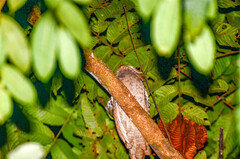
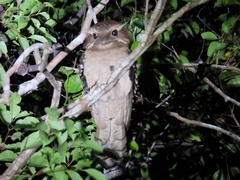
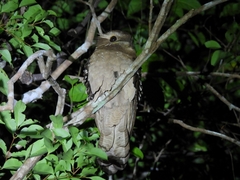
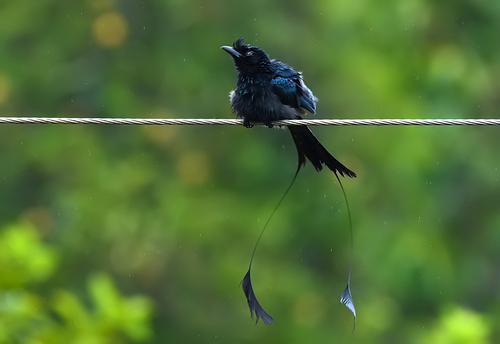
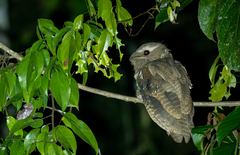
Large Frogmouth

Large Frogmouth

Batrachostomus auritus

Silhouette: Matt Wilkins · PhyloPic

LCNTVUVulnerableENCR
Daily sighting probability ~30% · Possible
at Way Kambas National Park

In 3 days ~60% in a week ~90%

84 Verified sightings at Way Kambas National Park From 2019 to 2026
398 In all 4 parks
May Best month
☀️🌙 Day & Night When it's spotted

About the Large Frogmouth

The large frogmouth (Batrachostomus auritus) is a species of bird in the family Podargidae. It is found in Brunei, Indonesia, Malaysia, and Thailand, in subtropical or tropical moist lowland forest. Logging of its habitat poses a risk to its survival, and the International Union for Conservation of Nature has listed it as a vulnerable species.

The large frogmouth is considerably larger than other members of its genus and grows to a length of about 42 cm (17 in). The sexes are similar and the colouring is rather variable, the upper parts being mainly chestnut and blackish-brown, barred and spotted with white and buff. The underparts are dull brown or pale rufous, the belly being paler than the breast. The beak is horn-coloured with a darker tip, the gape being yellow, the irises are some shade of light or dark brown, and the legs are a dull yellow.

The species occurs in Thailand, Malaysia, Indonesia and Brunei. Its range extends from southern Thailand, through Sabah, Sarawak and peninsular Malaysia to Kalimantan, Sumatra, Indonesia and Brunei. Its habitat is primary lowland forest, but it is also found in secondary forest and in areas... Wikipedia →

Sounds

Call0:17

Malaysia · 2018

© Lim Ying Hien · XC808134 · CC BY-NC-ND 4.0

Song0:40

Malaysia · 1986

© Jelle Scharringa · XC610050 · CC BY-NC-SA 4.0

Alarm call0:58

Indonesia · 2015

© Kolbjørn Schjølberg · XC244676 · CC BY-NC-SA 4.0

Global Distribution

Parks Where Found

# Park Country Daily sighting probability
1 Way Kambas National Park 🇮🇩 Indonesia
~30%
2 Kinabatangan Wildlife Sanctuary 🇲🇾 Malaysia
~10%
3 Taman Negara National Park 🇲🇾 Malaysia
<5%
4 Danum Valley Conservation Area 🇲🇾 Malaysia
<5%

Before you go

What are the chances of seeing a Large Frogmouth in Way Kambas National Park?

Possible

About 30% of wildlife watchers report a Large Frogmouth sighting in Way Kambas National Park on a given day, based on 84 verified sightings from GBIF citizen-science data from 2019 to 2026. It is the 60th most-seen of the 205 birds we can rate there. Over three days the chance rises to about 60%, and over a week to about 90%, if each day is a fresh chance.

When is the best time to see a Large Frogmouth in Way Kambas National Park?

May–July and September

In those months about 30% of wildlife watchers report a Large Frogmouth in Way Kambas National Park on a given day, against about 20% in March–April, August and October, the lowest months. November to February have too few records to rate.

What time of day is best to see a Large Frogmouth?

Between 7 and 10 pm

Across all the parks we cover, that three-hour window holds the most Large Frogmouth sightings with a recorded time, and about 6 in 10 of them come between 6 pm and 6 am: it is seen both by day and at night.

Is Way Kambas National Park the best place to see a Large Frogmouth?

Yes

Of the 4 parks where we can rate Large Frogmouth sightings, Way Kambas National Park has the highest daily chance: about 30%. Next come Kinabatangan Wildlife Sanctuary (Malaysia, about 10%) and Taman Negara National Park (Malaysia, under 5%).

Which relatives of the Large Frogmouth live in Way Kambas National Park?

Same genus: Batrachostomus

The closest relatives of the Large Frogmouth that you can see in Way Kambas National Park (genus Batrachostomus, Asian Frogmouths) are Sunda Frogmouth (about 50%) and Gould's Frogmouth (about 20%), with each one's daily chance of a sighting.

Where does the Large Frogmouth sighting chance come from?

GBIF citizen-science records

It is estimated from how often the Large Frogmouth is recorded against all the birds logged in Way Kambas National Park (84 verified sightings from 2019 to 2026), calibrated against known sighting rates. Figures are rounded to the nearest 10% because citizen-science data supports honest approximations, not decimals, and months with records from fewer than five people show "—". How it works.

← Back to Way Kambas National Park