Malaysian Nightjar

Malaysian Nightjar

Lyncornis temminckii

Silhouette: Sheatherius · PhyloPic

LCLeast ConcernNTVUENCR
Daily sighting probability ~40% · Likely
at Way Kambas National Park

In 3 days ~70% in a week >90%

94 Verified sightings at Way Kambas National Park From 2019 to 2026
109 In all 2 parks
October Best month
☀️ Diurnal When it's spotted

About the Malaysian Nightjar

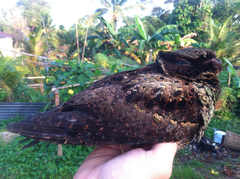
The Malaysian eared nightjar or Malay eared nightjar (Lyncornis temminckii) is a species of nightjar in the family Caprimulgidae. It was formerly placed in the genus Eurostopodus. It is known as Taptibau Kecil in Bahasa melayu or Tukang Tabtibau amongst Malaysian indigenous communities. It is dispersed throughout Southeast Asia, primarily occurring in Malaysia, Sumatra, Borneo, Thailand, Indonesia and Singapore. It is a nocturnal insectivorous bird characterised by cryptic colouration of brown and white patterns, to aid it in camouflaging into its environment. Due to the nocturnal nature and feeding habits, it prefers subtropical, tropical and moist lowland forests, and have been recorded from sea-level to 1065 meters. It is easily distinguished by its 'ear-tufts,' giving it an "eared" appearance which led to its name.

The Malaysian eared nightjar belongs to the order Caprimulgiformes, Caprimulgidae family and the Lyncornis genus. The nightjars include seven extant species split into two genera, Eurostopodus and Lyncornis. The Malaysian eared nightjar is monotypic and its sister species, the great eared nightjar (Lyncornis macrotis) are the only two species... Wikipedia →

Sounds

Flight call0:12

Malaysia · 2026

© Lim Ying Hien 林勇贤 · XC1159751 · CC BY-NC-ND 4.0

Song1:18

Malaysia · 2025

© Frank Lambert · XC1051217 · CC BY-NC-ND 4.0

Call0:06

Malaysia · 2005

© Beatrix Saadi-Varchmin · XC605544 · CC BY-NC-SA 4.0

Global Distribution

Parks Where Found

# Park Country Daily sighting probability
1 Way Kambas National Park 🇮🇩 Indonesia
~40%
2 Taman Negara National Park 🇲🇾 Malaysia
<5%

Before you go

What are the chances of seeing a Malaysian Nightjar in Way Kambas National Park?

Likely

About 40% of wildlife watchers report a Malaysian Nightjar sighting in Way Kambas National Park on a given day, based on 94 verified sightings from GBIF citizen-science data from 2019 to 2026. It is the 30th most-seen of the 205 birds we can rate there. Over three days the chance rises to about 70%, and over a week to over 90%, if each day is a fresh chance.

When is the best time to see a Malaysian Nightjar in Way Kambas National Park?

October

In that month about 50% of wildlife watchers report a Malaysian Nightjar in Way Kambas National Park on a given day, against about 20% in March–April and July, the lowest months. November to February have too few records to rate.

What time of day is best to see a Malaysian Nightjar?

Between noon and 3 pm

Across all the parks we cover, that three-hour window holds the most Malaysian Nightjar sightings with a recorded time, and about 8 in 10 of them come between 6 am and 6 pm: it is a daytime animal.

Is Way Kambas National Park the best place to see a Malaysian Nightjar?

Yes

Of the 2 parks where we can rate Malaysian Nightjar sightings, Way Kambas National Park has the highest daily chance: about 40%. Next come Taman Negara National Park (Malaysia, under 5%).

Which relatives of the Malaysian Nightjar live in Way Kambas National Park?

Same family: Caprimulgidae

The closest relatives of the Malaysian Nightjar that you can see in Way Kambas National Park (family Caprimulgidae, Nightjars and Allies) are Large-tailed Nightjar (about 70%), Savanna Nightjar (about 30%) and Bonaparte's Nightjar (about 10%), with each one's daily chance of a sighting.

Where does the Malaysian Nightjar sighting chance come from?

GBIF citizen-science records

It is estimated from how often the Malaysian Nightjar is recorded against all the birds logged in Way Kambas National Park (94 verified sightings from 2019 to 2026), calibrated against known sighting rates. Figures are rounded to the nearest 10% because citizen-science data supports honest approximations, not decimals, and months with records from fewer than five people show "—". How it works.

← Back to Way Kambas National Park


