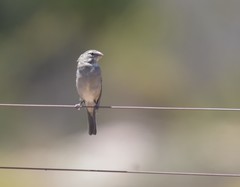
White-throated Canary

White-throated Canary

Crithagra albogularis

Silhouette: Sheatherius · PhyloPic

LCLeast ConcernNTVUENCR
Daily sighting probability ~30% · Possible
at West Coast National Park

In 3 days ~60% in a week ~90%

349 Verified sightings at West Coast National Park From 2019 to 2026
644 In all 6 parks
July Best month
☀️ Diurnal When it's spotted

About the White-throated Canary

The white-throated canary (Crithagra albogularis) is a species of finch in the family Fringillidae. The white-throated canary was formerly placed in the genus Serinus but phylogenetic analysis using mitochondrial and nuclear DNA sequences found that the genus was polyphyletic. The genus was therefore split and a number of species including the white-throated canary were moved to the resurrected genus Crithagra.

The white-throated canary is a small bird about 15 cm long with generally dull-coloured plumage and a yellow or yellow-green rump. It has a heavy horn-coloured beak and brown irises. Its legs are brown. The male and female have similar external appearances, and juveniles resemble adults.

It is found in Angola, Botswana, Lesotho, Namibia, and South Africa. Its natural habitats are subtropical or tropical dry shrubland and subtropical or tropical high-altitude grassland. Media related to Crithagra albogularis at Wikimedia Commons

White-throated canary - Species text in The Atlas of Southern African Birds. White-throated canary Structured guide to the species in southern Africa Wikipedia →

Sounds

Song0:53

South Africa · 2022

© Lynette Rudman · XC741522 · CC BY-NC-SA 4.0

Call0:51

South Africa · 2017

© Peter Boesman · XC392440 · CC BY-NC-ND 4.0

Song0:46

South Africa · 2019

© Frank Lambert · XC521379 · CC BY-NC-ND 4.0

Global Distribution

Parks Where Found

# Park Country Daily sighting probability
1 De Hoop Nature Reserve 🇿🇦 South Africa
~30%
2 West Coast National Park 🇿🇦 South Africa
~30%
3 Namib-Naukluft National Park 🇳🇦 Namibia
~20%
4 Kgalagadi Transfrontier Park 🇿🇦 South Africa
<5%
5 Addo Elephant National Park 🇿🇦 South Africa
<5%
6 Etosha National Park 🇳🇦 Namibia
<5%

Cities Where Found

# City Country Daily sighting probability
1 Cape Town 🇿🇦 South Africa
<5%

Before you go

What are the chances of seeing a White-throated Canary in West Coast National Park?

Possible

About 30% of wildlife watchers report a White-throated Canary sighting in West Coast National Park on a given day, based on 349 verified sightings from GBIF citizen-science data from 2019 to 2026. It is the 71st most-seen of the 192 birds we can rate there. Over three days the chance rises to about 60%, and over a week to about 90%, if each day is a fresh chance.

When is the best time to see a White-throated Canary in West Coast National Park?

July

In that month about 50% of wildlife watchers report a White-throated Canary in West Coast National Park on a given day, against under 5% in December, the lowest month. That is one of West Coast National Park's wettest months, with about 60 mm of rain against 5 mm in February.

What time of day is best to see a White-throated Canary?

Between 8 and 11 am

Across all the parks we cover, that three-hour window holds the most White-throated Canary sightings with a recorded time, and about 9 in 10 of them come between 6 am and 6 pm: it is a daytime animal.

Is West Coast National Park the best place to see a White-throated Canary?

Among the best

Of the 6 parks where we can rate White-throated Canary sightings, West Coast National Park ranks 2nd at about 30%, level with the leaders once rounded. The best odds are in De Hoop Nature Reserve (South Africa, about 30%).

Where does the White-throated Canary sighting chance come from?

GBIF citizen-science records

It is estimated from how often the White-throated Canary is recorded against all the birds logged in West Coast National Park (349 verified sightings from 2019 to 2026), calibrated against known sighting rates. Figures are rounded to the nearest 10% because citizen-science data supports honest approximations, not decimals, and months with records from fewer than five people show "—". How it works.

← Back to West Coast National Park