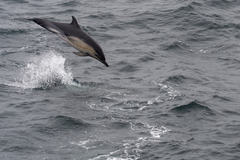
Common Dolphin

Common Dolphin

Delphinus delphis

Silhouette: Chris huh · PhyloPic

LCLeast ConcernNTVUENCR
Daily sighting probability ~10% · With luck
at Wilsons Promontory National Park

In 3 days ~30% in a week ~60%

6 Verified sightings at Wilsons Promontory National Park From 2019 to 2026
189 In all 5 parks
September Best month
☀️ Diurnal When it's spotted

About the Common Dolphin

The common dolphin (Delphinus delphis) is the most abundant cetacean in the world, with an estimated global population of about six million. It is currently the only member of the genus Delphinus, the type genus of the subfamily Delphininae. This places it as a close relative of the bottlenose dolphin, humpback dolphin, striped dolphin, spinner dolphin, Clymene dolphin, spotted dolphin, Fraser's dolphin, the tucuxi, and the Guiana dolphin.

The common dolphin was once divided into two different species, the short-beaked common dolphin and the long-beaked common dolphin. These are now generally regarded as ecotypes. Recent research shows that many long-beaked populations worldwide are not closely related to one another, often originating from short-beaked ancestors, and they do not consistently share the same derived traits. For this reason, these forms are no longer classified as separate species.

Despite its name, the common dolphin is not widely considered the "archetypal" dolphin; that role is more often associated with the bottlenose dolphin, largely because of its frequent appearances in aquaria and the media. Nevertheless, the common dolphin held cultural significance in antiquity and frequently appeared in Greek and Roman art, such as in murals created by the Minoan civilization. Wikipedia →

Global Distribution

Parks Where Found

# Park Country Daily sighting probability
1 Channel Islands National Park 🇺🇸 United States
~30%
2 Bahía de Loreto National Park 🇲🇽 Mexico
~30%
3 Wilsons Promontory National Park 🇦🇺 Australia
~10%
4 Galápagos Islands 🇪🇨 Ecuador
~10%
5 Table Mountain National Park 🇿🇦 South Africa
<5%

Cities Where Found

# City Country Daily sighting probability
1 Lisbon 🇵🇹 Portugal
<5%
2 San Diego 🇺🇸 United States
<5%
3 Los Angeles 🇺🇸 United States
<5%
4 New York City 🇺🇸 United States
<5%

Zoos & Centres Where Found

# Zoo / Centre Country
1 National Aquarium of New Zealand 🇳🇿 New Zealand In captivity

Before you go

What are the chances of seeing a Common Dolphin in Wilsons Promontory National Park?

With luck

About 10% of wildlife watchers report a Common Dolphin sighting in Wilsons Promontory National Park on a given day, based on 6 verified sightings from GBIF citizen-science data from 2019 to 2026. It is the 11th most-seen of the 11 mammals we can rate there. Over three days the chance rises to about 30%, and over a week to about 60%, if each day is a fresh chance.

When is the best time to see a Common Dolphin in Wilsons Promontory National Park?

September

In that month about 40% of wildlife watchers report a Common Dolphin in Wilsons Promontory National Park on a given day, against under 5% in January–February and April–August, the lowest months.

What time of day is best to see a Common Dolphin?

Between 9 am and noon

Across all the parks we cover, that three-hour window holds the most Common Dolphin sightings with a recorded time, and about 9 in 10 of them come between 6 am and 6 pm: it is a daytime animal.

Is Wilsons Promontory National Park the best place to see a Common Dolphin?

3rd of 5

Of the 5 parks where we can rate Common Dolphin sightings, Wilsons Promontory National Park ranks 3rd at about 10%. The best odds are in Channel Islands National Park (United States, about 30%) and Bahía de Loreto National Park (Mexico, about 30%).

Where does the Common Dolphin sighting chance come from?

GBIF citizen-science records

It is estimated from how often the Common Dolphin is recorded against all the mammals logged in Wilsons Promontory National Park (6 verified sightings from 2019 to 2026), calibrated against known sighting rates. Figures are rounded to the nearest 10% because citizen-science data supports honest approximations, not decimals, and months with records from fewer than five people show "—". How it works.

← Back to Wilsons Promontory National Park