Hog Deer

Hog Deer

Axis porcinus

Silhouette: Steven Traver · PhyloPic

LCNTVUENEndangeredCR
Daily sighting probability ~20% · Possible
at Wilsons Promontory National Park

In 3 days ~40% in a week ~70%

12 Verified sightings at Wilsons Promontory National Park From 2019 to 2026
295 In all 6 parks
May Best month
🌅 Crepuscular When it's spotted

About the Hog Deer

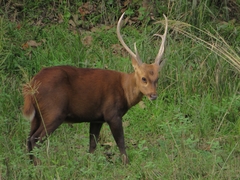
The Indian hog deer (Axis porcinus), or Indochinese hog deer, is a small cervid native to the region of the Indian subcontinent and Indo-Gangetic Plain. Introduced populations are established in Australia, as well as the United States and Sri Lanka.

Its name derives from the hog-like manner in which it runs through forests (with its head hung low), to ease ducking under obstacles instead of leaping over them, like most other deer. Cervus porcinus was the scientific name used by Eberhard August Wilhelm von Zimmermann in 1777 and 1780, based on an earlier description of Indian hog deer brought to England from India.

It was placed in the genus Axis by William Jardine in 1835 and by Brian Houghton Hodgson in 1847. In 2004, it was proposed to be placed in the genus Hyelaphus. The proposal has not been accepted, with most authors keeping it under Axis. A subspecies, A. p. annamiticus, was once considered its own species, but is now generally considered the same species as A. porcinus.

A mature hog deer stag stands about 70 centimetres (28 in) at the shoulder, and weighs approximately 50 kilograms (110 lb); hinds are much smaller, standing about 61 centimetres... Wikipedia →

Global Distribution

Parks Where Found

# Park Country Daily sighting probability
1 Kaziranga National Park 🇮🇳 India
~90%
2 Royal Bardia National Park 🇳🇵 Nepal
~50%
3 Chitwan National Park 🇳🇵 Nepal
~50%
4 Manas National Park 🇮🇳 India
~30%
5 Wilsons Promontory National Park 🇦🇺 Australia
~20%
6 Jim Corbett National Park 🇮🇳 India
~10%

Zoos & Centres Where Found

# Zoo / Centre Country
1 Pairi Daiza 🇧🇪 Belgium In captivity
2 ZooParc de Beauval 🇫🇷 France In captivity
3 Ostrava Zoo 🇨🇿 Czechia In captivity
4 Beijing Wildlife Park 🇨🇳 China In captivity
5 Assam State Zoo cum Botanical Garden 🇮🇳 India In captivity
6 Nehru Zoological Park 🇮🇳 India In captivity
7 Nakhon Ratchasima Zoo 🇹🇭 Thailand In captivity
8 Chiang Mai Night Safari 🇹🇭 Thailand In captivity
9 Shanghai Zoo 🇨🇳 China In captivity
10 Safari World 🇹🇭 Thailand In captivity
11 La Torbiera 🇮🇹 Italy In captivity
12 Mysore Zoo 🇮🇳 India In captivity
13 Burgers' Ocean 🇳🇱 Netherlands In captivity
14 Bannerghatta Zoo 🇮🇳 India In captivity
15 National Zoo of Malaysia 🇲🇾 Malaysia In captivity
16 Saigon Zoo and Botanical Gardens 🇻🇳 Vietnam In captivity
17 Sukhothai Airport Zoo 🇹🇭 Thailand In captivity
18 Johor Zoo 🇲🇾 Malaysia In captivity
19 Thrissur Zoo 🇮🇳 India In captivity
20 Nawab Wajid Ali Shah Prani Udyan 🇮🇳 India In captivity

Before you go

What are the chances of seeing a Hog Deer in Wilsons Promontory National Park?

Possible

About 20% of wildlife watchers report a Hog Deer sighting in Wilsons Promontory National Park on a given day, based on 12 verified sightings from GBIF citizen-science data from 2019 to 2026. It is the 8th most-seen of the 11 mammals we can rate there. Over three days the chance rises to about 40%, and over a week to about 70%, if each day is a fresh chance.

When is the best time to see a Hog Deer in Wilsons Promontory National Park?

May

In that month about 40% of wildlife watchers report a Hog Deer in Wilsons Promontory National Park on a given day, against under 5% in February, July–September and November, the lowest months.

What time of day is best to see a Hog Deer?

Between 10 am and 1 pm

Across all the parks we cover, that three-hour window holds the most Hog Deer sightings with a recorded time, and about 6 in 10 of them come between 6 am and 6 pm: it is most active around dawn and dusk.

Where does the Hog Deer sighting chance come from?

GBIF citizen-science records

It is estimated from how often the Hog Deer is recorded against all the mammals logged in Wilsons Promontory National Park (12 verified sightings from 2019 to 2026), calibrated against known sighting rates. Figures are rounded to the nearest 10% because citizen-science data supports honest approximations, not decimals, and months with records from fewer than five people show "—". How it works.

← Back to Wilsons Promontory National Park