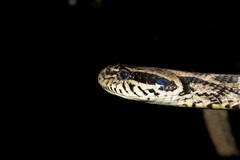
Reddish Peninsular Cat Snake

Reddish Peninsular Cat Snake

Boiga forsteni

Silhouette: Alex Slavenko · PhyloPic

LCLeast ConcernNTVUENCR
Daily sighting probability ~20% · Possible
at Yala National Park

In 3 days ~40% in a week ~70%

5 Verified sightings at Yala National Park From 2019 to 2026
10 In all 2 parks
July Best month
🌅 Crepuscular When it's spotted

About the Reddish Peninsular Cat Snake

Boiga forsteni, also known commonly as Forsten's cat snake, is a species of mildly venomous rear-fanged snake in the family Colubridae. The species is endemic to South Asia. Boiga forstenii is found in Nepal, Sri Lanka, and India (Sikkim, West Bengal, Maharashtra, Gujarat, Kerala, Uttar Pradesh to Bihar, Madhya Pradesh, Orissa, Andhra Pradesh, Tamil Nadu, southern Rajasthan, Uttarakhand, and Jharkhand).

The specific name, forstenii, is in honor of Dutch naturalist Eltio Alegondas Forsten (1811–1843). See snake scales for terms used In B. forsteni the anterior palatine and mandibular teeth are considerably larger than the others. The eye is about as long as its distance from the nostril.

The rostral scale is broader than deep, and the internasals are much shorter than the prefrontals. The frontal is nearly as long as its distance from the end of the snout, which is shorter than the parietal scales. The loreal is square or deeper than it is long. There is one preocular scale, extending to the upper surface of the head, and two or three postoculars. The temporal scales are very small and numerous. There are eight to eleven upper... Wikipedia →

Global Distribution

Parks Where Found

# Park Country Daily sighting probability
1 Kanha National Park 🇮🇳 India
~20%
2 Yala National Park 🇱🇰 Sri Lanka
~20%

Zoos & Centres Where Found

# Zoo / Centre Country
1 Nehru Zoological Park 🇮🇳 India In captivity
2 Thiruvananthapuram Zoo 🇮🇳 India In captivity
3 National Zoological Gardens of Sri Lanka 🇱🇰 Sri Lanka In captivity

Before you go

What are the chances of seeing a Reddish Peninsular Cat Snake in Yala National Park?

Possible

About 20% of wildlife watchers report a Reddish Peninsular Cat Snake sighting in Yala National Park on a given day, based on 5 verified sightings from GBIF citizen-science data from 2019 to 2026. It is the 14th most-seen of the 15 reptiles we can rate there. Over three days the chance rises to about 40%, and over a week to about 70%, if each day is a fresh chance.

When is the best time to see a Reddish Peninsular Cat Snake in Yala National Park?

July

In that month about 30% of wildlife watchers report a Reddish Peninsular Cat Snake in Yala National Park on a given day, against under 5% in March, May–June and August–November, the lowest months. That is one of Yala National Park's driest months, with about 45 mm of rain against 340 mm in November.

What time of day is best to see a Reddish Peninsular Cat Snake?

Between 4 and 7 pm

Across all the parks we cover, that three-hour window holds the most Reddish Peninsular Cat Snake sightings with a recorded time, and about 7 in 10 of them come between 6 am and 6 pm: it is most active around dawn and dusk.

Is Yala National Park the best place to see a Reddish Peninsular Cat Snake?

Among the best

Of the 2 parks where we can rate Reddish Peninsular Cat Snake sightings, Yala National Park ranks 2nd at about 20%, level with the leaders once rounded. The best odds are in Kanha National Park (India, about 20%).

Which relatives of the Reddish Peninsular Cat Snake live in Yala National Park?

Same family: Colubridae

The closest relatives of the Reddish Peninsular Cat Snake that you can see in Yala National Park (family Colubridae, Colubrid Snakes) are Dhaman (about 20%) and Green Vine Snake (about 20%), with each one's daily chance of a sighting.

Where does the Reddish Peninsular Cat Snake sighting chance come from?

GBIF citizen-science records

It is estimated from how often the Reddish Peninsular Cat Snake is recorded against all the reptiles logged in Yala National Park (5 verified sightings from 2019 to 2026), calibrated against known sighting rates. Figures are rounded to the nearest 10% because citizen-science data supports honest approximations, not decimals, and months with records from fewer than five people show "—". How it works.

← Back to Yala National Park