



Completed
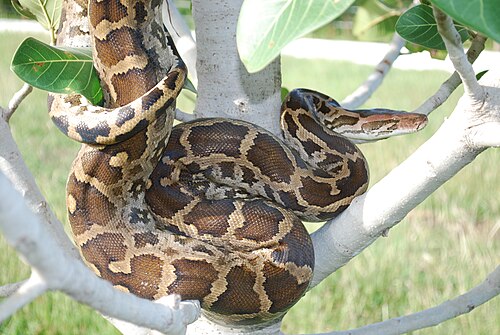


Indian Python
Python molurus
Silhouette: DS Biswas · PhyloPic
- KingdomAnimalia (Animals)
- PhylumChordata (Chordates)
- ClassSquamata
- FamilyPythonidae (Pythons)
- GenusPython (Common Pythons)
- SpeciesPython molurus (Indian Python)
In 3 days ~50% in a week ~80%
15 Verified sightings at Yala National Park From 2019 to 2026
97 In all 3 parks
January Best month
🌅 Crepuscular When it's spotted
About the Indian Python
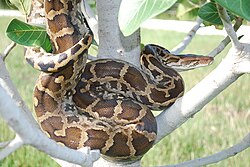
The Indian python (Python molurus) is a large python species native to tropical and subtropical regions of the Indian subcontinent and Southeast Asia. It is also known by the common names black-tailed python, Indian rock python, and Asian rock python. Although smaller than its close relative the Burmese python, it is still among the largest snakes in the world. It is generally lighter colored than the Burmese python and reaches usually 3 m (9 ft 10 in). Like all pythons, it is nonvenomous.
The rock python's color pattern is whitish or yellowish with the blotched patterns varying from tan to dark brown shades. This varies with terrain and habitat. Specimens from the hill forests of Western Ghats and Assam are darker, while those from the Deccan Plateau and Eastern Ghats are usually lighter. All pythons are non-venomous.
The nominate subspecies occurring in India typically grows to 3 m (9 ft 10 in). This value is supported by a 1990 study in Keoladeo National Park, where 25% of the python population was 2.7–3.3 m (8 ft 10 in – 10 ft 10 in) long. Two individuals even measured nearly 3.6 m (11 ft 10 in).
Because of confusion with the Burmese python, exaggerations, and... Wikipedia →
Recent sightings of Indian Python in Yala National Park
LIVEiNaturalistGlobal Distribution
Parks Where Found
| # | Park | Country | Daily sighting probability |
|---|---|---|---|
| 1 | Keoladeo National Park | 🇮🇳 India | |
| 2 | Kanha National Park | 🇮🇳 India | |
| 3 | Yala National Park | 🇱🇰 Sri Lanka |
Zoos & Centres Where Found
Closest Relatives at Yala National Park
No species of the same family or order lives in Yala National Park, so these are its closest relatives here: other reptiles.





Before you go
What are the chances of seeing an Indian Python in Yala National Park?
Possible
About 20% of wildlife watchers report an Indian Python sighting in Yala National Park on a given day, based on 15 verified sightings from GBIF citizen-science data from 2019 to 2026. It is the 8th most-seen of the 15 reptiles we can rate there. Over three days the chance rises to about 50%, and over a week to about 80%, if each day is a fresh chance.
When is the best time to see an Indian Python in Yala National Park?
January–February, September and November
In those months about 30% of wildlife watchers report an Indian Python in Yala National Park on a given day, against under 5% in May–July and October, the lowest months.
What time of day is best to see an Indian Python?
Between 3 and 6 am
Across all the parks we cover, that three-hour window holds the most Indian Python sightings with a recorded time, and about half of them come between 6 am and 6 pm: it is most active around dawn and dusk.
Is Yala National Park the best place to see an Indian Python?
3rd of 3
Of the 3 parks where we can rate Indian Python sightings, Yala National Park ranks 3rd at about 20%. The best odds are in Keoladeo National Park (India, about 70%) and Kanha National Park (India, about 20%).
Where does the Indian Python sighting chance come from?
GBIF citizen-science records
It is estimated from how often the Indian Python is recorded against all the reptiles logged in Yala National Park (15 verified sightings from 2019 to 2026), calibrated against known sighting rates. Figures are rounded to the nearest 10% because citizen-science data supports honest approximations, not decimals, and months with records from fewer than five people show "—". How it works.
