
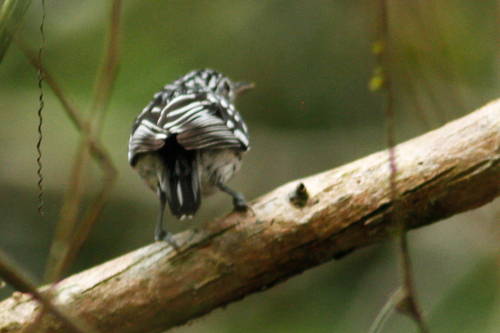
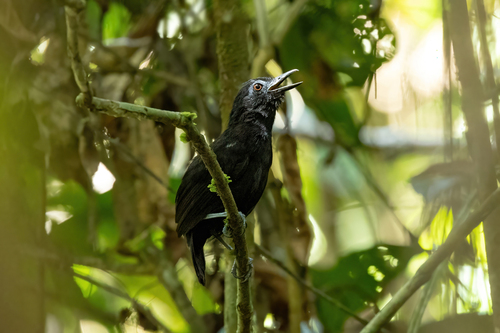
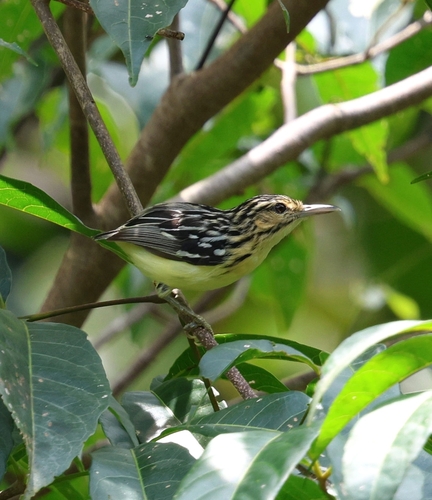
Chestnut-shouldered Antwren

Chestnut-shouldered Antwren

Terenura humeralis

Silhouette: Sheatherius · PhyloPic

Daily sighting probability <5% · Rare
at Yasuní National Park

In 3 days <5% in a week ~10%

41 Verified sightings at Yasuní National Park From 2019 to 2026
131 In all 3 parks
March Best month

About the Chestnut-shouldered Antwren

The chestnut-shouldered antwren (Euchrepomis humeralis) is a species of bird in subfamily Euchrepomidinae of family Thamnophilidae, the "typical antbirds". It is found in Bolivia, Brazil, Ecuador, and Peru. The chestnut-shouldered antwren was described by the English ornithologists Philip Sclater and Osbert Salvin in 1880 and given the binomial name Terenura humeralis. There it remained until the current genus Euchrepomis was created in 2012 following phylogenetic analysis.

The chestnut-shouldered antwren is monotypic. The chestnut-shouldered antwren is 9.5 to 11 cm (3.7 to 4.3 in) long and weighs about 7 to 8 g (0.25 to 0.28 oz). The sexes have different plumage. Adult males have a whitish supercilium and a thin dark line through the eye on an otherwise pale gray face. Their crown and nape are black, their back greenish olive, their rump rufous-chestnut, and their uppertail coverts and tail grayish olive. Their wing coverts are blackish gray with whitish tips that form two bars on the closed wing, their flight feathers olive-tinged blackish gray with pale olive-yellow edges, and the bend of the wing rufous-chestnut. Their throat and... Wikipedia →

Sounds

Recording0:23

Ecuador · 2025

© Nelson Apolo · iNaturalist · CC BY-NC 4.0

Global Distribution

Parks Where Found

# Park Country Daily sighting probability
1 Manu National Park 🇵🇪 Peru
<5%
2 Yasuní National Park 🇪🇨 Ecuador
<5%
3 Tambopata National Reserve 🇵🇪 Peru
<5%

Before you go

What are the chances of seeing a Chestnut-shouldered Antwren in Yasuní National Park?

Rare

Under 5% of wildlife watchers report a Chestnut-shouldered Antwren sighting in Yasuní National Park on a given day, based on 41 verified sightings from GBIF citizen-science data from 2019 to 2026. It is the 398th most-seen of the 533 birds we can rate there. Over three days the chance rises to under 5%, and over a week to about 10%, if each day is a fresh chance.

When is the best time to see a Chestnut-shouldered Antwren in Yasuní National Park?

Any time of year

In every month with enough records, under 5% of wildlife watchers report a Chestnut-shouldered Antwren in Yasuní National Park on a given day, so our monthly data shows no clear season.

Is Yasuní National Park the best place to see a Chestnut-shouldered Antwren?

Among the best

Of the 3 parks where we can rate Chestnut-shouldered Antwren sightings, Yasuní National Park ranks 2nd at under 5%, level with the leaders once rounded. The best odds are in Manu National Park (Peru, under 5%).

Which relatives of the Chestnut-shouldered Antwren live in Yasuní National Park?

Same family: Thamnophilidae

The closest relatives of the Chestnut-shouldered Antwren that you can see in Yasuní National Park (family Thamnophilidae, Typical Antbirds) are Mouse-colored Antshrike (about 20%), Silvered Antbird (about 20%) and Dusky-throated Antshrike (about 20%), with each one's daily chance of a sighting.

Where does the Chestnut-shouldered Antwren sighting chance come from?

GBIF citizen-science records

It is estimated from how often the Chestnut-shouldered Antwren is recorded against all the birds logged in Yasuní National Park (41 verified sightings from 2019 to 2026), calibrated against known sighting rates. Figures are rounded to the nearest 10% because citizen-science data supports honest approximations, not decimals, and months with records from fewer than five people show "—". How it works.

← Back to Yasuní National Park