
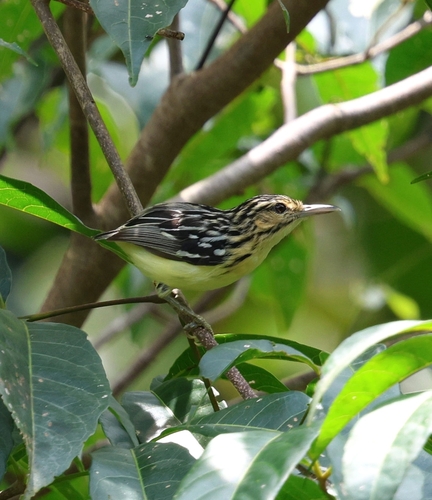
Cinereous Antshrike

Cinereous Antshrike

Thamnomanes caesius

Silhouette: Sheatherius · PhyloPic

LCLeast ConcernNTVUENCR
Daily sighting probability ~10% · With luck
at Yasuní National Park

In 3 days ~30% in a week ~50%

298 Verified sightings at Yasuní National Park From 2019 to 2026
476 In all 5 parks
July Best month
☀️ Diurnal When it's spotted

About the Cinereous Antshrike

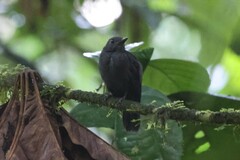
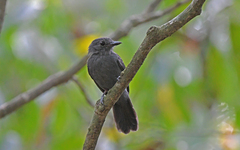
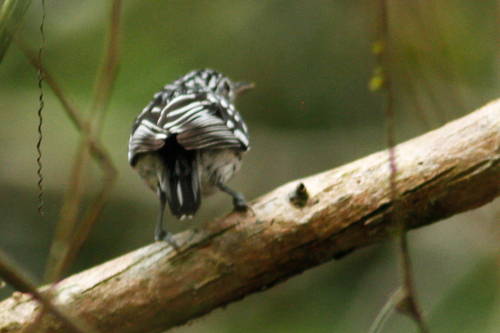
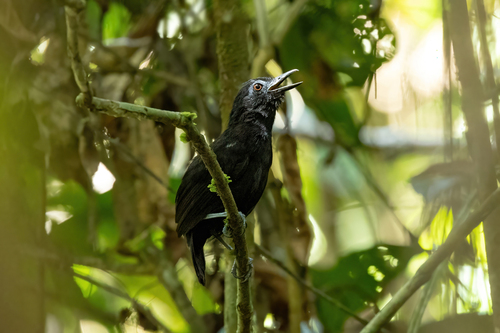
The cinereous antshrike (Thamnomanes caesius) is an insectivorous bird in subfamily Thamnophilinae of family Thamnophilidae, the "typical antbirds". It is found in Bolivia, Brazil, Colombia, Ecuador, French Guiana, Guyana, Peru, Suriname, and Venezuela.

The cinereous antshrike was described by the Dutch zoologist Coenraad Jacob Temminck in 1820 and given the binomial name Muscicapa caesius. It is now placed in the genus Thamnomanes which was introduced by the German ornithologist Jean Cabanis in 1847. The specific epithet caesius is the Latin for "bluish gray".

The cinereous antshrike and the bluish-slate antshrike (T. schistogynus) were treated by some authors in the early twentieth century as conspecific. They now are considered a superspecies. The cinereous antshrike has these five subspecies:

The cinereous antshrike is 14 to 15 cm (5.5 to... Wikipedia →

Sounds

Call0:18

Ecuador · 2025

© Manuel Sánchez-Nivicela · XC1169957 · CC BY-NC-ND 4.0

Song0:59

Brazil · 2025

© JAYRSON ARAUJO DE OLIVEIRA · XC1035531 · CC BY-NC-SA 4.0

Recording0:13

Colombia · 2001

© Mauricio Álvarez-Rebolledo (Colección de Sonidos Ambientales - Instituto Humboldt) · XC525658 · CC BY-NC-SA 4.0

Global Distribution

Parks Where Found

# Park Country Daily sighting probability
1 Brownsberg Nature Park 🇸🇷 Suriname
~40%
2 Yasuní National Park 🇪🇨 Ecuador
~10%
3 Amacayacu National Natural Park 🇨🇴 Colombia
~10%
4 Anavilhanas National Park 🇧🇷 Brazil
<5%
5 Cuyabeno Wildlife Reserve 🇪🇨 Ecuador
<5%

Before you go

What are the chances of seeing a Cinereous Antshrike in Yasuní National Park?

With luck

About 10% of wildlife watchers report a Cinereous Antshrike sighting in Yasuní National Park on a given day, based on 298 verified sightings from GBIF citizen-science data from 2019 to 2026. It is the 178th most-seen of the 533 birds we can rate there. Over three days the chance rises to about 30%, and over a week to about 50%, if each day is a fresh chance.

When is the best time to see a Cinereous Antshrike in Yasuní National Park?

May to March

In those months about 10% of wildlife watchers report a Cinereous Antshrike in Yasuní National Park on a given day, against under 5% in April, the lowest month.

What time of day is best to see a Cinereous Antshrike?

Between 8 and 11 am

Across all the parks we cover, that three-hour window holds the most Cinereous Antshrike sightings with a recorded time, and about 8 in 10 of them come between 6 am and 6 pm: it is a daytime animal.

Is Yasuní National Park the best place to see a Cinereous Antshrike?

2nd of 5

Of the 5 parks where we can rate Cinereous Antshrike sightings, Yasuní National Park ranks 2nd at about 10%. The best odds are in Brownsberg Nature Park (Suriname, about 40%).

Where does the Cinereous Antshrike sighting chance come from?

GBIF citizen-science records

It is estimated from how often the Cinereous Antshrike is recorded against all the birds logged in Yasuní National Park (298 verified sightings from 2019 to 2026), calibrated against known sighting rates. Figures are rounded to the nearest 10% because citizen-science data supports honest approximations, not decimals, and months with records from fewer than five people show "—". How it works.

← Back to Yasuní National Park